Recently, we ran an AEO audit for a company that believed it had a strong digital presence. They had invested heavily in their website, published content for years, and built a solid reputation within their industry. On the surface, everything looked healthy.
Then we started asking AI systems simple questions about the company.
What we found surprised everyone: multiple AI platforms were describing the business using information from a webinar that had been recorded more than eleven years earlier.
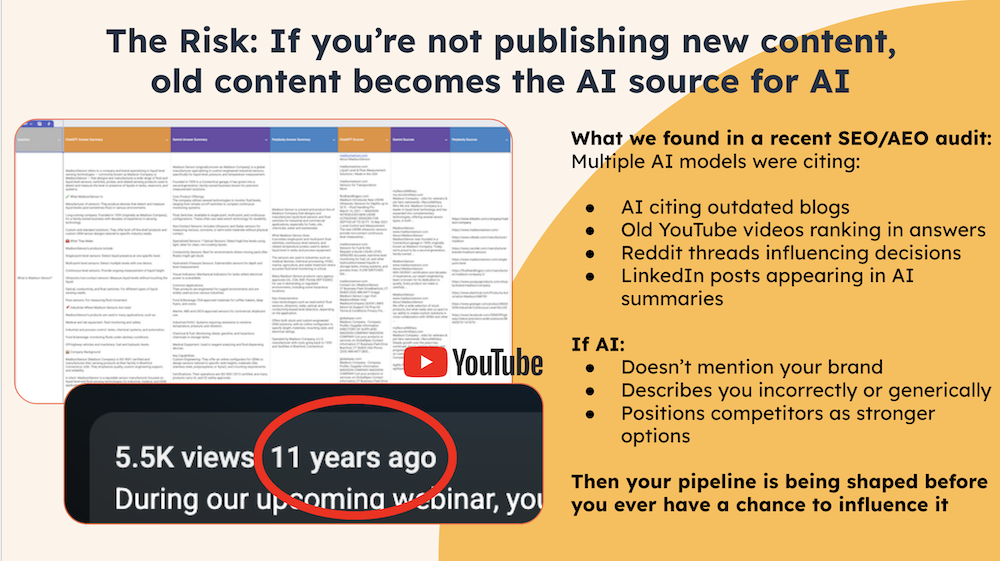
Since then, the company had evolved significantly. Its products had changed, its messaging had changed, leadership had changed, and even parts of the business itself looked very different.
Yet AI still trusted that webinar because it remained one of the strongest expertise signals available online.
That moment revealed something important: the real question is no longer whether AI can find your company. The real question is whether AI understands your company.
That's exactly what an AEO audit is designed to answer.
An AEO (Answer Engine Optimization) audit helps you understand whether AI includes your company in answers, how your brand is represented, which competitors appear alongside you, what sources influence those answers, and where your expertise signals are breaking down.
Because visibility is no longer just about rankings.
It's about representation.
TL;DR
If you only remember a few things from this article, remember these:
AI visibility is not the same as SEO visibility.
Being mentioned by AI is not as important as being understood by AI.
AI builds answers using signals from websites, videos, webinars, reviews, LinkedIn, Reddit, and other third-party sources.
The companies winning AI search are usually the ones creating the clearest expertise signals.
Before creating more content, audit how AI currently sees your company.
Most companies don’t have a content problem. They have an expertise distribution problem.
An AEO audit helps you understand whether AI recognizes your expertise, where it gets its information, how competitors compare, and what you need to improve to become the trusted answer.
Here’s how to conduct an AEO audit and uncover how AI currently understands your business.
How to run your own AEO audit (step by step)
Step 1: Define Your Core Entities
Before you audit AI brand visibility, you need clarity around the entities that define your expertise.
Entities are the people, companies, products, services, methodologies, technologies, and concepts that AI connects together when trying to understand your business.
For example, some of Nextiny's core entities include Nextiny Marketing, Gabriel Marguglio, HubSpot, Answer Engine Optimization (AEO), Video Marketing, and the Human-to-Answer™ Framework.
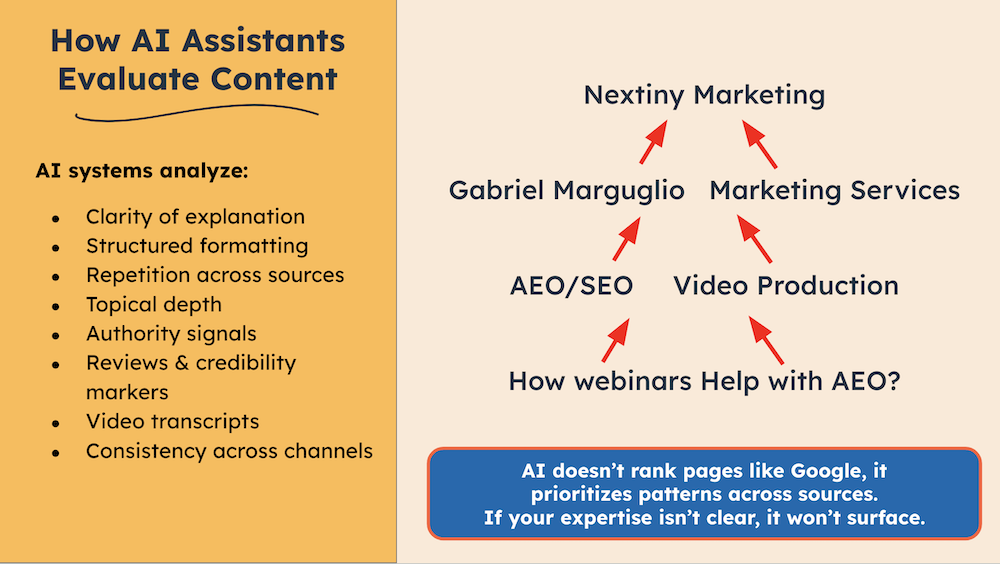
AI doesn't simply recognize these terms individually. It tries to understand the relationships between them.
Does AI understand that Gabriel Marguglio is associated with Nextiny Marketing? Does it understand that Nextiny specializes in HubSpot and AEO? Does it connect webinars, video strategy, and the Human-to-Answer Framework with your expertise?
Those relationships are often where companies struggle.
The expertise exists, but the connections are weak.
Before creating additional content, clearly define who you help, what problems you solve, what differentiates you, and which topics you want AI systems to associate with your brand.
If you don't establish those connections consistently, AI will build them on its own.
Step 2: Audit Your SEO Foundation First
AEO does not replace SEO, It builds on top of it.
Many companies jump directly into AI visibility discussions without realizing that foundational SEO issues make it harder for AI systems to understand their content.
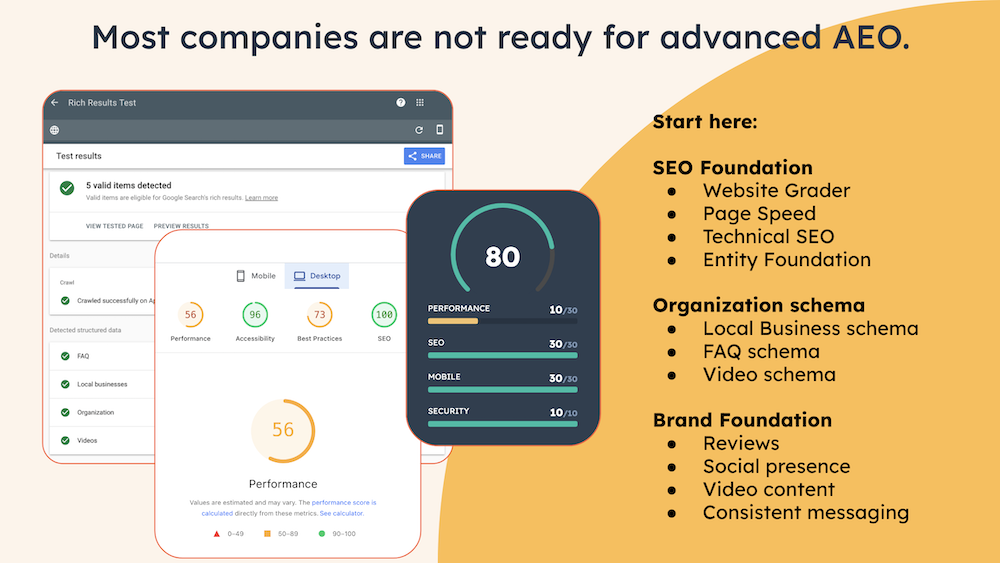
If your website is slow, poorly organized, difficult to crawl, or missing important technical signals, AI models face the same challenges search engines do.
Review:
- Core Web Vitals
- Mobile responsiveness
- Metadata
- Heading structure
- Internal linking
- Crawlability
- Schema markup
Schema deserves special attention because it helps AI understand relationships between entities. Organization schema, author schema, article schema, FAQ schema, and video schema all help transform content from isolated pages into connected knowledge.
A strong AEO strategy starts with a clear SEO foundation.
If you're still building your SEO foundation, our guides on SEO vs AEO and Schema Made Simple provide a deeper look at how technical SEO, structured data, and entity optimization support AI visibility.
Related Article: Schema Made Simple: How to Become the AI Answer (From SEO to AEO)
Step 3: Ask AI the Same Questions Your Buyers Ask
This is often the most eye-opening step in the entire audit process.
Most companies assume AI understands them reasonably well.
Then they start asking real buying questions.
That's when surprises appear.
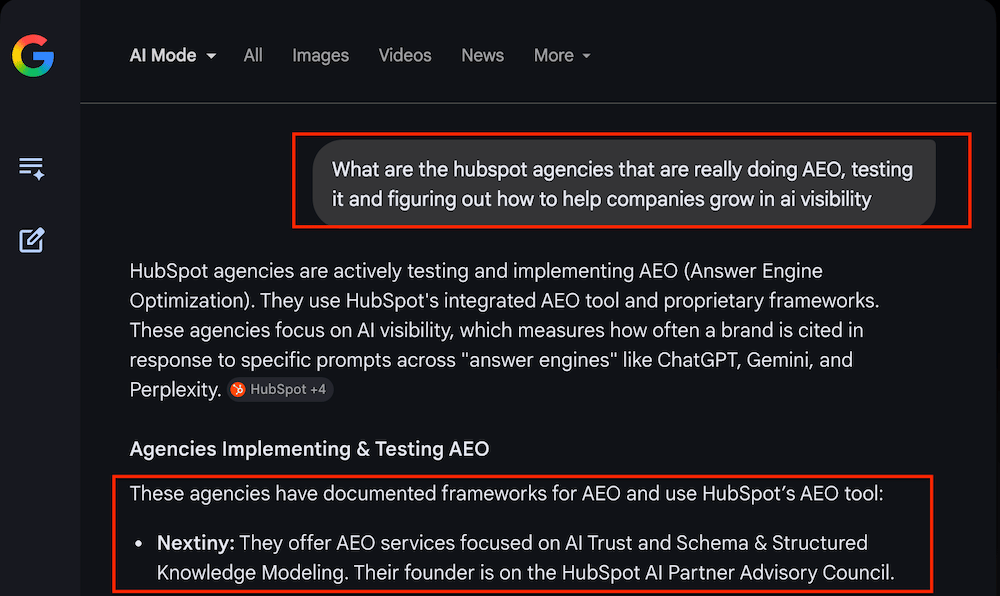
Open ChatGPT, Gemini, Perplexity, Claude, and Copilot and ask the same questions prospects ask during their research process:
- Who are the best HubSpot AEO agencies?
- Compare [Your Company] vs [Competitor]
- What does this company specialize in?
- What are customers saying about this company?
- Who are the leaders in Answer Engine Optimization in the HubSpot community?
Then keep going:
-
Ask AI to explain further.
-
Ask it to compare.
-
Ask it to identify strengths and weaknesses.
-
Ask it to dig deeper.
The goal isn't simply to see whether your company appears, It's to understand how AI describes your expertise.
Step 4: Analyze the Sources AI Trusts
This is where most companies get their biggest wake-up call. When we run AEO audits, we often discover that AI is building its understanding of a company from sources nobody has looked at in years. Most organizations assume AI primarily learns from their website.
It doesn't.
AI builds consensus from multiple sources including websites, YouTube videos, webinars, LinkedIn posts, review sites, Reddit discussions, industry publications, and third-party mentions.
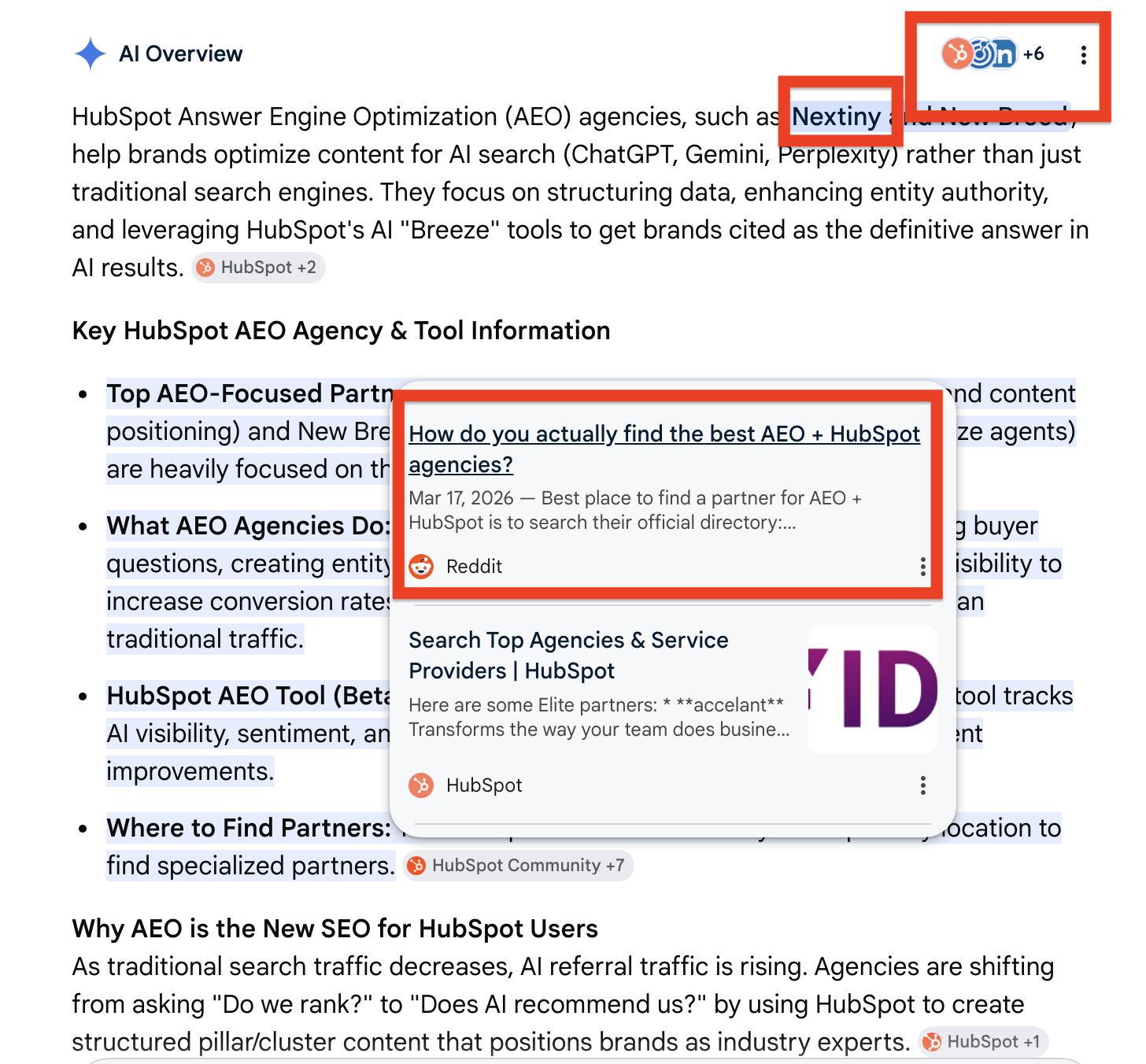
One of our favorite examples came from an audit where multiple AI platforms were describing a company using information from a webinar that had been recorded more than eleven years earlier.
The company had changed products.
The messaging had changed.
Leadership had changed.
Even the company name had evolved.
But AI still considered that webinar one of the strongest sources available.
The lesson wasn't that the old video was a problem.
The lesson was that nothing newer had become a stronger signal.
That single discovery completely changed the company's content strategy.
Instead of creating more generic content, they focused on publishing more expertise-driven content, webinars, videos, and thought leadership that better represented who they are today.
If you don't actively shape the narrative, AI will build one using whatever information it can find.
Step 5: Audit How AI Describes Your Brand
One of the biggest mistakes we see companies make is celebrating visibility without evaluating representation.
AI mentioning your company is not the goal. AI understanding your company—and accurately explaining why you're different, is the goal.
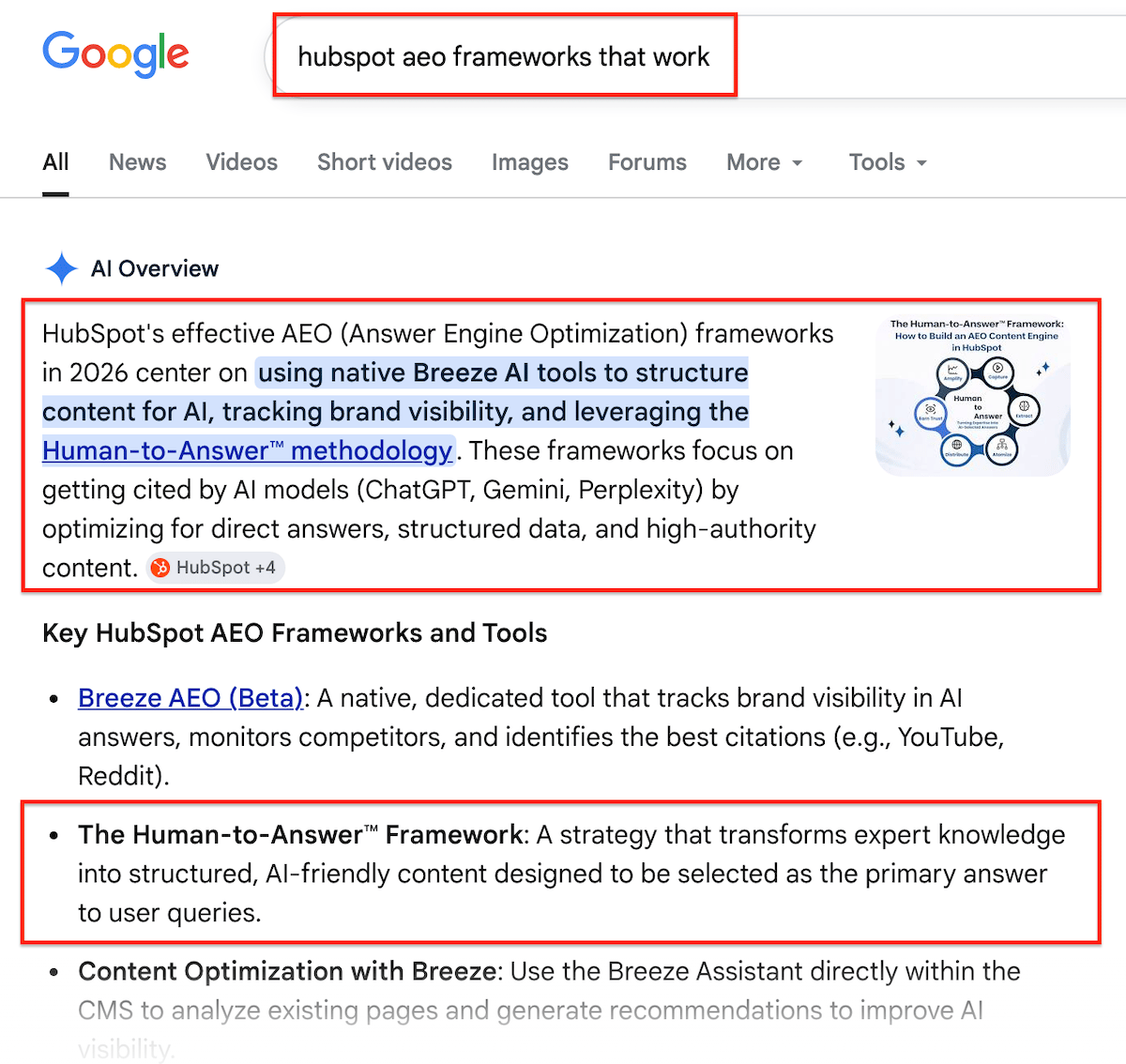
We've seen companies appear in AI-generated answers and still lose opportunities because the description was incomplete, outdated, or failed to explain what made them different.
Visibility without differentiation doesn't create demand.
In our experience, being accurately understood by AI is often more valuable than simply being mentioned by AI.
When reviewing AI responses, pay close attention to:
- Accuracy
- Clarity
- Sentiment
- Differentiation
- Expertise positioning
Many organizations discover that their biggest challenge isn't visibility.
It's positioning.
AI knows they exist.
It just doesn't fully understand why they matter.
Step 6: Measure Visibility with HubSpot's AEO
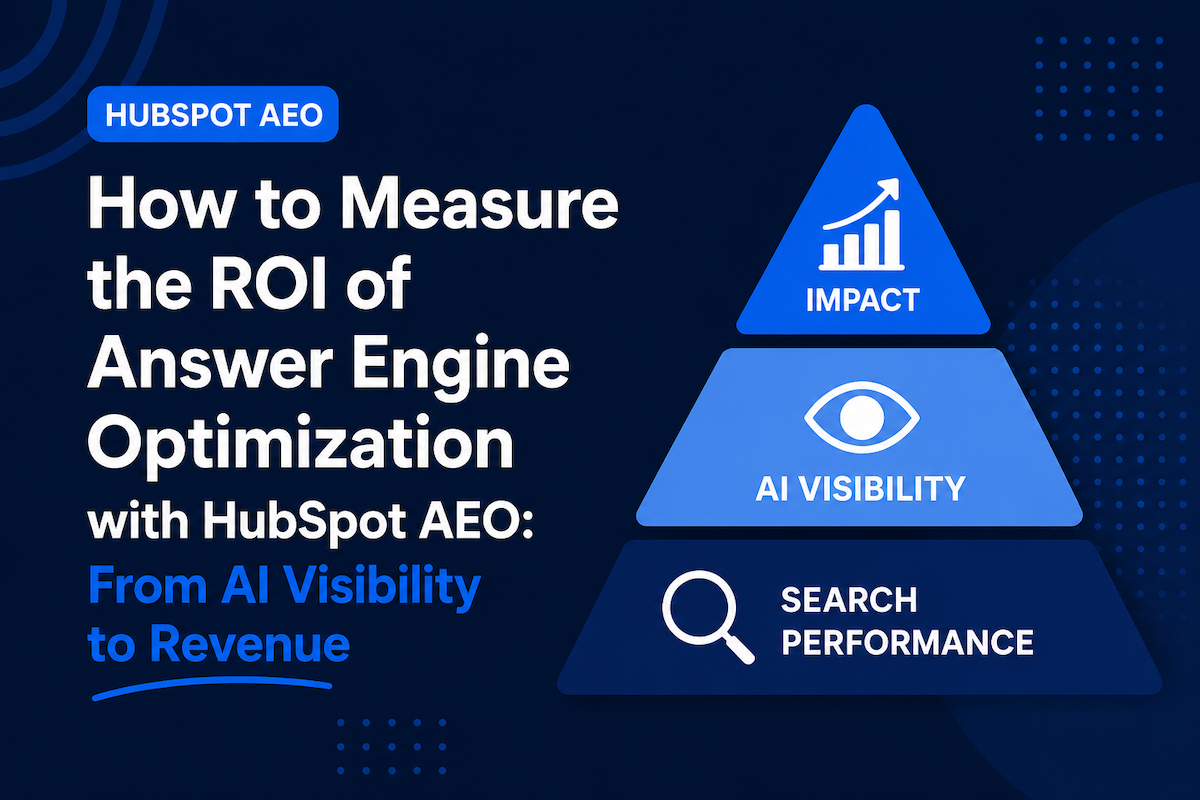
Once you've completed a manual audit, HubSpot's AEO provides a structured way to benchmark your visibility.
Unlike traditional SEO tools that analyze URLs and rankings, HubSpot AEO evaluates how AI systems perceive your brand.
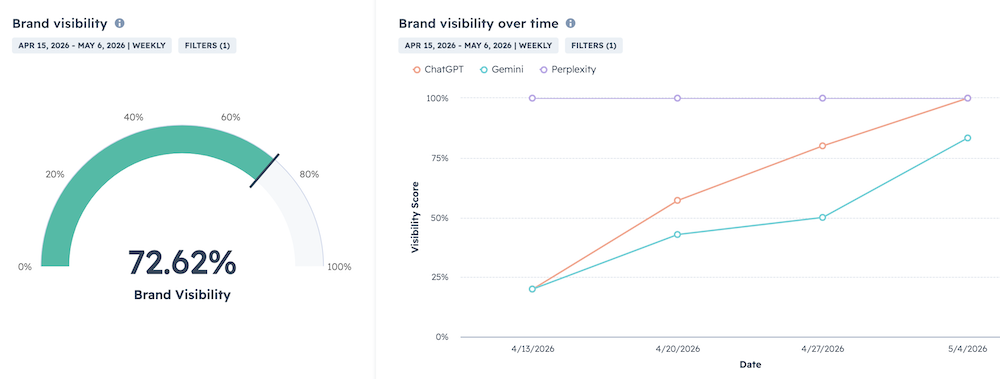
The tool helps measure:
- Brand recognition
- Presence quality
- Sentiment
- Visibility
- Competitive positioning
The real value isn't the score itself, it comes from identifying patterns, benchmarking progress, and understanding whether AI recognizes the expertise you're trying to build.
Step 7: Identify the Real Content Gaps
After completing an audit, many companies immediately assume they need more content.
 Related Experiment: How AI-generated content performs in Google Search: A 16-month experiment (Source: Search Engine Land) Google indexed most pages quickly, but without authority, unique insight, or trust signals, rankings collapsed within months.
Most of the time, that's not the real issue.
The problem is usually a lack of clear expertise signals.
Your best content often already exists inside your business.
It's sitting in sales calls, customer questions, onboarding sessions, webinars, support conversations, and internal meetings.
The challenge isn't creating expertise.
The challenge is capturing and distributing it.
That's one reason webinars have become such powerful AEO assets.
They capture natural language, real explanations, objections, examples, stories, and expertise in a format AI systems increasingly trust.
The purpose of an AEO audit isn’t to identify every possible improvement. It’s to uncover the highest-impact opportunities to strengthen the expertise signals that shape how buyers—and AI systems—understand your business.
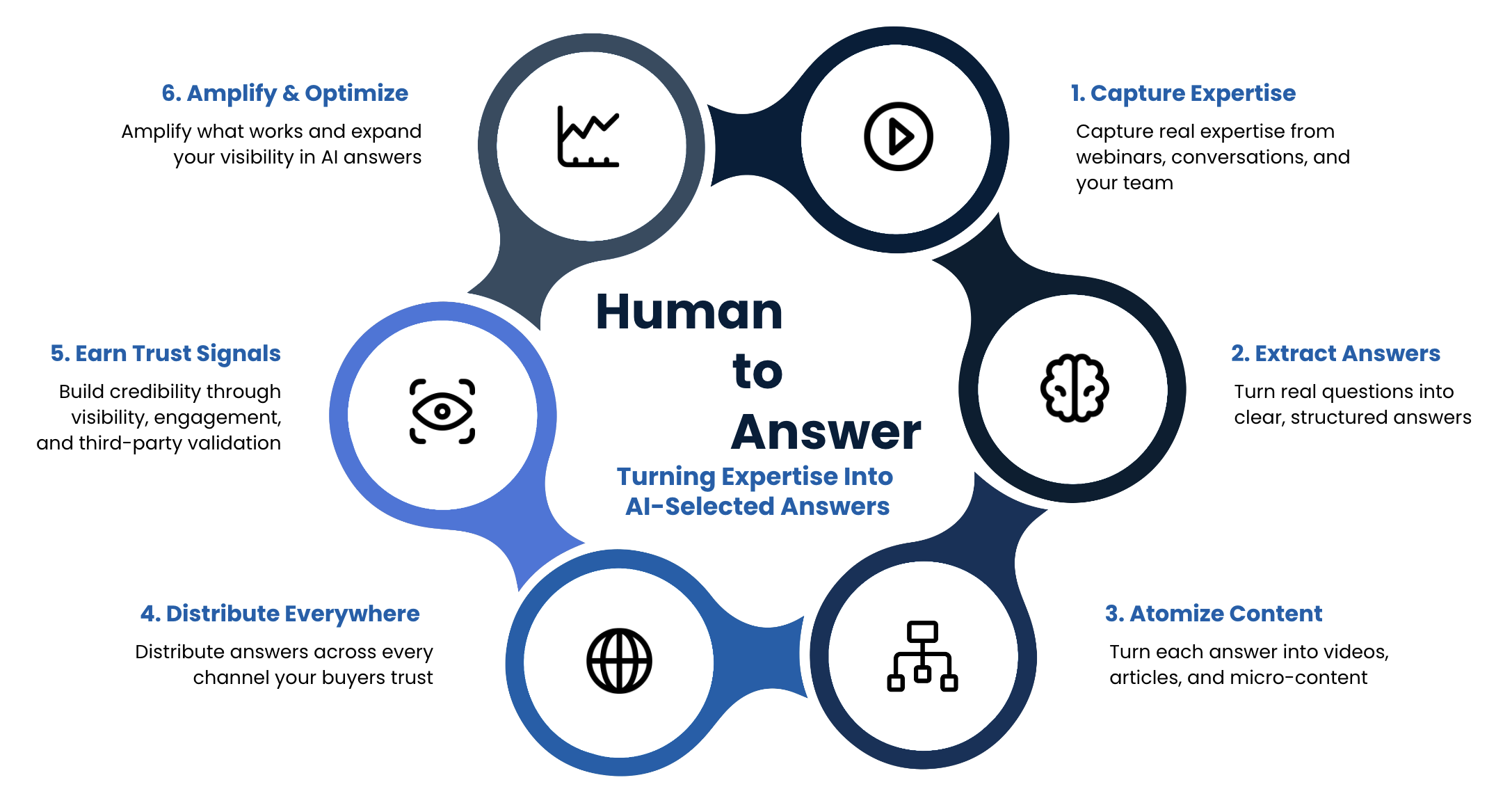
Related Article: The Human-to-Answer™ Framework: How to Build an AEO Content Engine in HubSpot
What We've Learned From Running AEO Audits
After running AEO audits for clients and applying the same methodology to our own marketing, we've noticed something surprising.
The companies winning visibility in AI search are rarely the companies publishing the most content.
They’re usually the companies distributing expertise most effectively.
When people receive a low AEO score or discover they're barely visible in AI-generated answers, their first reaction is often, "We need more content."
In our experience, that's usually the wrong conclusion.
Most companies don't have a content problem.
They have an expertise distribution problem.
We learned this lesson firsthand:
Over roughly seven months, we operationalized what eventually became the Human-to-Answer™ Framework. Instead of publishing disconnected content pieces, we built an educational ecosystem centered around webinars, customer conversations, FAQs, HubSpot insights, and subject-matter expertise. During that time, we hosted more than 20 webinars and educational events focused on AEO, HubSpot AEO, AI visibility, schema, entity optimization, AI search, and content distribution. The goal was to create stronger expertise signals.
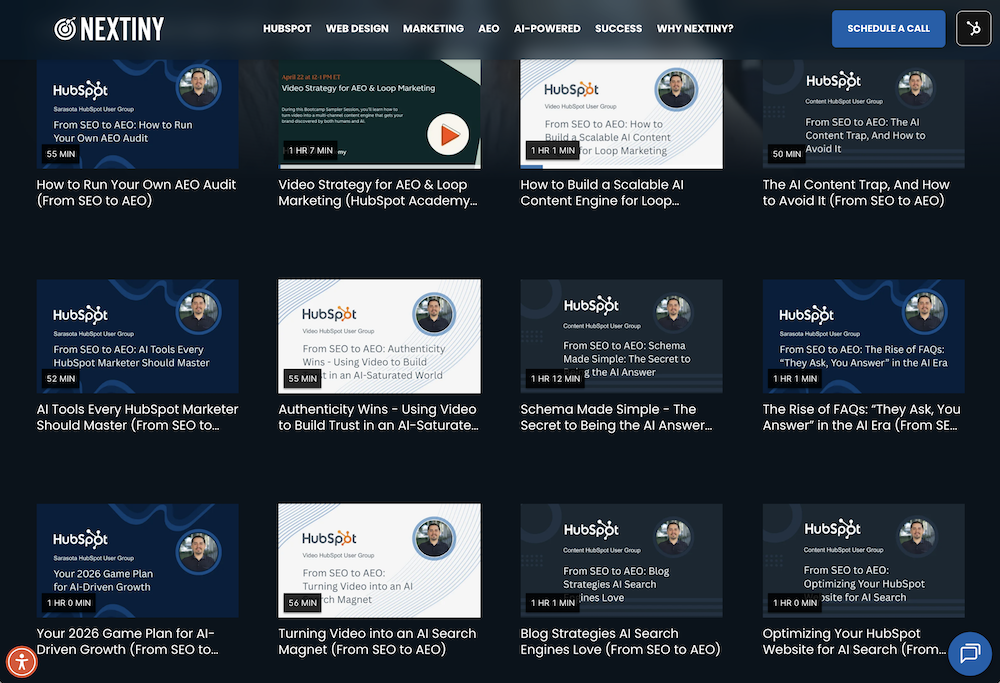
Every webinar generated blog articles, FAQ content, LinkedIn posts, videos, email campaigns, and sales enablement resources. Every customer conversation became a source of insight, and every question became an opportunity to create a trusted answer.
Over time, those signals began to compound. More visibility generated more engagement, more conversations, more citations, more authority, and ultimately more inbound demand.
The results reinforced what we were beginning to suspect.
Over seven months, Nextiny used the Human-to-Answer™ Framework to turn more than 20 webinars, customer conversations, CRM insights, and educational content into an AEO engine that generated 32.95% organic traffic growth, 160% growth in organic contacts, 225% growth in direct leads, and more than $250K in webinar-driven and AEO-related revenue.
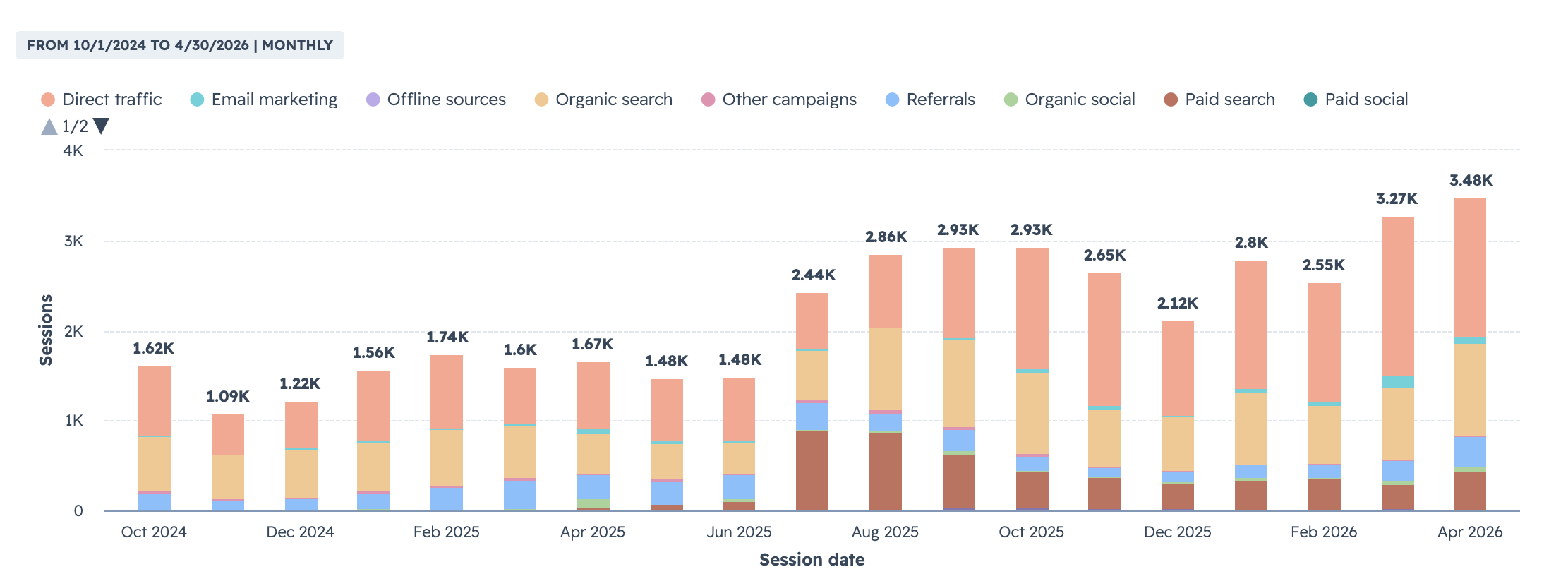
Those outcomes taught us an important lesson: the goal isn’t simply to publish more content. The goal is to capture real expertise, distribute it strategically, and strengthen the signals that help both buyers and AI systems understand who you are and why you matter.
Related Case Study: How Nextiny Increased AI Visibility, Organic Traffic, Leads, and Revenue by Turning Real Human Conversations Into a HubSpot AEO Engine
As we analyzed AEO audits and worked through low visibility scores, we consistently found four common patterns.
AI Doesn't Clearly Understand the Company's Expertise
Many companies have years of content, but AI still struggles to answer a simple question:
"What is this company actually known for?"
The business may offer multiple services, target several industries, or have evolved over time without updating its positioning. As a result, AI recognizes the brand but struggles to explain its expertise with confidence.
Expertise Signals Are Scattered Across Too Many Channels
In many audits, the expertise is there—but it's fragmented.
Some of it lives in old blog posts. Some appears in old webinars. Some is buried inside PDFs, LinkedIn posts, podcasts, case studies, and outdated service pages.
Humans can often connect those dots. AI frequently cannot.
The companies performing best in AI search create stronger connections between their content, their people, their services, and the problems they solve.
Competitors Have Stronger Entity Relationships
One of the most revealing parts of an AEO audit is seeing how AI connects entities.
Companies with strong AI visibility tend to create clear relationships between their brand, leadership team, services, methodologies, industries, and the customer problems they solve. When those relationships are consistently reinforced across websites, videos, social media, and third-party mentions, AI gains confidence in how it describes the company.
Trusted Sources Matter More Than Most Companies Realize
One of the biggest surprises we continue to see is how often AI relies on webinars, videos, reviews, and third-party content. In many cases, these sources carry more weight than traditional marketing content because they contain authentic expertise, real conversations, and human explanations.
That’s one reason webinars have become such an important part of our Human-to-Answer™ Framework. They capture the exact questions buyers ask and the real answers subject matter experts provide, creating some of the strongest expertise signals AI can find.
Ultimately, the goal isn’t simply to increase visibility. It’s to help AI understand who you are, what you do, and why you’re different.
HubSpot AEO Case Study: How We Increased AI Brand Visibility in Weeks using the Human-to-Answer™ Framework
You're Measuring Clicks, Not Influence
One of the biggest mistakes we see companies make is assuming that rankings, traffic, and leads tell the complete story.
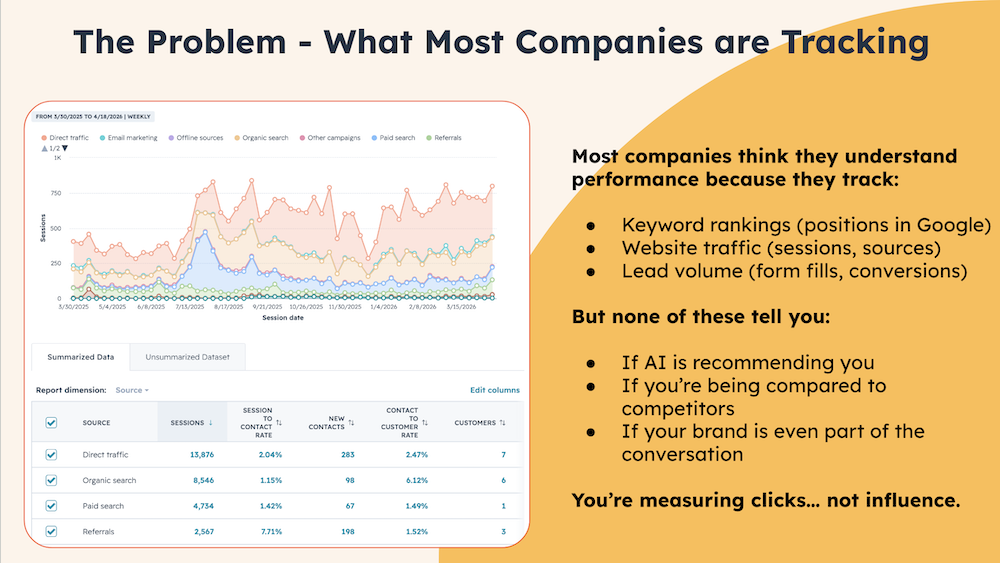
They don't.
Those metrics tell you what happened after someone found you.
They don't tell you what happened before.
Today's buyers are having conversations with ChatGPT, Gemini, Perplexity, Claude, Copilot, and Google AI Overviews throughout their research process. They're using AI to understand problems, evaluate solutions, compare vendors, validate decisions, and answer questions they don't want to ask a salesperson.
One of the most common things we hear is:
"Our buyers don't use ChatGPT."
Maybe.
But they absolutely use AI to:
- Validate you
- Compare you
- Research your reputation
- Evaluate alternatives
- Ask questions they don't want to ask your sales team
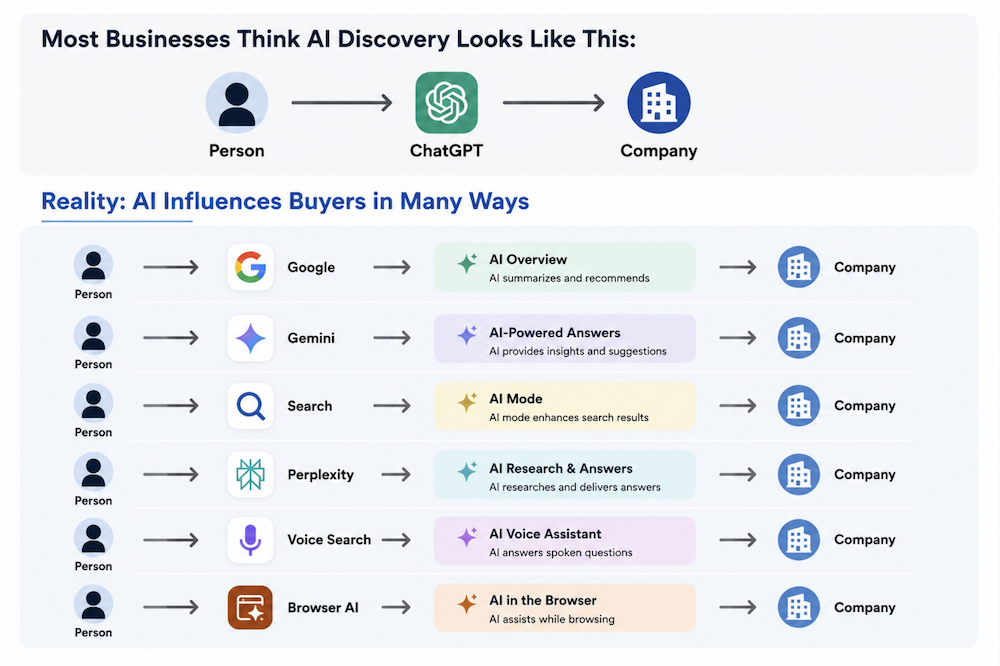
The reality is that AI is influencing far more decisions than most companies realize.
Industry research shows that nearly 60% of Google searches now end without a click, while approximately 70% of B2B buyers complete most of their decision-making process before speaking with sales.
There's another reason this shift matters.
As Rand Fishkin has argued for years, marketers have become overly focused on traffic as the primary measure of success. In a zero-click world, visibility and influence often happen without a website visit. Traffic still matters, but clicks are no longer the only evidence that marketing is working.
As Fishkin puts it:
"We need to return to the roots of marketing... be present in all the places where our audience pays attention." - Rand Fishkin
That's exactly what's happening with AI.
Buyers are still researching. They're still comparing options. They're still building trust and making decisions. The difference is that more of those activities now happen inside AI platforms, search results, social networks, communities, videos, webinars, podcasts, and other trusted sources before someone ever visits your website.
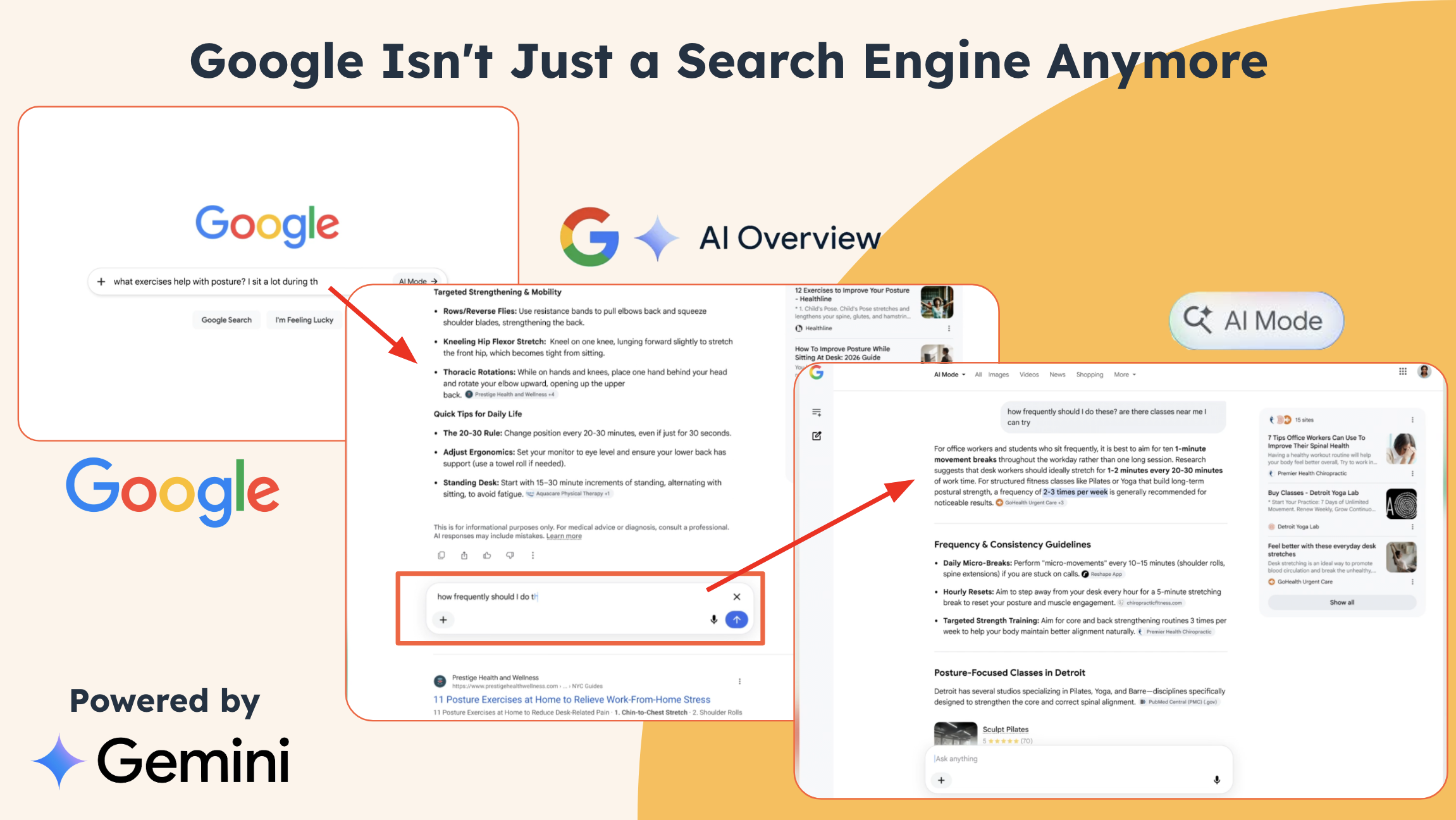
One of the ideas we strongly agree with is that zero-click doesn't mean zero sales.
Influence still exists even when the click never happens.
That's why rankings alone are becoming an incomplete measure of visibility.
You're measuring clicks.
Your buyers are measuring confidence.
And AI is increasingly shaping that confidence before the click ever occurs.
An AEO audit helps you understand what happens before the click.
Related Article: How to Use LinkedIn and Reddit for AEO
Frequently Asked Questions About AEO Audits & HubSpot AEO
What is an AEO audit?
An AEO (Answer Engine Optimization) audit evaluates how AI systems understand, describe, and recommend your company across answer engines such as ChatGPT, Gemini, Perplexity, Copilot, and Google AI Overviews. It helps identify how visible your brand is, what sources influence AI-generated answers, how competitors compare, and where your expertise signals may be weak or outdated.
How is an AEO audit different from a traditional SEO audit?
A traditional SEO audit focuses on rankings, technical performance, keywords, and organic search visibility. An AEO audit goes further by evaluating how AI systems perceive your brand, whether they accurately represent your expertise, what sources they trust, and whether your company appears in AI-generated recommendations and comparisons.
Does AEO replace SEO?
No. AEO builds on top of SEO rather than replacing it. Technical SEO, high-quality content, internal linking, schema markup, and strong site architecture remain essential. AEO expands the focus beyond rankings to include how AI systems interpret and represent your expertise across the web.
How often should companies run an AEO audit?
Most organizations should conduct an AEO audit at least once every quarter. You should also perform an audit after significant changes to your business, such as launching new services, entering new markets, repositioning your brand, changing leadership, or implementing a new content strategy.
What tools can you use to conduct an AEO audit?
An AEO audit typically combines both manual analysis and specialized tools. Companies often use ChatGPT, Gemini, Perplexity, Claude, Copilot, and Google AI Overviews to evaluate representation and visibility. Platforms like HubSpot AEO can provide additional insights into brand recognition, sentiment, competitive positioning, and AI visibility trends.
What is HubSpot AEO?
HubSpot AEO is a tool designed to help organizations understand how AI systems perceive and represent their brand. Rather than focusing solely on rankings and website performance, HubSpot AEO provides insights into areas such as AI visibility, brand recognition, sentiment, presence quality, and competitive positioning. It helps marketers evaluate whether AI systems accurately understand their expertise and how they compare against competitors.
How can HubSpot AEO support an AEO audit?
HubSpot AEO can help benchmark your visibility after you’ve completed a manual audit. While manually asking ChatGPT, Gemini, Perplexity, Claude, and other AI systems provides valuable qualitative insights, HubSpot AEO adds a layer of measurement and trend analysis. It can help identify patterns over time, highlight changes in brand perception, uncover competitive gaps, and track whether your efforts to strengthen expertise signals are improving AI visibility and representation.
What are expertise signals?
Expertise signals are the pieces of evidence AI systems use to understand what your organization is known for. These signals can include blog articles, webinars, videos, case studies, customer reviews, podcasts, LinkedIn content, media mentions, FAQs, and subject-matter expert contributions. Strong expertise signals help AI confidently associate your brand with specific topics and solutions.
Why do webinars matter for AEO?
Webinars capture authentic conversations, real customer questions, and detailed explanations from subject-matter experts. Because they often contain natural language and practical insights, webinars can become powerful expertise signals that influence how AI systems understand and describe a company.
What should you look for during an AEO audit?
When conducting an AEO audit, pay close attention to whether AI systems:
- Recognize your company and areas of expertise
- Describe your products and services accurately
- Differentiate you from competitors
- Reference current and trustworthy sources
- Reflect positive sentiment and customer perception
- Associate your brand with the topics you want to be known for
Why might AI misunderstand a company?
AI often struggles when expertise signals are inconsistent, outdated, or fragmented across multiple channels. Companies that have evolved their positioning without updating their content, messaging, and supporting assets may find that AI continues relying on old information that no longer reflects who they are today.
What is the goal of an AEO audit?
The goal of an AEO audit is not simply to determine whether AI can find your company. The goal is to understand whether AI accurately represents your expertise, trusts the right sources, differentiates you from competitors, and positions your organization as a credible answer when buyers are researching solutions.
How long does an AEO audit take?
The time required depends on the size and complexity of the organization. A basic AEO audit may be completed within a couple of days, while a more comprehensive audit involving competitor analysis, source evaluation, entity mapping, and AI visibility benchmarking may take a couple of weeks. The goal is not speed—it’s gaining a clear understanding of how AI currently represents your brand and where opportunities for improvement exist.
Final Thoughts
If you want to prepare for AI-driven discovery, start by understanding how AI sees your company today. Run the audit, ask the hard questions, compare competitors, analyze the sources, review your positioning, and identify the gaps.
What an AEO audit ultimately reveals is not just whether AI can find you, but whether AI truly understands you.
Ready to See How AI Sees Your Company?
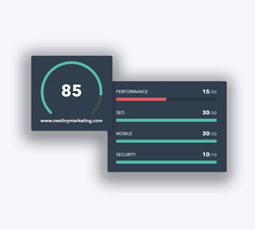
If you’re wondering whether AI accurately understands your company—or whether outdated, incomplete, or inconsistent signals are shaping the answers buyers see—our SEO + AEO Audit can help uncover the truth.
The audit evaluates:
- Traditional SEO performance
- AI visibility across major answer engines
- Entity relationships and expertise signals
- Content gaps and opportunities
- Competitive positioning
- Technical foundations such as schema and site structure
Most importantly, it helps you understand where AI's perception of your company differs from how you want to be known.
From SEO to AEO Next Webinars
Want to see these ideas in action? Join our next live sessions to go deeper on SEO/AEO, Loop Marketing, HubSpot optimization, and AI-powered strategy. Register here to our AEO webinars.
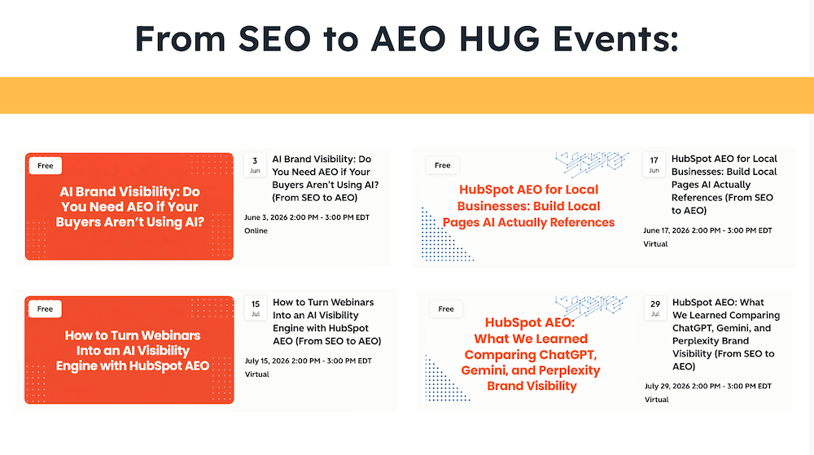
Register for our AEO webinars or review Past SEO to AEO recordings.
Want help with AEO? Get a personalized SEO/AEO Audit.