Why 2026 Requires a New Visibility Strategy
Search is undergoing the most dramatic transformation in its history. Google AI Overviews, ChatGPT Search, Perplexity, and Claude are no longer simply showing links, they’re delivering full answers derived from structured data, entities, and trusted sources across the web. In many cases, these AI engines bypass traditional search entirely.
For HubSpot users, these shifts create a new mandate: it’s no longer enough for your website to rank. In 2026, your digital ecosystem must be structured so that AI tools can understand your expertise, interpret your content, and confidently use your company as the answer.
This guide provides a complete, standalone, end-to-end strategy for transitioning from traditional SEO to AEO (Answer Engine Optimization), with a detailed 90-day implementation plan built for modern marketing, sales alignment, and HubSpot workflows.
Recording from our HubSpot User Group Webinar: "From SEO to AEO: Your 2026 Game Plan for AI-Driven Growth"
Why Is Search Shifting From Links to Answers in 2026?
Search behavior is evolving faster than at any point in the last decade. Users now default to tools that can synthesize information instantly, in their own words, without requiring them to click through multiple websites.
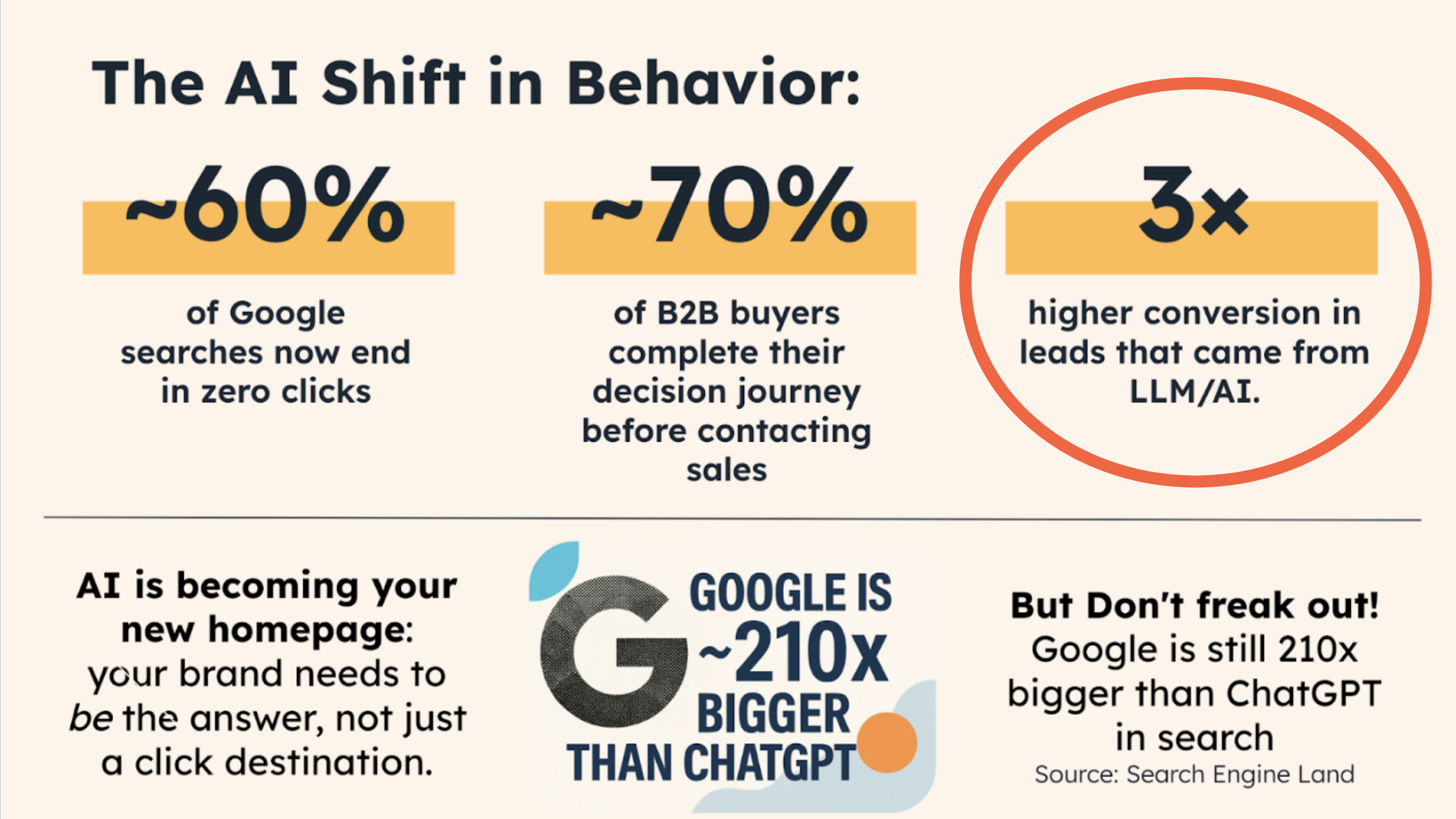
Related Article: Google is still 210x bigger than ChatGPT in search
AI-driven experiences such as Google AI Overviews routinely deliver multi-paragraph summaries, complete with citations. Meanwhile, ChatGPT, Perplexity, and Claude provide side-by-side comparisons, definitions, pros and cons, and fully formed recommendations.
This shift is driven by three converging factors:
1. The rise of zero-click search
Users increasingly receive complete answers directly on search results pages. This trend has accelerated with Google's introduction of AI-generated summaries.
2. The explosion of conversational interfaces
People are becoming accustomed to asking questions in natural language. They expect systems to respond with precise, personalized explanations, not long lists of hyperlinks.
AI Search Adoption Is Growing Rapidly:
“According to McKinsey, about half of consumers now use AI-powered search tools, and AI is projected to influence $750 billion in revenue by 2028.” Source: McKinsey
3. AI engines pulling from structured, trusted data
AI models determine what to display and who to cite based on the clarity of your content, your EEAT signals, and the strength of your entity structure across the web.
What this means for your strategy in 2026
SEO still matters, deeply. But the goalposts have shifted. Optimizing for how AI interprets and distributes your content is now just as important as optimizing for how Google crawls and ranks pages.
You must build an ecosystem that can be read, understood, and reused by answer engines, not just search engines.
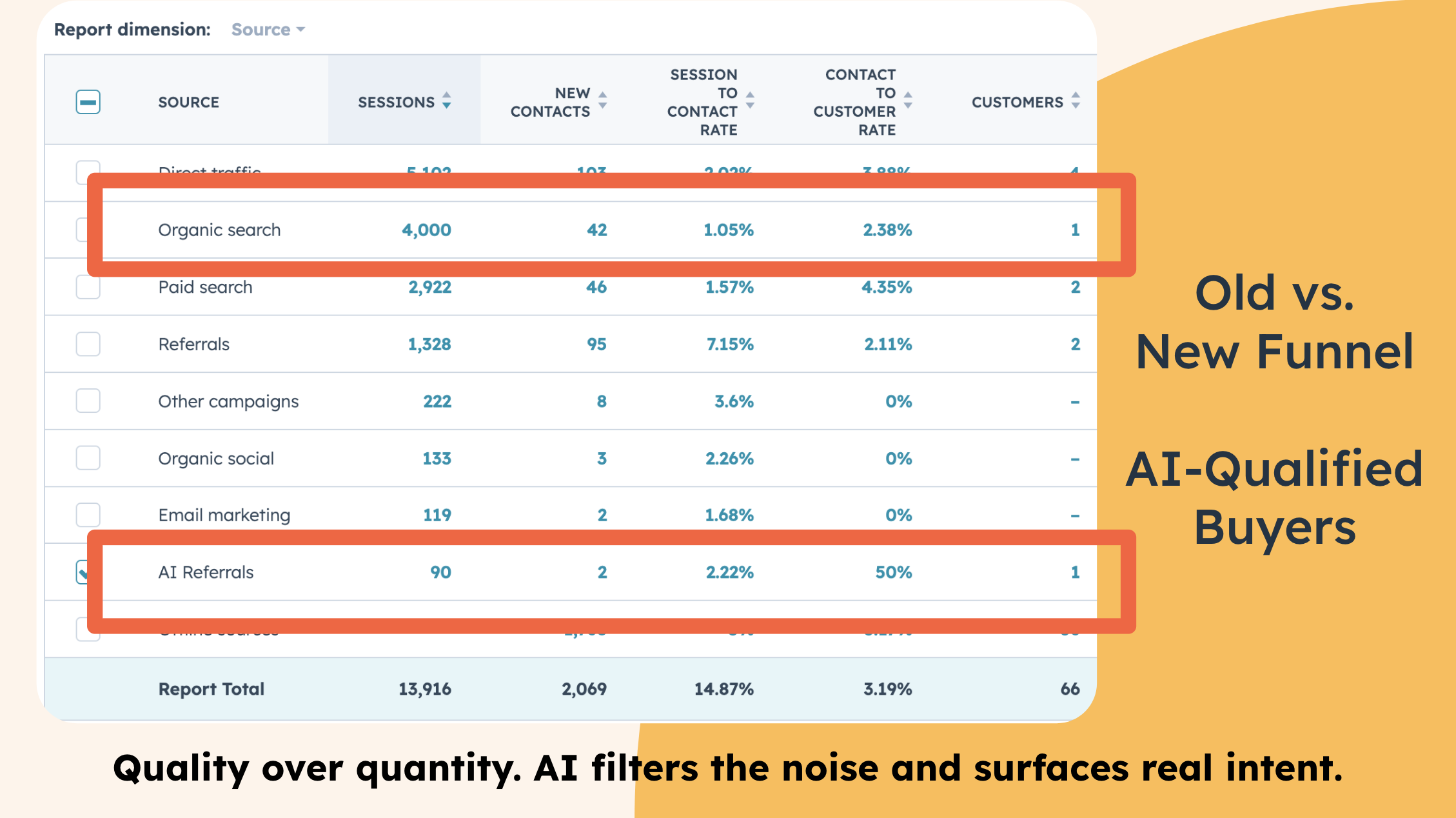
Example from on of our HubSpot Portals: Higher conversion/closing rates for AI Referral sources (2.22% conversion rate / 50% closing rate)
Related Article: From SEO to AEO (Answer Engine Optimization): How AI is Redefining Client Acquisition
How Is AI Reshaping the Entire Buyer Journey, Not Just Discovery?
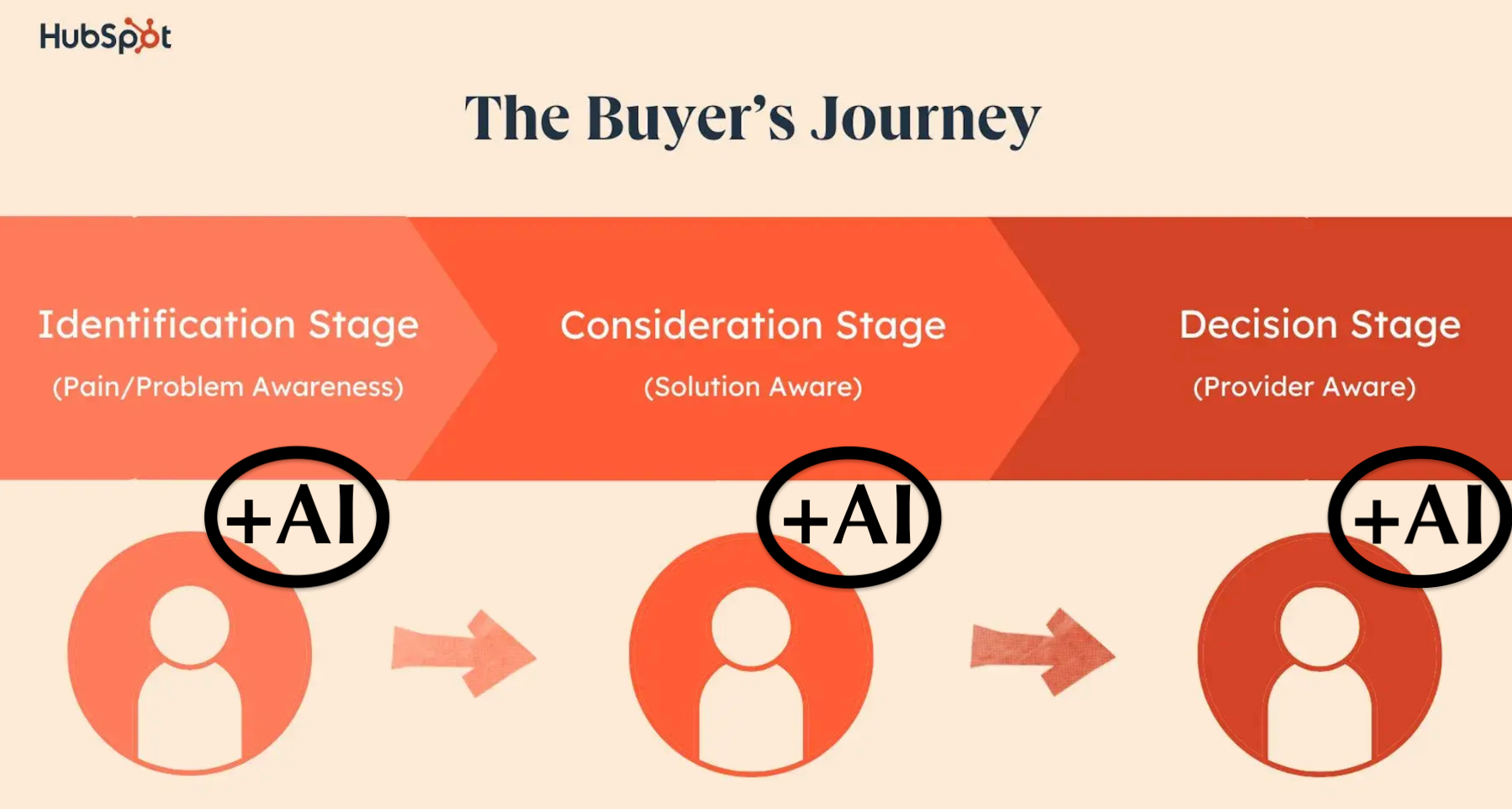
Most businesses think AI visibility only influences top-of-funnel awareness, “Will people find us in ChatGPT instead of Google?” But the deeper, more consequential shift is what’s happening in the middle and bottom of the funnel.
Buyers now use AI tools throughout their decision-making process, especially during validation, comparison, and risk assessment. Even if they discover your company through referrals, events, or your existing content, they turn to AI for clarity and confidence.
Here’s what modern buyers are doing:
- Asking AI to explain your offerings in plain language
- Requesting comparisons between you and competitors
- Investigating your reputation, trust signals, and results
- Exploring pricing expectations and implementation steps
- Testing whether your positioning holds up across external sources
- Seeking alternative vendors they might not know yet
These are critical questions, and buyers ask them outside your visibility, long after marketing hands them to sales.
Why this matters now more than ever
Sales cycles in 2025–2026 have grown longer and more fragmented. Prospects drop out of communication for weeks, only to reappear after conducting extensive AI-assisted research.
This new behavior means:
- Your messaging must be reinforced everywhere AI looks
- Your proof, testimonials, and case studies must be accessible and consistent
- Your website must be structured in a way AI can parse reliably
- Your brand entities must be well defined to avoid misrepresentation
The new reality
AEO is not just a marketing strategy. It’s a sales enablement strategy. AI has become an invisible stakeholder in every deal, and one that holds enormous sway.
If AI can’t describe your company accurately, you stand to lose deals you never even knew existed.
AI Trust Signals & User Behavior:
“Approximately 70% of consumers say they somewhat trust generative AI search results, and 79% expect to use AI-enhanced search within the next year.” Source: WordStream
What Does an AEO-Optimized HubSpot Website Look Like in 2026?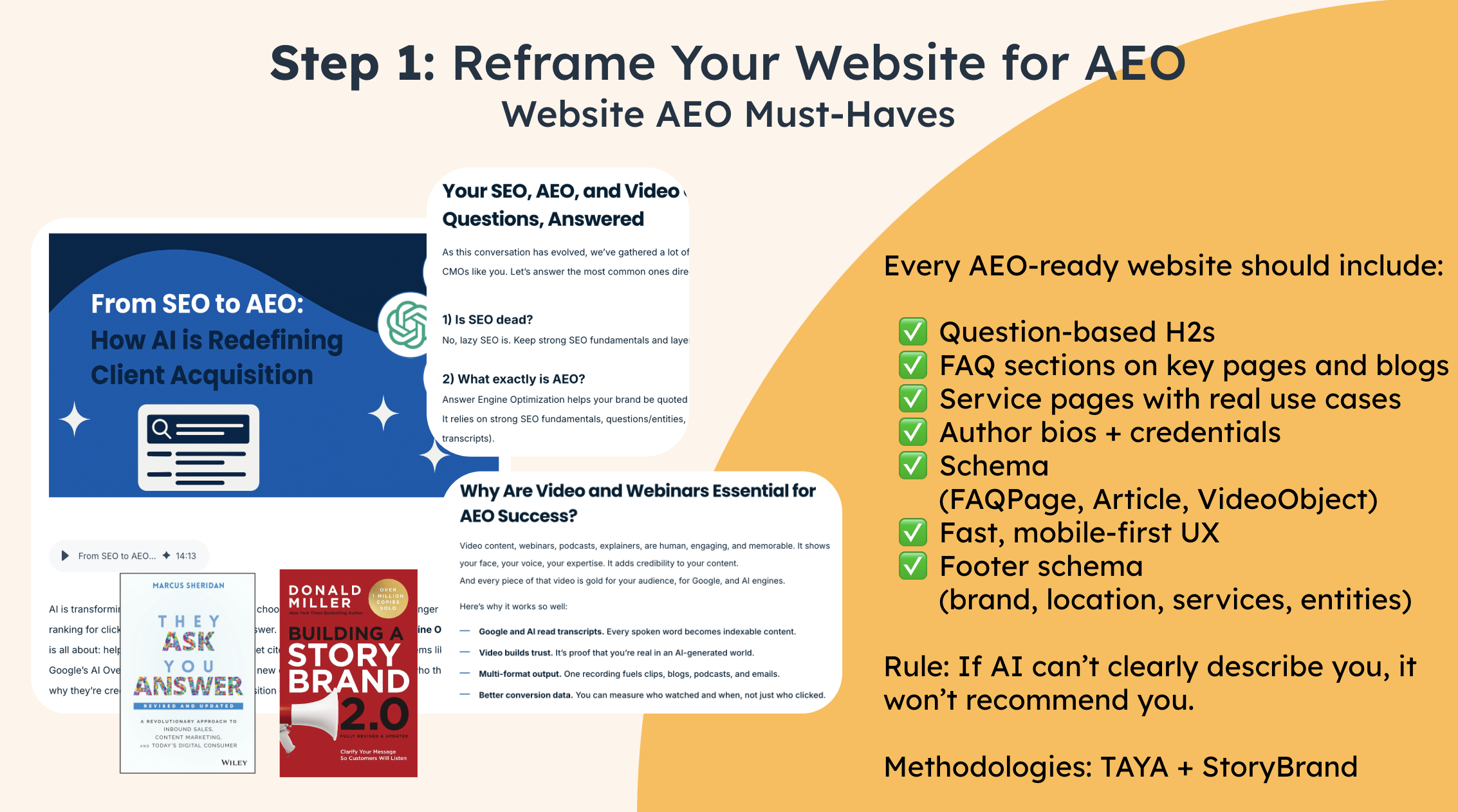
Your website must serve both humans and machines. Search engines still crawl your pages, but AI engines interpret your content at a deeper structural level, evaluating not just what you say but how clearly you say it.
Essential characteristics of an AEO-ready website
1. It speaks in the language of your buyers
Every major section should use natural, searchable questions that reflect how users phrase their queries today. This helps both humans and AI understand the context quickly.
Examples:
- “How does this company help businesses implement HubSpot successfully?”
- “What is the difference between SEO, AEO, and GEO?”
- “How can AI improve customer acquisition workflows?”
These questions act as anchors for AI engines, signaling the intent of each section.
2. It includes structured, digestible, answer-first content
LLMs prefer content that:
- opens with a straightforward, declarative answer
- includes supporting details and evidence
- uses examples to illustrate key points
- maintains semantic clarity
This structure allows AI to extract information cleanly and confidently.
3. It uses schema to communicate with search engines and AI engines
HubSpot automatically includes foundational schema (WebPage, Organization, Article), but AI visibility requires more:
- FAQPage schema
- VideoObject schema
- Product or Service schema
- HowTo schema, when relevant
These allow answer engines to parse your content at a granular level.
4. It demonstrates EEAT clearly
Your authority must be obvious and tangible through:
- detailed author bios
- certifications
- real customer results
- testimonials and case studies
- media mentions
- transparent methodology descriptions
AI evaluates these as signals of reliability.
5. It’s fast, mobile-friendly, and easy to navigate
Technical SEO is still foundational:
- page load speed
- clean code
- accessibility
- proper indexing
- coherent URL structure
These are prerequisites for effective AEO.
In short:
An AEO-optimized HubSpot website isn’t radically different from a high-performing SEO site — but it is more structured, more explicit, and more centered around delivering clear answers.
Why Does AEO Require Shifting From “Publishing Content” to “Publishing Answers”?
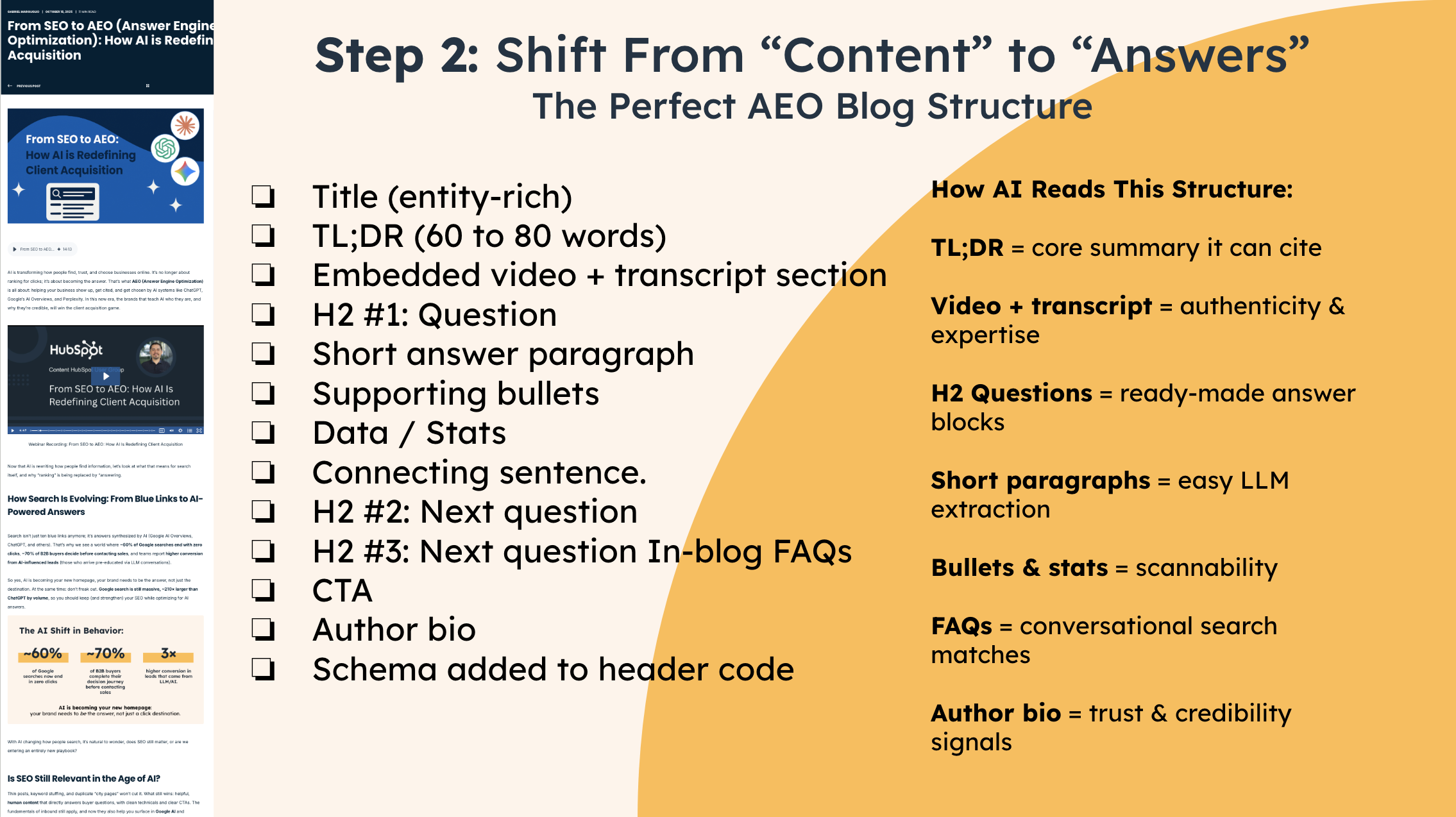
Traditional content calendars are built around traffic goals: publish frequently, target keywords, and hope for ranking improvements. But in the AI era, the metric has shifted from traffic generation to answer generation.
AI engines reward clarity, specificity, and authority.
This means that your content must be:
- structured around real buyer questions
- designed for quick extraction
- rich in unique insights and human expertise
- validated by proof, examples, and references
Generic top-of-funnel blog posts with broad topics no longer provide sufficient value for AI engines.
Why question-driven content works so well
- It aligns with natural language patterns buyers use in AI queries.
- It gives LLMs clear, labeled context for citation.
- It reduces ambiguity, improving model confidence.
- It produces modular “answer blocks” AI can pull from.
This is why formats like:
- TL;DR summaries
- question-based H2s
- direct-opening paragraphs
- FAQs
- comparison sections
- step-by-step explanations
…are increasingly prioritized by engines like Google AI Overviews.
Example of AEO-friendly writing
Q: What is the difference between SEO, AEO, and GEO?
A: SEO optimizes content for search engines, AEO optimizes content for AI answer engines, and GEO optimizes content for generative search experiences such as Google AI Overviews. Together, they form a unified visibility strategy that ensures your business can be discovered, evaluated, and selected across both traditional and AI-driven environments.
This is the type of content AI tools prefer — clean, explicit, and structured.
Related Article: How to Use HubSpot, StoryBrand, and They Ask You Answer for Marketing Success
Why Video Has Become Essential for AEO, SEO, and GEO
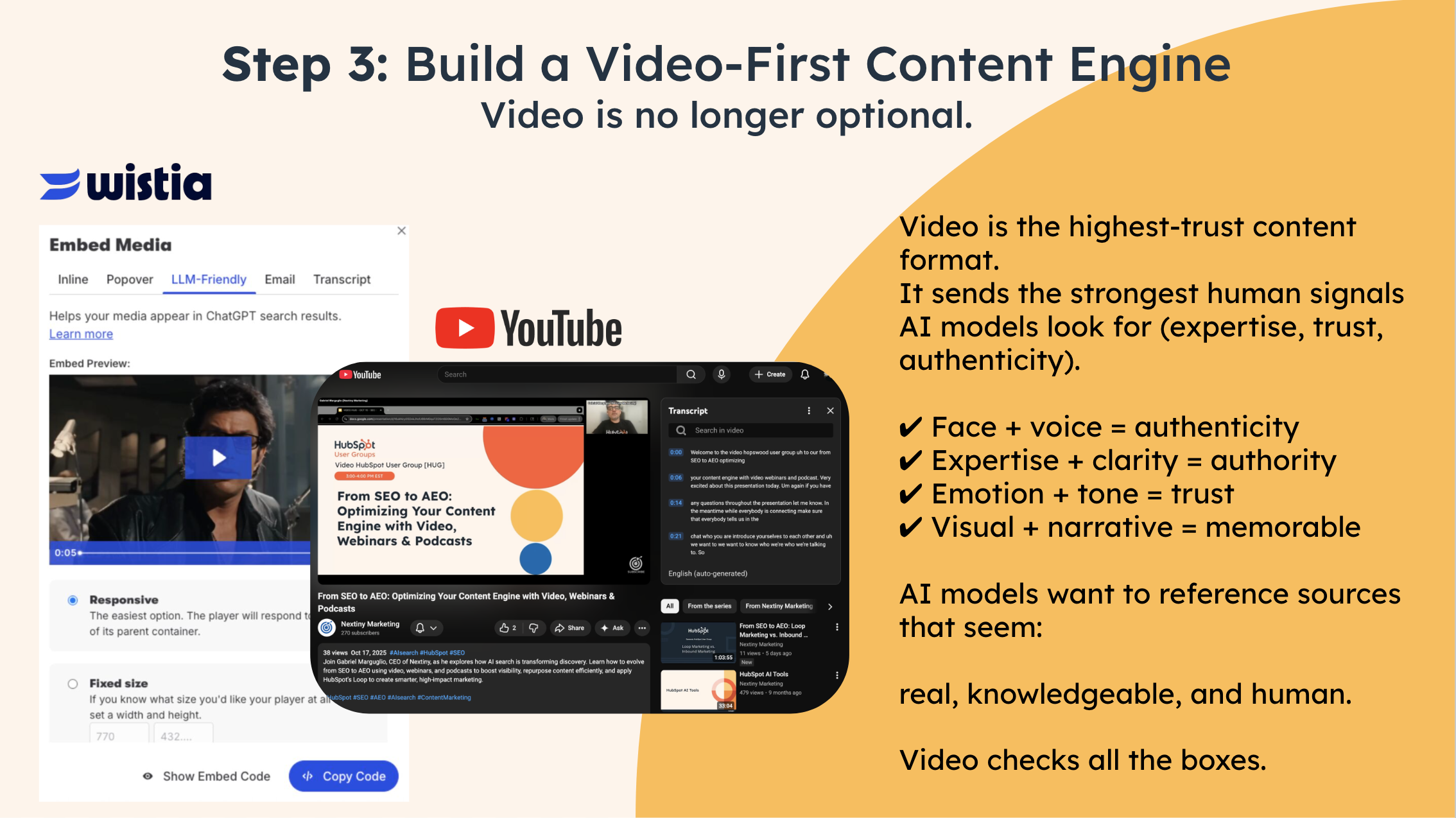
Text alone is no longer enough to establish trust. AI engines evaluate not only the accuracy of your content but also the authenticity and authority reflected through your digital footprint.
Video provides uniquely human signals
AI is increasingly capable of generating human-like text, but it cannot replicate:
- the nuance of your voice
- the confidence behind your explanations
- your personality
- your emotional tone
- your real world experience
These signals matter. Engines evaluating EEAT consider multimedia content a form of proof of expertise.
Related Article: From SEO to AEO: Optimizing Your Content Engine with Video, Webinars & Podcasts
Video also fuels your entire content engine
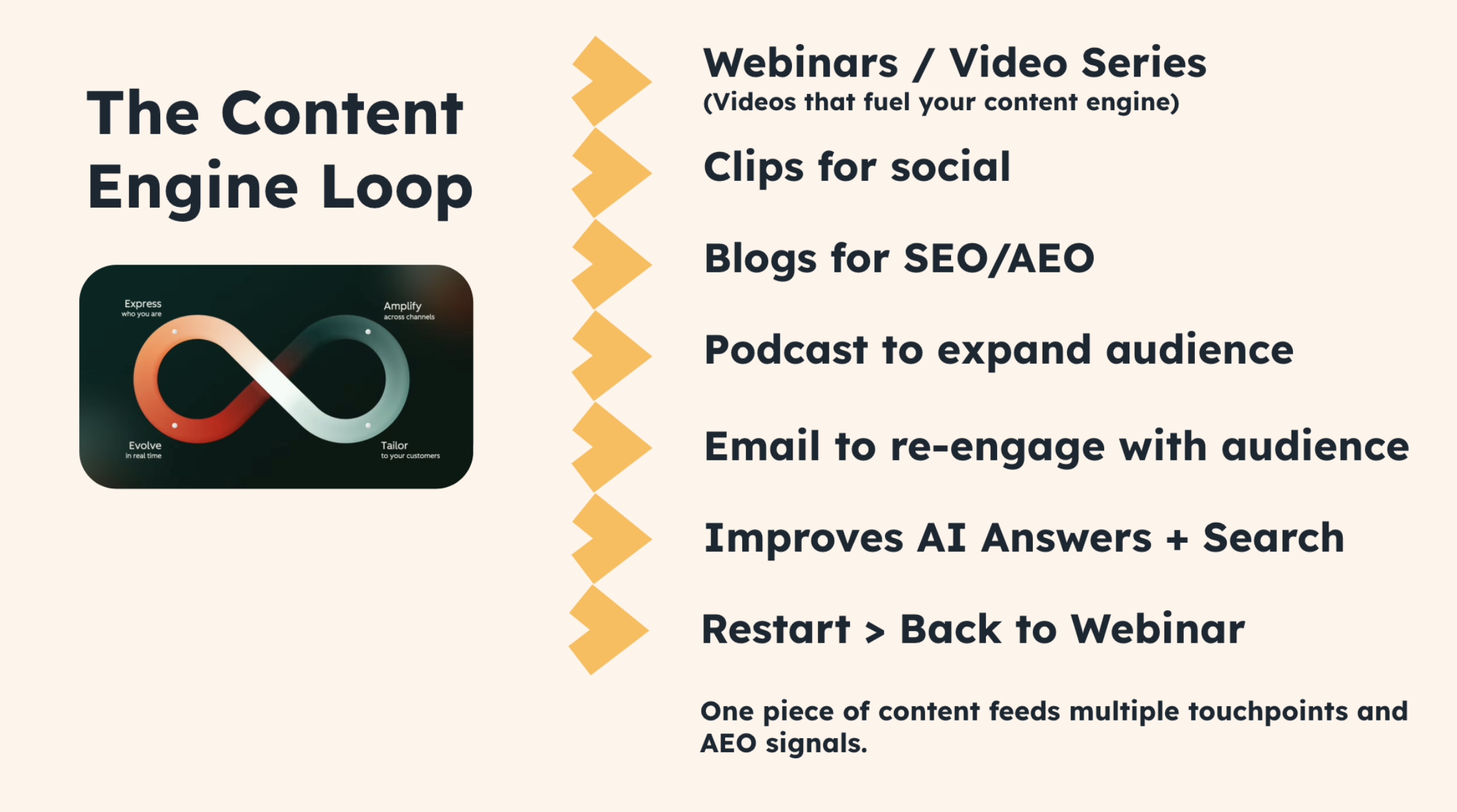
One high-quality video can be repurposed into:
- full-length blog posts
- FAQ sections
- short explainer clips
- LinkedIn videos
- transcripts
- email sequences
- podcast audio
- case study excerpts
This creates semantic reinforcement across multiple platforms, strengthening your entities.
Related Article: Loop Marketing vs Inbound Marketing (From SEO to AEO)
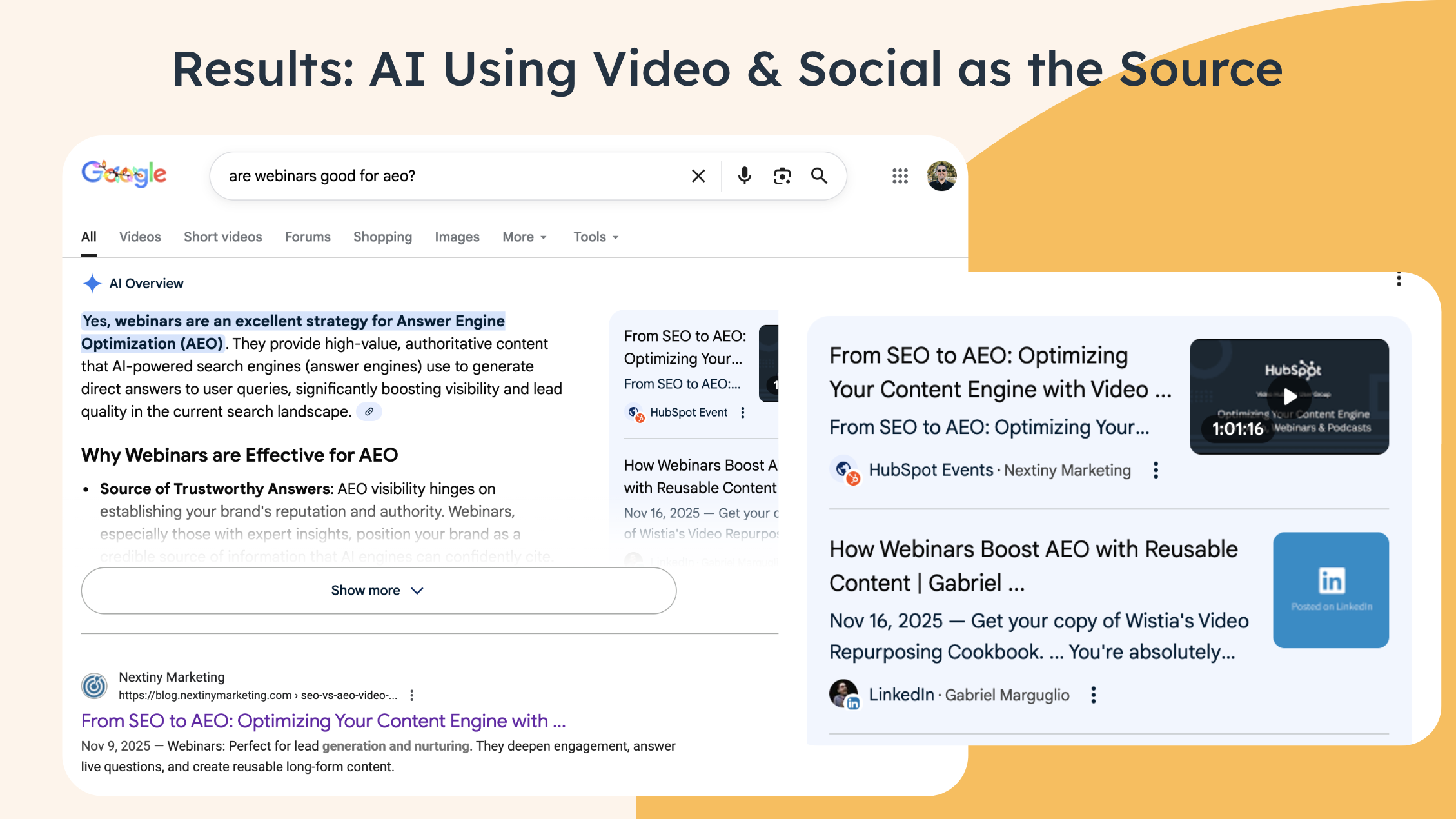
AI engines increasingly cite video sources
Structured video descriptions, timestamps, transcripts, and schema give search and AI engines rich contextual markers. The more video you publish across platforms such as YouTube, LinkedIn, and your HubSpot CMS, the stronger your AEO footprint becomes.
What Role Do Entities Play in AI Visibility?
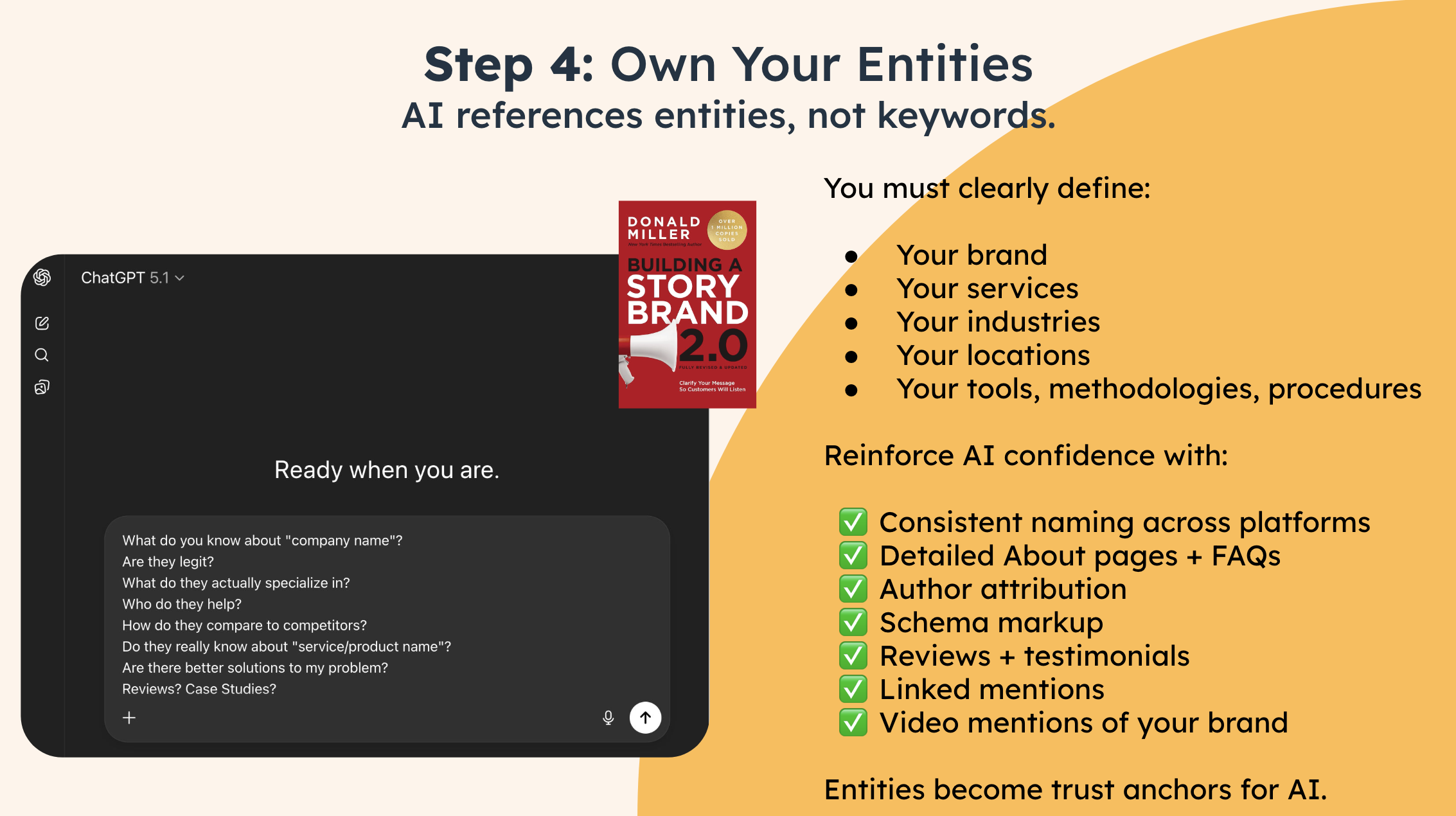
Entities are the backbone of how AI understands the world. Unlike traditional keyword systems, which rely on matching strings of text, entities represent concepts: people, companies, products, industries, locations, methods, and technologies.
Why entities are more important in 2026
When a user asks an AI:
- “Who is the best HubSpot partner for AEO?”
- “Is [your company] credible?”
- “What are alternatives to [your service]?”
…the model pulls from its entity graph. If your entities are weak, inconsistent, or absent, your brand is unlikely to appear in answers — even if your content is strong.
To strengthen entity visibility:
- use consistent naming
- write detailed About pages
- publish bios with credentials
- list awards and certifications
- embed structured data
- produce multimedia across channels
- share expertise on social platforms
- maintain high-quality external citations
Strong entities make AI engines more confident in using your content in answers.
How Can HubSpot Users Measure AEO Success?
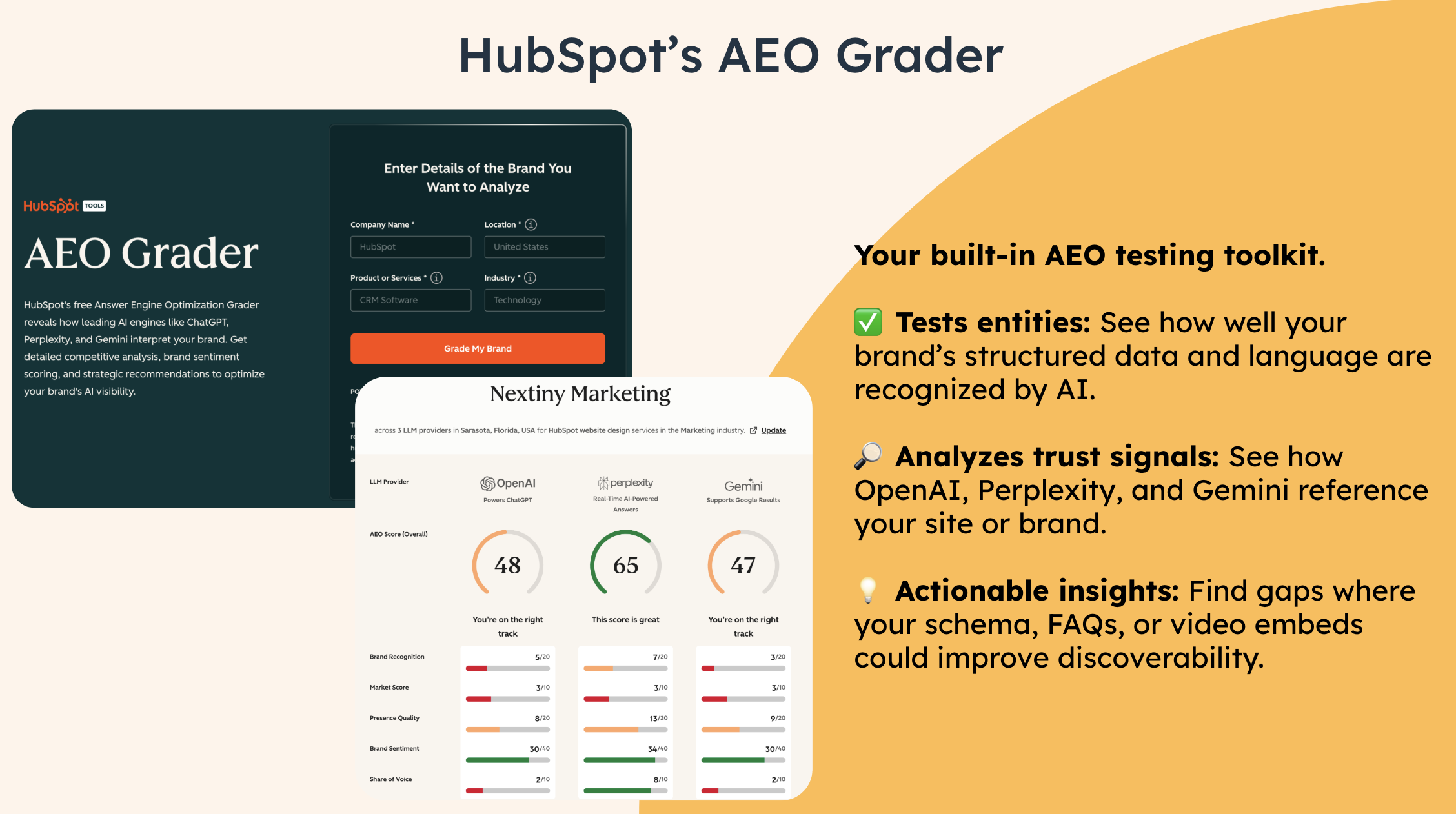
AEO is fully measurable today. HubSpot has introduced several tools and categories that help marketers quantify the impact of AI-driven visibility.
1. AI Referral Traffic
HubSpot's traffic analytics now include AI-driven referral categories, making it easier to understand which contacts originated from AI-assisted discovery.
2. AEO Grader Tools
These evaluate:
- how well your entities are understood
- whether your brand appears in answer engines
- where your content lacks clarity or structure
- opportunities for improvement
3. Video Engagement Metrics
HubSpot and Wistia make it possible to track:
- viewer retention
- CTAs within videos
- lead capture
- platform-by-platform engagement
4. Attribution and Deal Influence
You can analyze:
- which blogs influenced deals
- which videos contributed to closed-won revenue
- how often prospects revisit your content
5. AI Query Testing
Periodically asking AI tools about your company, your services, or your topics can reveal:
- how AI perceives your authority
- where your messaging is unclear
- how your competitors are represented
AEO is no longer theoretical — it can be measured and improved systematically.
Your 90-Day AEO Implementation Plan
Month 1: Build the Foundation: Make Your Website AI-Readable
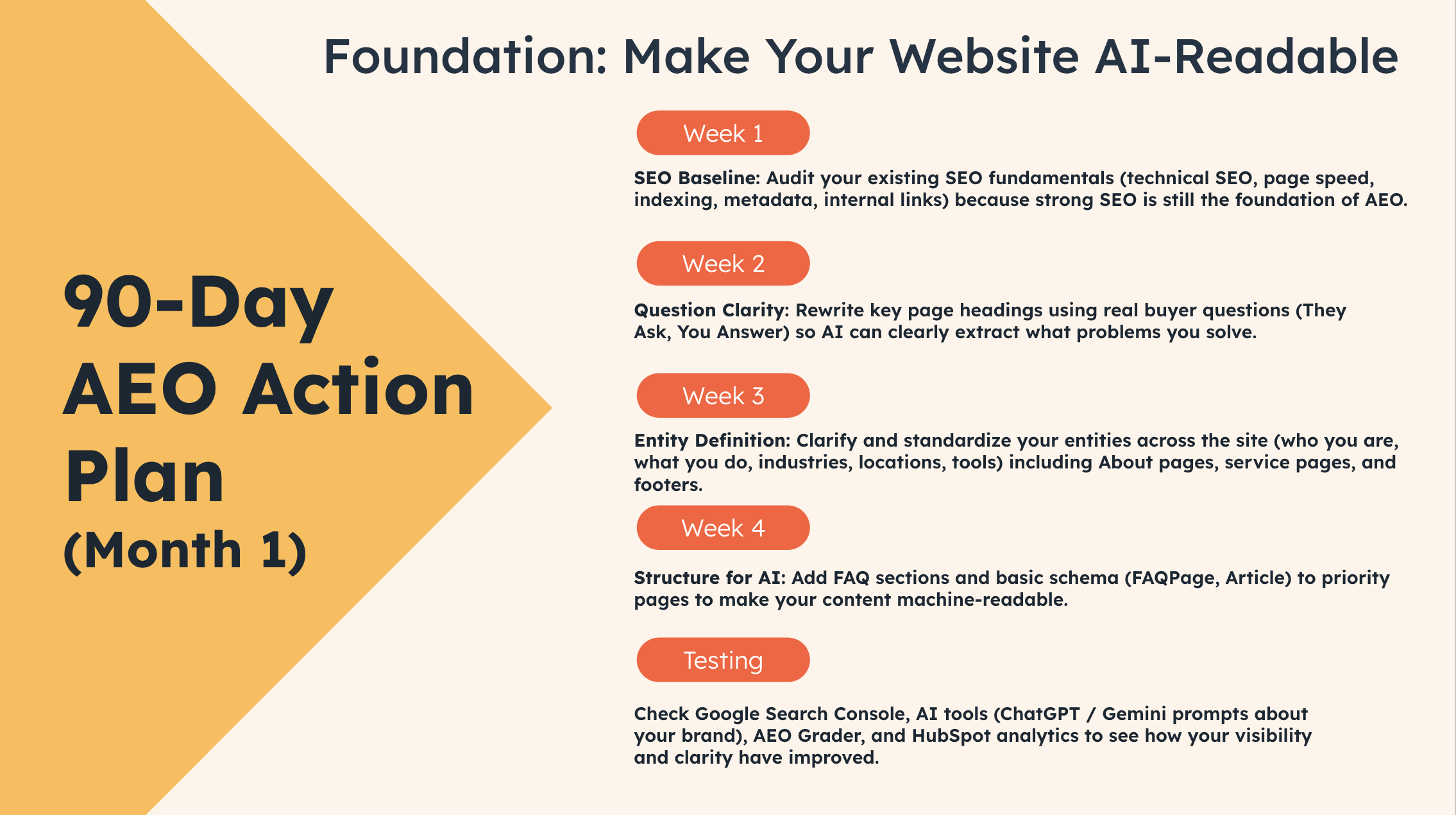
Week 1: Strengthen SEO Fundamentals
Fix core technical SEO issues:
- page speed
- mobile responsiveness
- internal linking
- metadata structure
- crawlability
- canonicalization
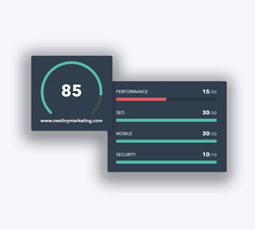
SEO remains the gateway to AEO. Test your website with Google's PageSpeed Insights and HubSpot's Website Grader.
Week 2: Rewrite Priority Pages Using Buyer Questions
Convert major sections into natural-language questions. This improves both user experience and AI comprehension.
Use the They Ask You Answer methodology as your framework.
Week 3: Standardize Entities Across Your Entire Ecosystem
Audit your:
- website
- YouTube
- directories
- bios
- blog tags
Ensure consistent terminology everywhere.
Week 4: Add Structured Data and FAQ Sections
Prioritize:
- Homepage
- Service pages
- Pricing pages
- Top blog posts
- About page
- Topic clusters
This creates a machine-readable backbone for your brand.
Month 2: Feed the Engine: Publish Answer-First Content & Video
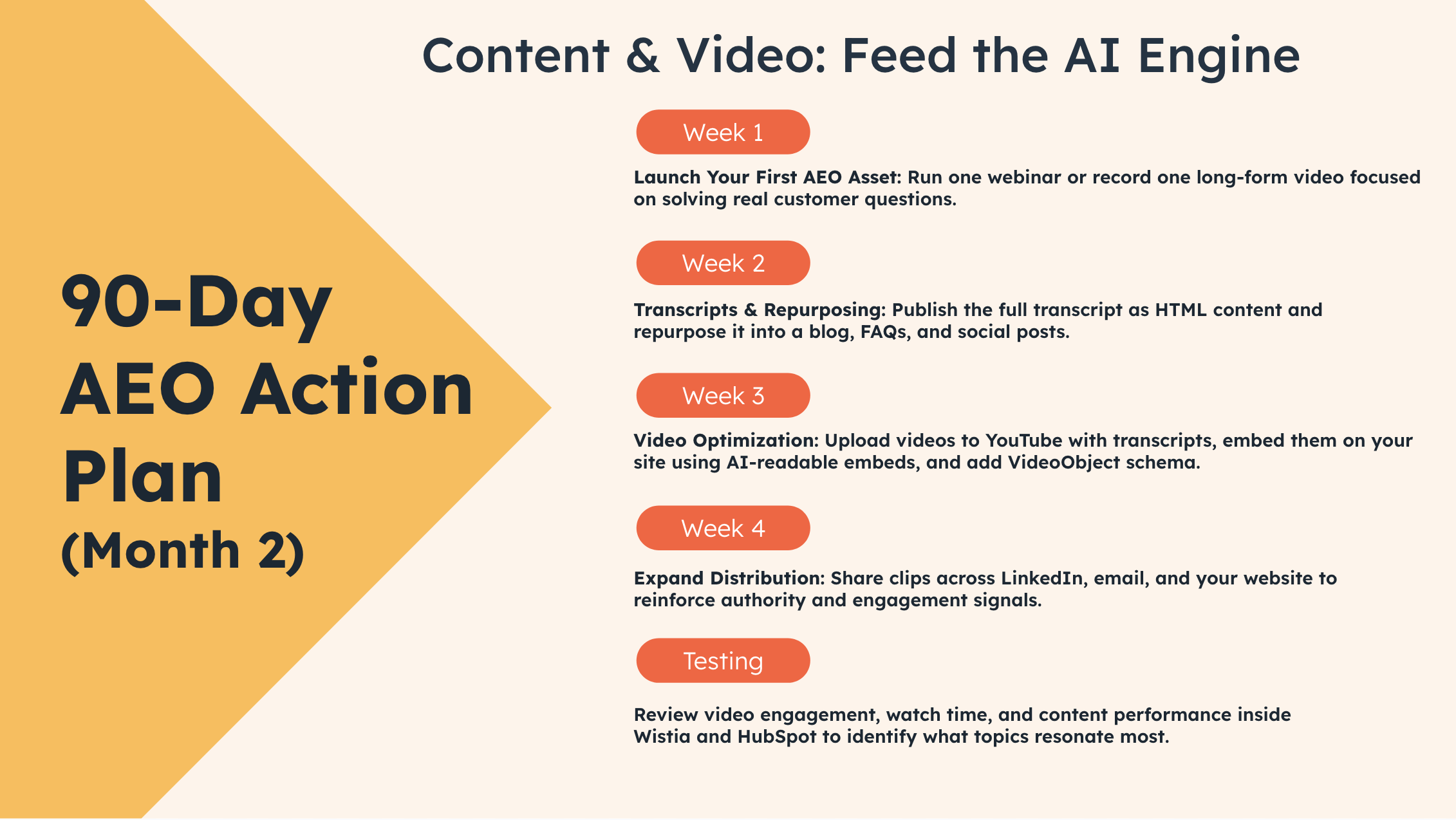
Week 1: Produce One Flagship Long-Form Video or Webinar
Choose a high-value buyer question and answer it with depth and clarity.
Week 2: Repurpose Into a Full Content Suite
Create:
- a long-form blog post
- short answer-based sections
- FAQ blocks
- social clips
- email sequences
Week 3: Optimize Video for AI Discoverability
- upload to YouTube
- include timestamps
- add a complete transcript
- embed with VideoObject schema
- cross-link from your blog
Week 4: Distribute Widely & Reinforce Entities
Promote across:
- HubSpot emails
- YouTube
- Blog clusters
- Sales enablement content
This increases the visibility and consistency of your authority.
Month 3: Align Sales: Support the AI-Driven Buyer Journey
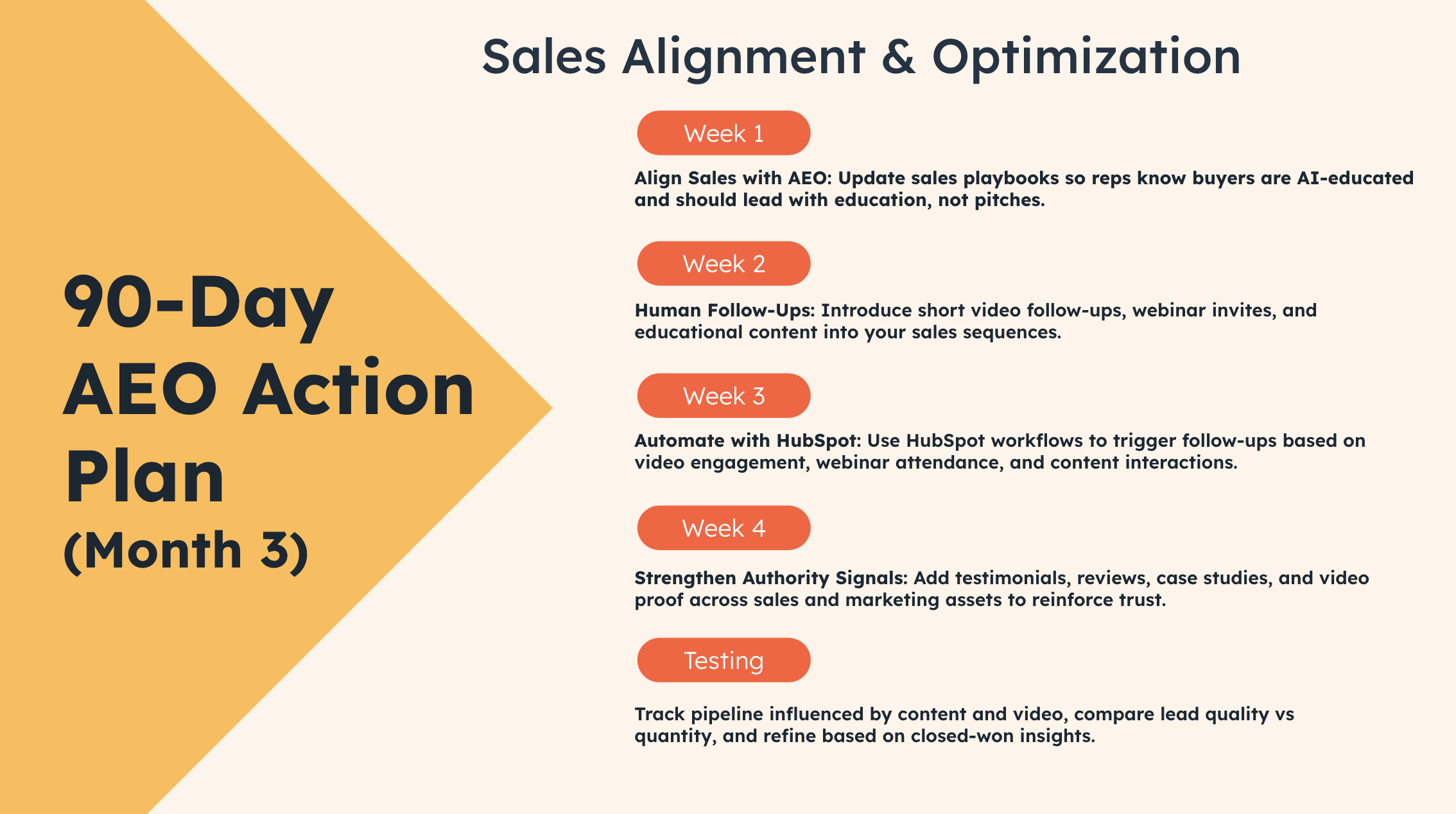
Week 1: Train Sales on AI-Educated Buyer Behavior
Equip reps to address:
- comparisons buyers receive from AI
- misinterpretations
- risk concerns
- competitive narratives
Week 2: Use Personalized Video Follow-Ups
These maintain momentum during long evaluation periods influenced by AI research.
Week 3: Automate Engagement Flows in HubSpot
Trigger workflows based on:
- video watch percentages
- content revisits
- webinar attendance
Week 4: Strengthen Your Proof Layer
Add:
- testimonials
- case studies
- screenshots
- micro-videos
- customer success stories
These elements are critical trust signals for both AI engines and human decision-makers.
Frequently Asked Questions About SEO, AEO, GEO, and AI Visibility
What is AEO?
AEO (Answer Engine Optimization) is the practice of structuring your content so that AI tools like ChatGPT, Google AI Overviews, and Perplexity select your business as the best, most trustworthy answer.
How is AEO different from SEO?
SEO focuses on ranking pages in search engines.
AEO focuses on making your brand the answer inside AI engines.
Both are essential, but AEO dominates buyer influence in mid-to-late stages.
How does GEO fit in SEO and AEO Strategies?
GEO (Generative Engine Optimization) targets visibility inside generative interfaces like Google AI Overviews. It overlaps with AEO but focuses more on formatting content for generative summaries. If you are doing good SEO and AEO, you are doing GEO.
Why is video so important for AEO?
Video conveys authenticity and expertise, two elements AI engines evaluate heavily. It strengthens EEAT and creates rich, structured data.
Do HubSpot users need to rebuild their entire website for AEO?
Not necessarily. Most sites need structural clarity, schema enhancements, answer-first content, and entity alignment, not a full redesign.
Final Takeaways for HubSpot Marketers Preparing for AEO in 2026
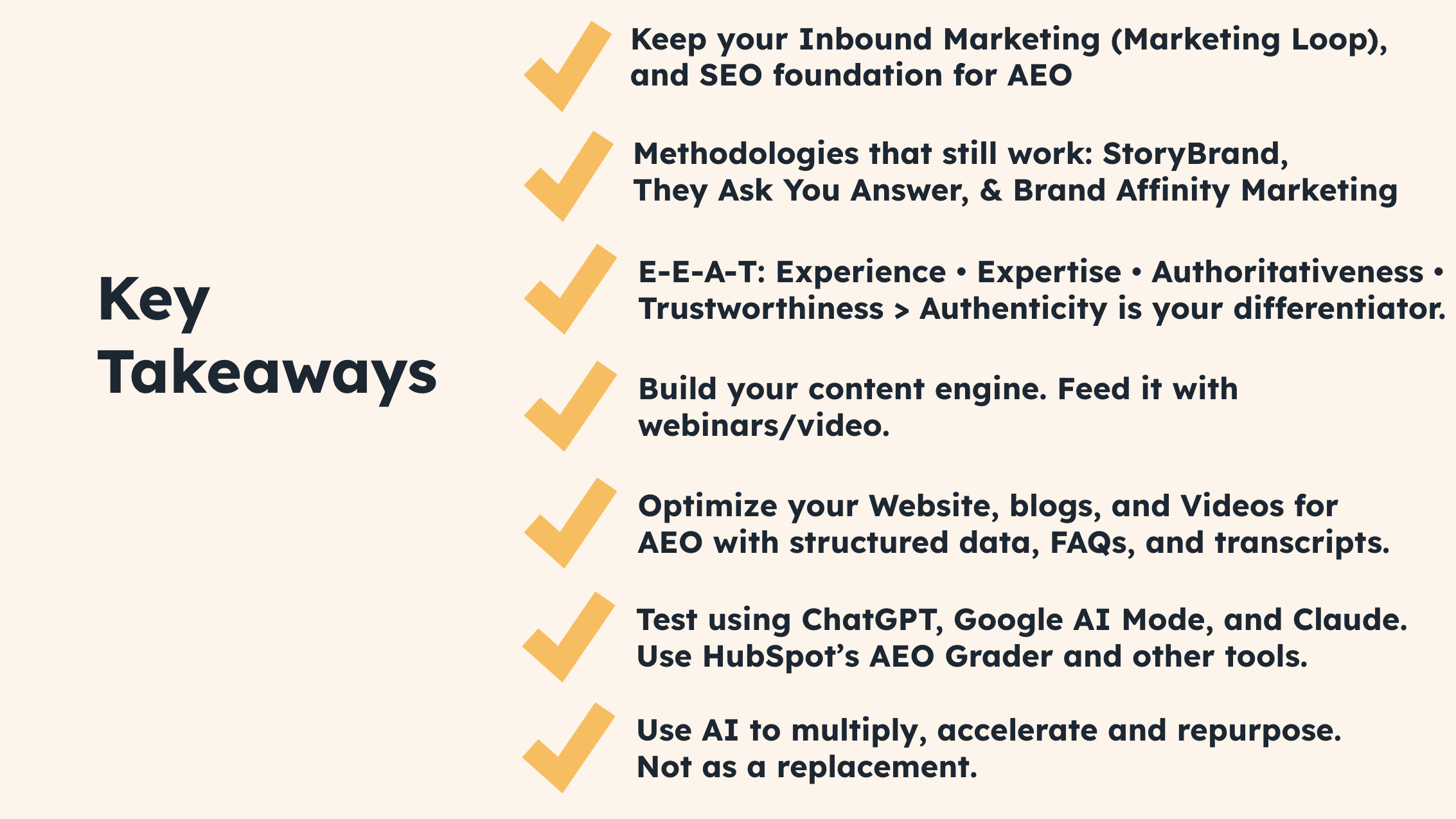
1. SEO remains critical, but AEO is now equally essential.
Your foundation still matters, but your visibility now depends on how clearly AI can interpret your content.
2. Your buyers are relying on AI at every stage of the funnel.
If you’re not part of those conversations, you’re losing deals without knowing it.
3. Structured, answer-focused content gives you maximum visibility.
Question-driven headings, schema, and high-quality video accelerate discoverability.
4. Authenticity is the new competitive advantage.
Real people, real voices, real expertise, AI engines weight these heavily.
5. The companies that adapt now will dominate their categories in 2026 and beyond.
AEO isn’t optional. It’s the natural evolution of organic growth.
The Brands AI Recommends Will Be the Brands That Win
The shift from SEO to AEO isn’t theoretical, it’s already shaping how buyers discover, evaluate, and choose solutions. In a world where AI engines summarize the internet for your customers, visibility is no longer about ranking first. It’s about being clear, credible, and citable.
The brands that succeed in 2026 won’t publish more content, they’ll publish better answers. They’ll own their entities, structure their pages for extraction, lead with video and real expertise, and reinforce trust signals everywhere AI is looking.
This playbook isn’t about chasing algorithms. It’s about building a digital presence so consistent, human, and authoritative that AI has no hesitation recommending you.
If your website can’t explain your value in a single answer, neither can AI.
And in the age of answer engines, that’s the difference between being discovered, and being invisible.
From SEO to AEO Next Webinars
Want to see these ideas in action? Join our next live sessions to go deeper on SEO/AEO, Loop Marketing, HubSpot optimization, and AI-powered strategy. Register here to our AEO webinars.
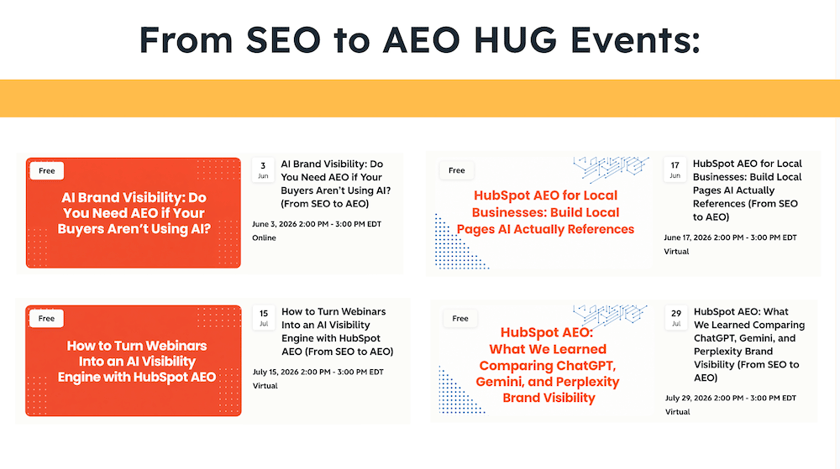
Register for our next related webinars or review past events recordings here:
- Feb 25, 2026, 2 PM (EST): AI Tools Every HubSpot Marketer Should Master
- Past SEO to AEO recordings