ChatGPT, Gemini, and Perplexity do not evaluate your brand the same way. After running AEO audits, testing hundreds of prompts, and tracking real companies in HubSpot AEO, we’ve found clear differences in what each AI engine appears to trust, and one strategy that improves your chances of showing up across all of them.
Webinar Recording: HubSpot AEO: What We Learned Comparing ChatGPT, Gemini, and Perplexity AI Brand Visibility
Search is no longer just about links. Google AI Overviews, Google AI Mode, ChatGPT, Gemini, Perplexity, Copilot, and other AI experiences are becoming part of how people discover companies, compare solutions, validate decisions, and decide who they trust.
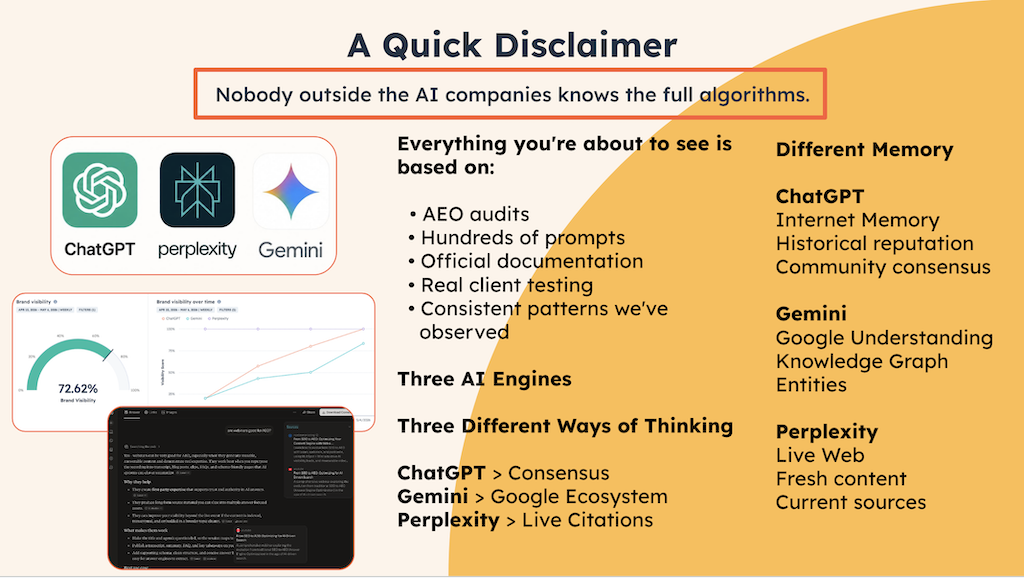
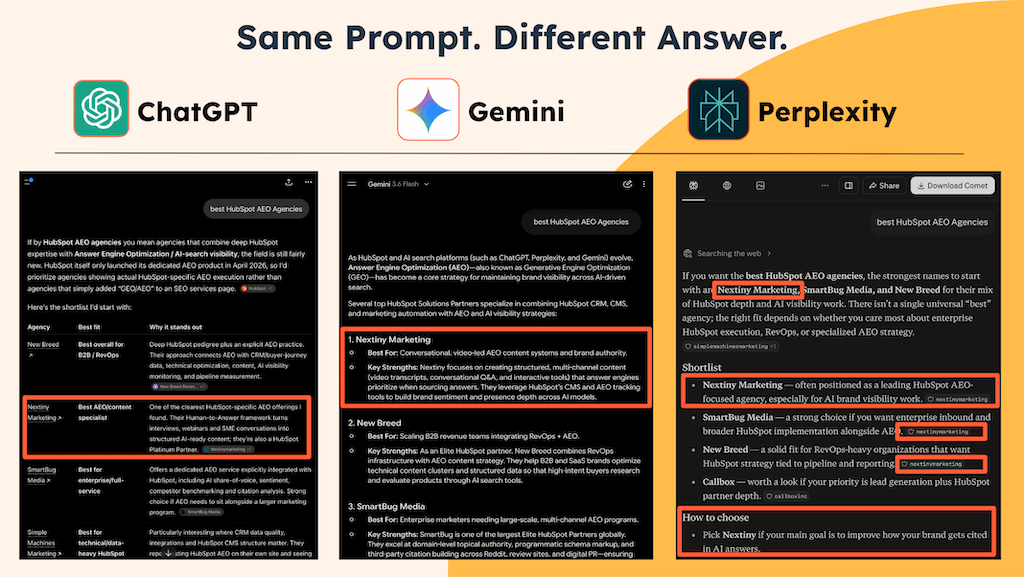
One of the first things we learned when we started tracking AI brand visibility is that there is no single “AI algorithm” to optimize for. ChatGPT, Gemini, and Perplexity think differently.
Based on AEO audits, prompt testing, real client work, official guidance, and patterns we’ve repeatedly observed, we think about the three engines this way: ChatGPT behaves more like a consensus engine, Gemini is deeply connected to the Google ecosystem, and Perplexity behaves more like a live citation and research engine.
These are not hard algorithmic rules, because nobody outside these companies knows their complete systems. They are recurring patterns we can actually observe and work with.
That may sound like you now need three separate AEO strategies.
Fortunately, that is not the real lesson.
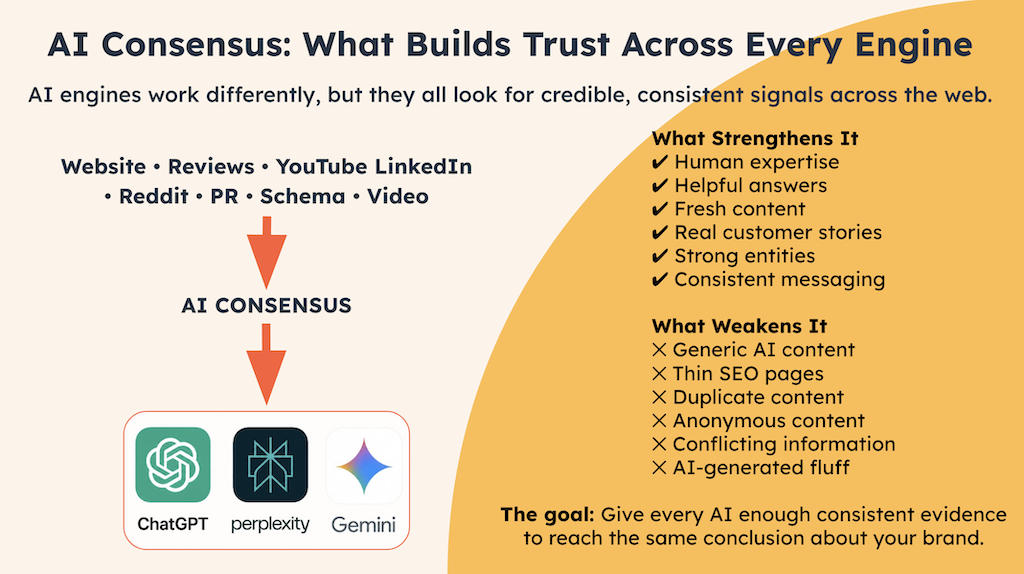
The real lesson is that although every AI engine evaluates trust differently, all of them need credible evidence. Your job is to create enough consistent, trustworthy signals across the internet that ChatGPT, Gemini, Perplexity, and whatever comes next can reach the same conclusion about your brand. We call that AI consensus.
Why AI Brand Visibility Is Different From Traditional SEO
Traditional SEO asks a familiar question: Where does this page rank for this keyword?
AEO asks something different: When my buyer asks AI a question, does my brand appear, how is it described, what sources support the answer, and does AI position me as a credible choice?
That distinction matters because AI is influencing much more than discovery. A prospect may already know your company and still ask ChatGPT to compare you with competitors before signing a contract. They may ask Gemini whether your claims are credible or use Perplexity to research reviews, pricing, case studies, and industry reputation.
All of that happens without your salesperson in the room.
This is why I’m now having AEO conversations with businesses where I might never have had a traditional SEO conversation. A highly specialized B2B company may not care whether thousands of people search for its product category every month. But when one qualified prospect is about to make a major purchase decision, that prospect can absolutely use AI to validate the company.
There is also a measurement problem. In one HubSpot portal we reviewed, organic search generated roughly 4,000 visits, 42 leads, and one customer during the period shown. AI referrals generated only around 90 visits and two leads, but also one customer. Far less traffic, far fewer leads, same number of customers.
That does not mean AI referrals will always convert that way. It means traffic alone no longer tells the whole story.
We have spent twenty years optimizing for clicks.
Now we also need to optimize for influence.
Does HubSpot AEO Measure ChatGPT, Gemini, and Perplexity?
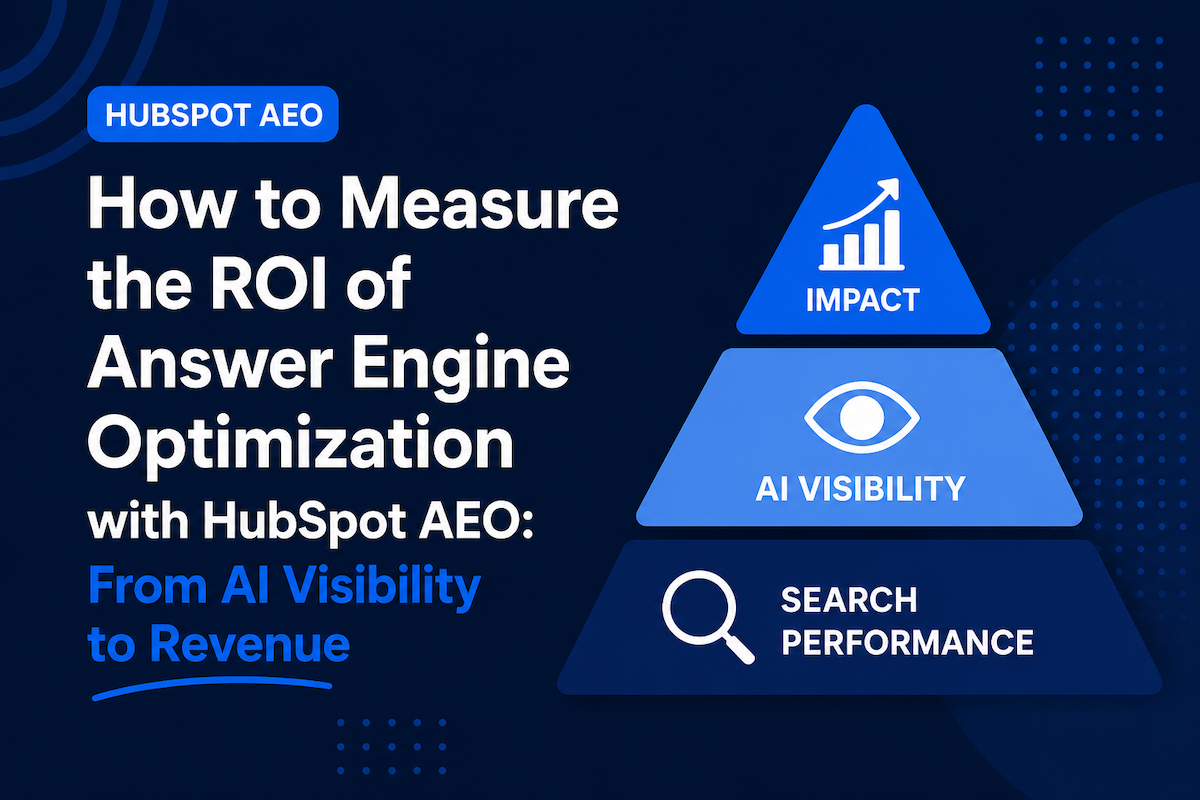
Yes. HubSpot AEO is designed to help marketers measure how frequently their brand appears across relevant AI prompts, including prompts evaluated across platforms such as ChatGPT, Gemini, and Perplexity. HubSpot defines Brand Visibility Score as the percentage of relevant prompts where your brand appears.
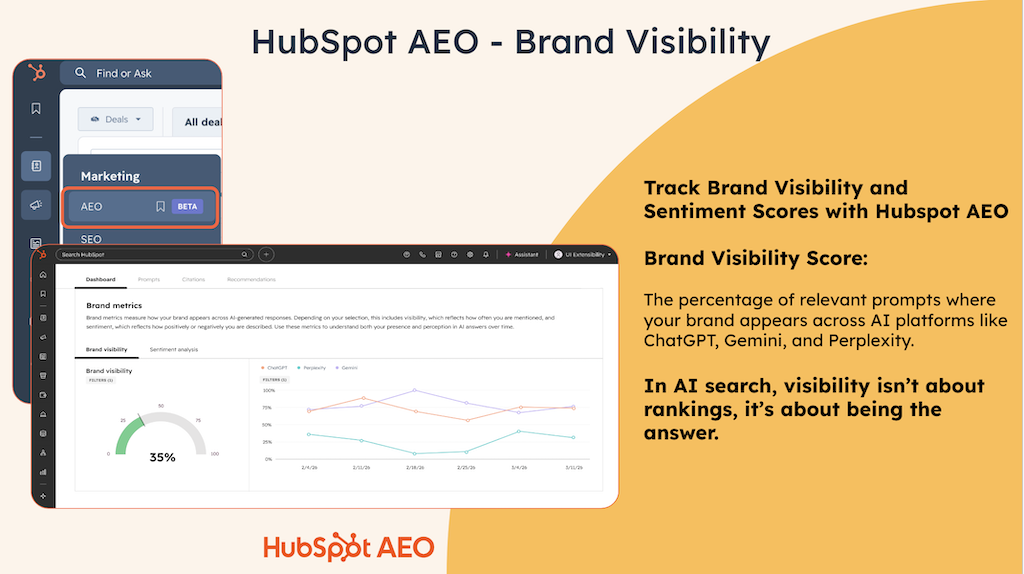
What makes this especially useful is that HubSpot does not treat prompts like traditional keywords.
Prompts represent actual buyer questions. HubSpot can show visibility for individual questions, compare your visibility against competitors, track changes over time, identify channels contributing citations, and recommend actions that may help improve visibility.
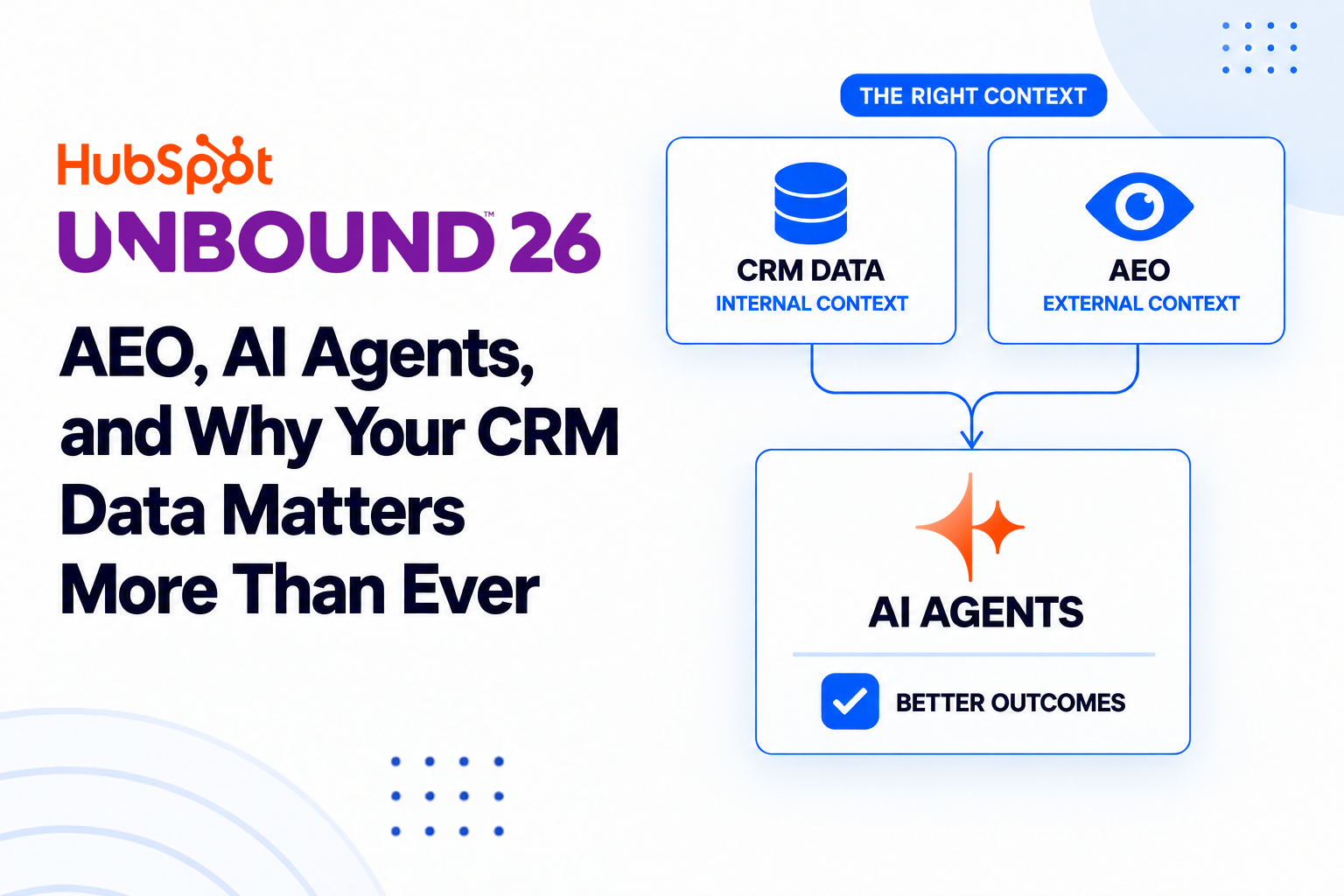
In the webinar we also highlighted that prompts can be suggested using CRM data, which means your AEO strategy can be grounded in what your actual buyers care about instead of a disconnected keyword list.
That changes the question from: “Where do we rank?”
to: “When our buyer asks this question, what does AI say?”
That is a much more useful question in an answer-first world.
How to Use HubSpot AEO for ChatGPT Brand Visibility
Short answer: HubSpot AEO can help you measure when ChatGPT mentions your brand, compare your visibility against competitors, inspect the sources shaping those answers, and identify where you need stronger brand consensus.
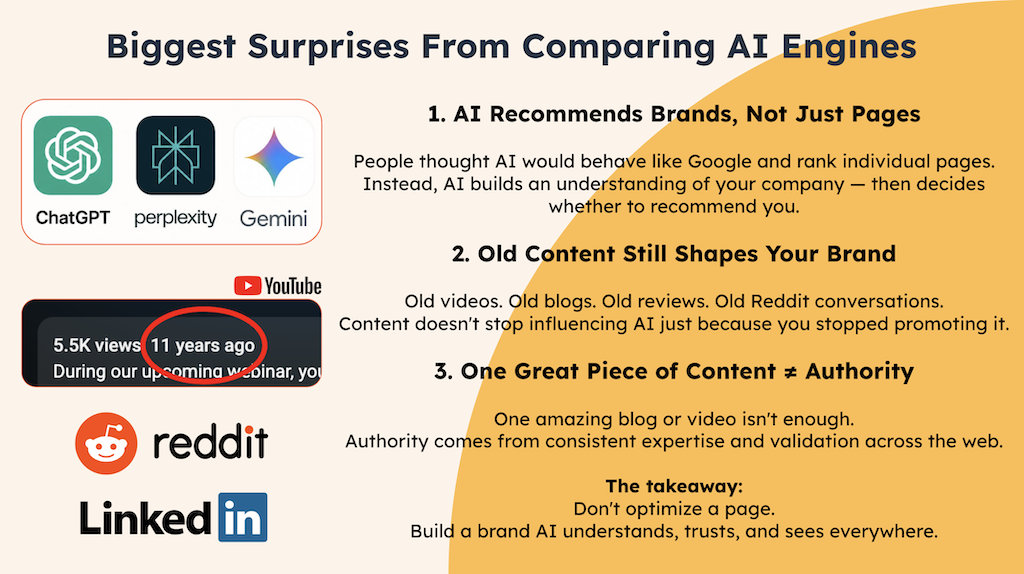
In our testing, ChatGPT behaves most like the consensus model.
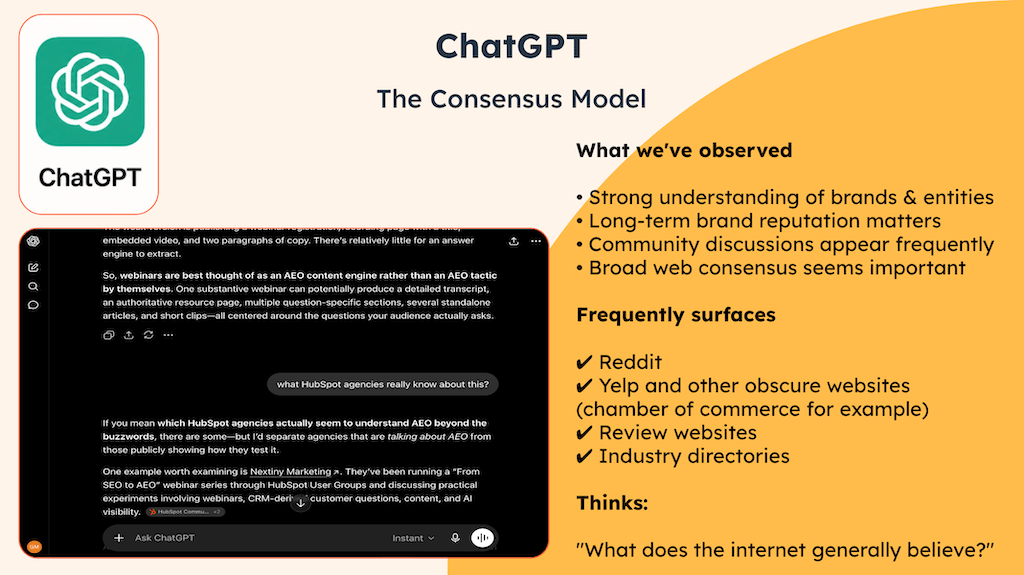
It appears to place meaningful weight on long-term brand reputation, established entities, community conversations, reviews, industry directories, and broad agreement across the web. In the webinar we specifically highlighted Reddit, review sites, industry directories, Yelp, and even older Chamber of Commerce pages as sources we have repeatedly seen surface.
Some of those sources can surprise you.
We found an old Chamber of Commerce profile influencing how AI understood a local company. At first, that makes no sense. Why would an outdated directory page matter more than a beautiful new company website?
Then think about it from AI’s perspective. You control your website. You can say almost anything about yourself there.
A Chamber of Commerce profile requires something outside your own marketing team. At some point, there was a real organization, a real membership, some kind of human verification, and evidence that your business actually exists in that market. That old page contains something extremely valuable to AI: independent corroboration.
That is why improving HubSpot AEO for ChatGPT is not just a content exercise.
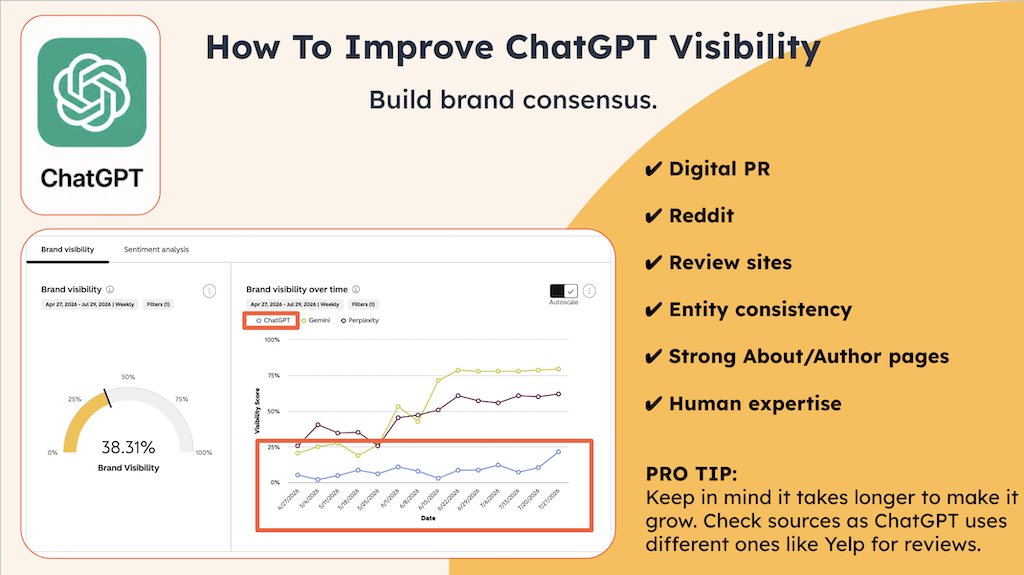
You need to build brand consensus.
That means paying attention to reviews, Reddit conversations where relevant, digital PR, directories, About pages, author pages, entity consistency, external mentions, and old sources that may still be shaping your brand story.
We recommend community building, review building, strong entity consistency, strong About and author pages, and human expertise as ways to improve ChatGPT visibility.
Reddit as a citation source for ChatGPT: Some new reports from mid-August 2026 suggest that ChatGPT has significantly reduced its use of Reddit as a citation source. Fluctuations like this are normal, especially when new models or major updates are introduced, and volatility tends to increase during these periods.
The takeaway is not to overhaul your entire strategy in response to short-term changes. Continue creating useful assets that reach people where they are. Even when a particular platform or piece of content isn’t being cited directly by a model, a strong multichannel presence helps build broader consensus around your brand, your expertise, and what you do.
ChatGPT / Reddit Update August 24, 2026:
Over the last couple of weeks there was a lot of discussion about ChatGPT dramatically reducing Reddit citations. Reddit’s share of ChatGPT Search citations reportedly dropped from 3.83% to 0.52% in just a few days. (Source: Search Engine Land - Reddit’s ChatGPT Search citations fell 86% in four days: Report)
Naturally, a lot of people started asking whether Reddit still matters for AEO and whether strategies needed to change. But then we noticed something interesting. We're currently tracking multiple clients in HubSpot AEO, and after the same ChatGPT update, we started seeing some pretty significant increases in ChatGPT brand visibility across multiple accounts.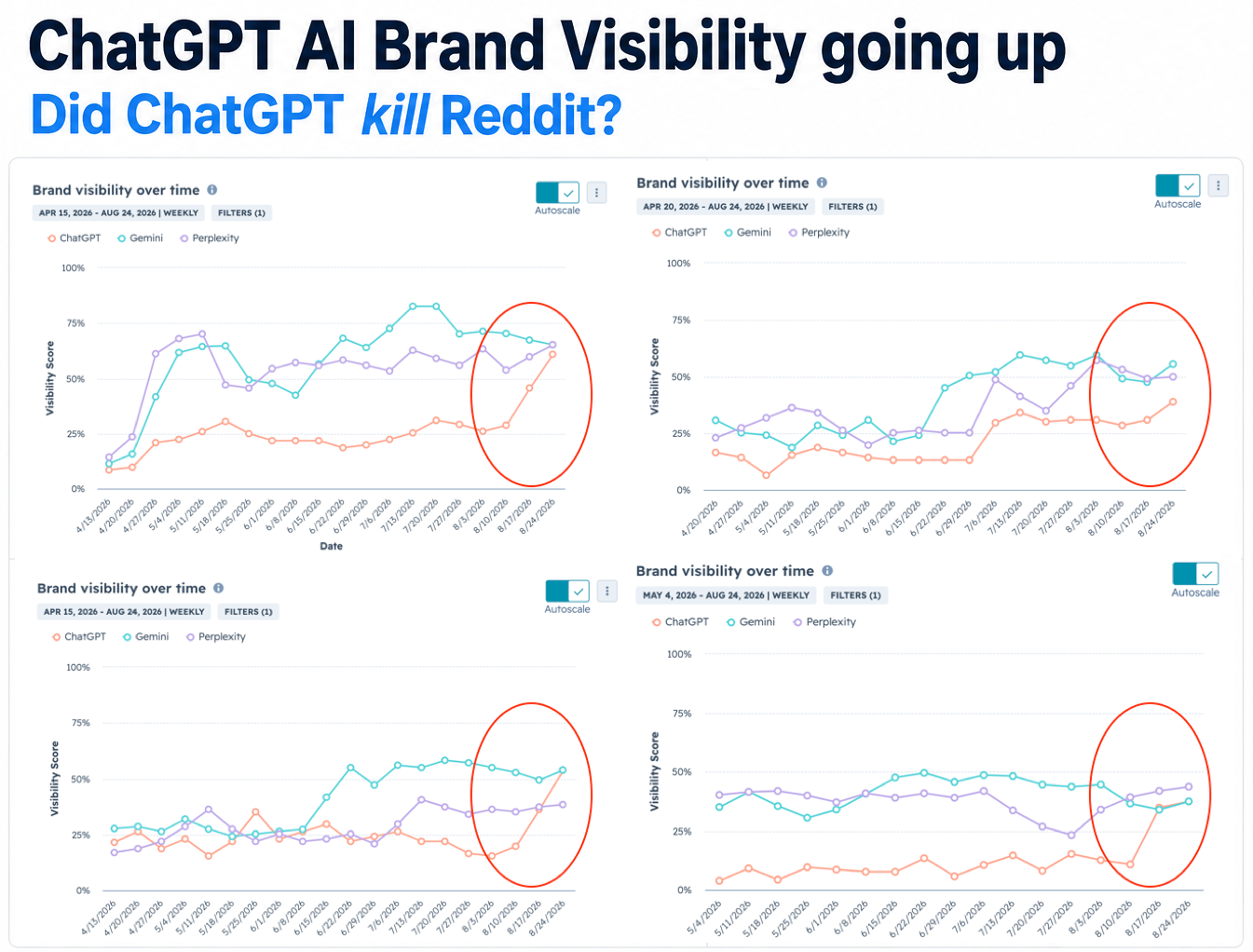
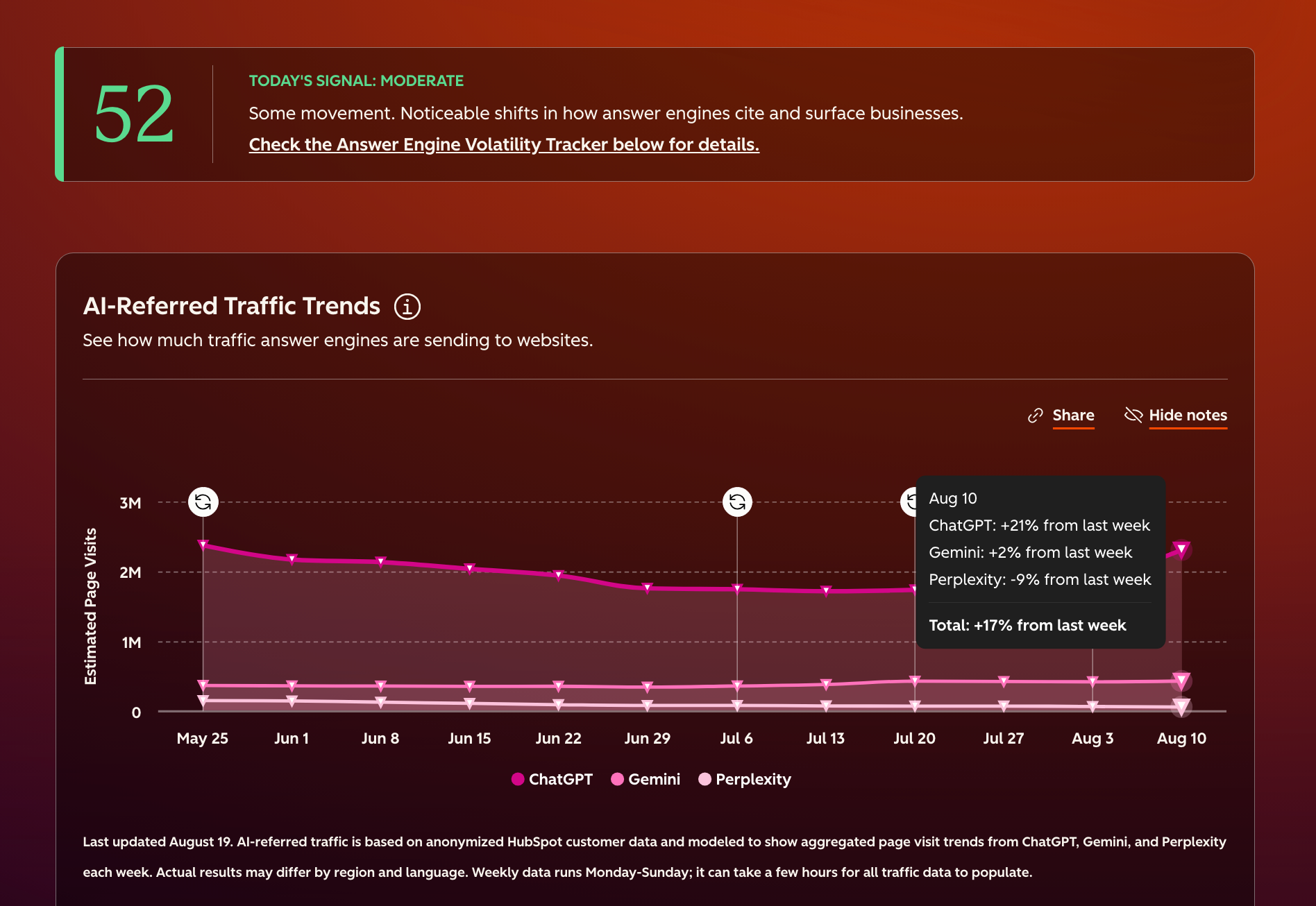
Use HubSpot AEO AI Search Sensor to monitor AI volatility and put short-term shifts into context. For example, ChatGPT-referred traffic increased 21% week over week following the model update, exactly the kind of movement that can accompany major changes to AI models and answer engines.
ChatGPT also appears to move more slowly in some of the brand visibility tracking we have done. That is another reason not to panic if Gemini or Perplexity improves before ChatGPT does.
Consensus takes time. History takes time. Trust takes time.
How to Use HubSpot AEO for Gemini Brand Visibility
Short answer: HubSpot AEO helps you track whether Gemini includes your brand for important prompts, while your optimization work should focus heavily on making sure Google clearly understands your company, entities, expertise, content, and relationships.
Gemini is different because Google has an asset other AI companies do not have at the same scale: decades of structured knowledge about the web.
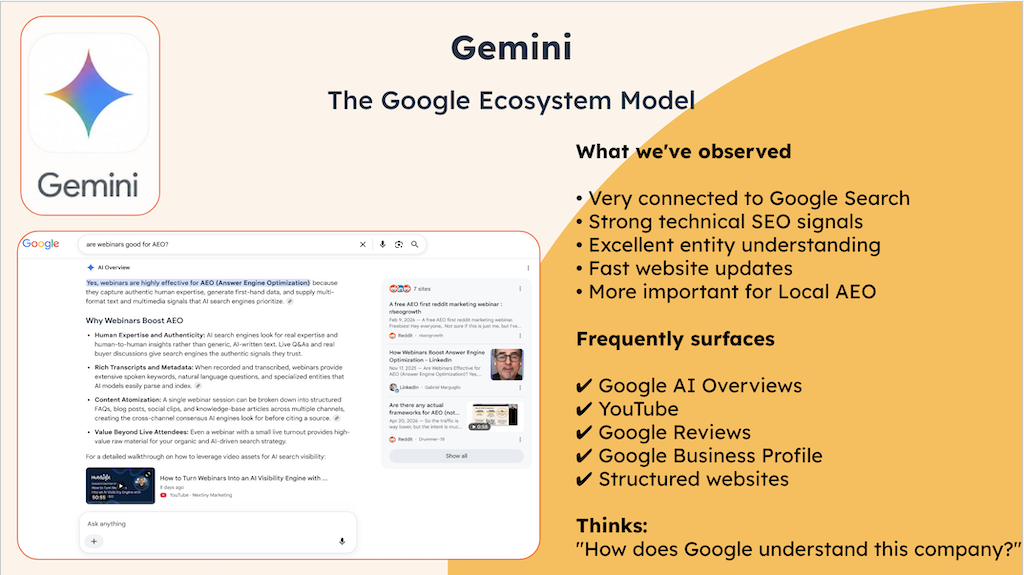
Google Search, the Knowledge Graph, YouTube, Google Business Profiles, reviews, Maps, structured data, and years of relationships between people, companies, products, locations, and topics all contribute to Google's understanding of entities.
So when I think about HubSpot AEO for Gemini, I start with one question:
How well does Google understand this company?
Our testing has shown Gemini to be especially connected to strong technical SEO signals, structured websites, entity understanding, Google AI Overviews, YouTube, Google Reviews, and Google Business Profile.
That brings some traditional SEO fundamentals directly into AEO.
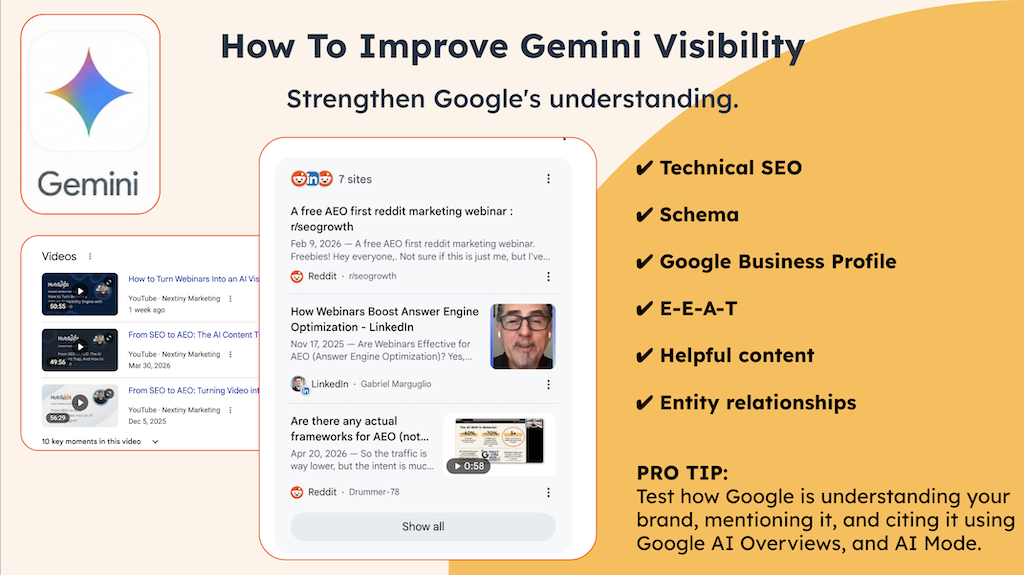
- Technical SEO.
- Schema.
- E-E-A-T.
- Entity relationships.
- Helpful content.
- YouTube.
Google Business Profile matters, especially for local businesses.
Schema is particularly important because it gives machines explicit information about what something is. This is an organization. This person is an author. This page contains an FAQ. This video belongs to this company. This office serves this location.
You are helping Google connect the dots.
Websites should be structured with schema because Google's systems depend on understanding entities and relationships, and making those relationships clear makes it easier for Google to understand and surface your content across AI experiences such as AI Overviews, AI Mode, and Gemini.
One of the best testing environments for this right now is Google AI Overviews. We have seen blogs, videos, and other new sources begin surfacing quickly enough that AI Overviews can become a useful feedback mechanism for testing whether Google understands the topic, author, company, and relationships you are trying to establish.
Ranking in Google and appearing in Gemini are not identical.
But if Google fundamentally misunderstands your company, you are making Gemini's job much harder.
How to Use HubSpot AEO for Perplexity Brand Visibility
Short answer: HubSpot AEO helps you track how often Perplexity includes your brand and which sources are supporting those answers, while your optimization strategy should emphasize fresh, useful, well-cited content that provides strong evidence.
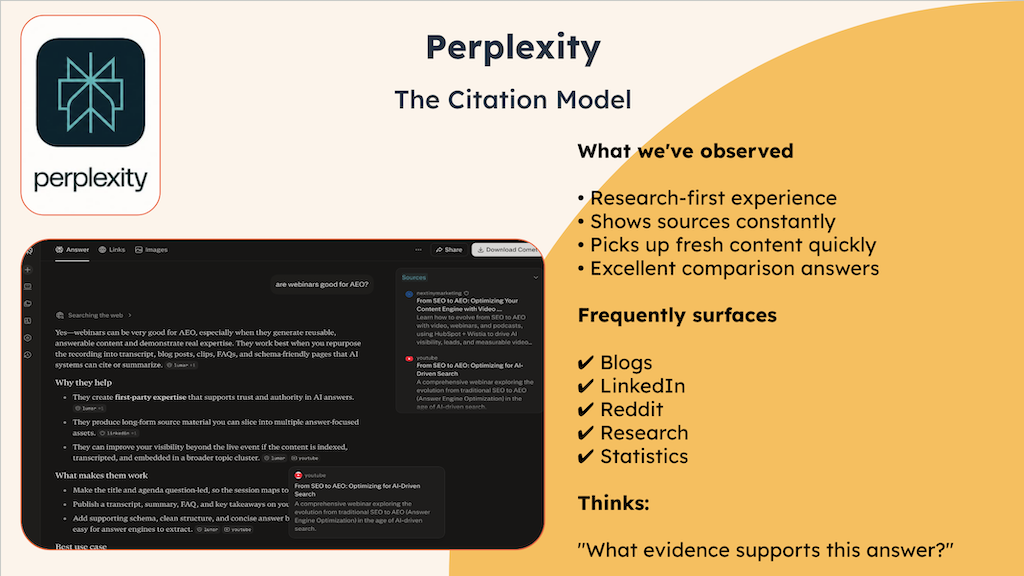
Perplexity behaves differently because citations are central to the user experience.
It feels more like a research engine.
That means it is constantly looking for sources it can confidently point to when building an answer. In our observations, Perplexity tends to reward fresher content, research, statistics, comparisons, LinkedIn, and other sources that provide direct support for the answer being generated.
In the webinar we talked about the distinction as live citations, fresh content, research, LinkedIn, and statistics.
That creates a great opportunity for companies with real expertise.
These all become very valuable:
- Original research.
- Statistics.
- Case studies.
- Comparison articles.
- White papers.
- Clear H2s that ask and answer buyer questions.
- Transparent sourcing.
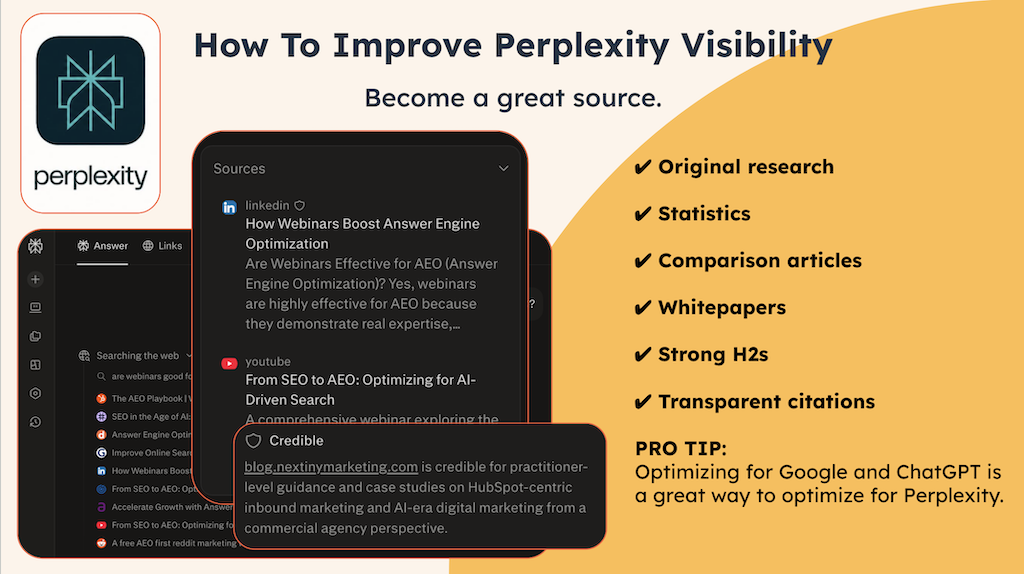
When we tested Perplexity around Nextiny, one of the most interesting things was not simply whether Nextiny appeared. It was how Perplexity described our content as a source. It recognized the practical guidance, case studies, HubSpot focus, and AEO work associated with the company.
That is exactly what we want.
And it did not happen because we wrote “Nextiny is an AEO expert” on our homepage.
The evidence exists across webinars, articles, experiments, videos, case studies, and social conversations. That is how you improve Perplexity brand visibility.
Become a source worth citing.
ChatGPT vs. Gemini vs. Perplexity for AEO
If you need the simplest possible comparison, this is how I would think about them:
|
AI Platform |
Core AEO Pattern |
Signals We Frequently See |
|
ChatGPT |
Consensus and historical reputation |
Reddit, reviews, directories, entities, long-term authority |
|
Gemini |
Google's understanding of your brand |
Technical SEO, E-E-A-T, YouTube, Google Business Profile, schema |
|
Perplexity |
Fresh evidence and live citations |
Research, recent content, statistics, LinkedIn, comparison content |
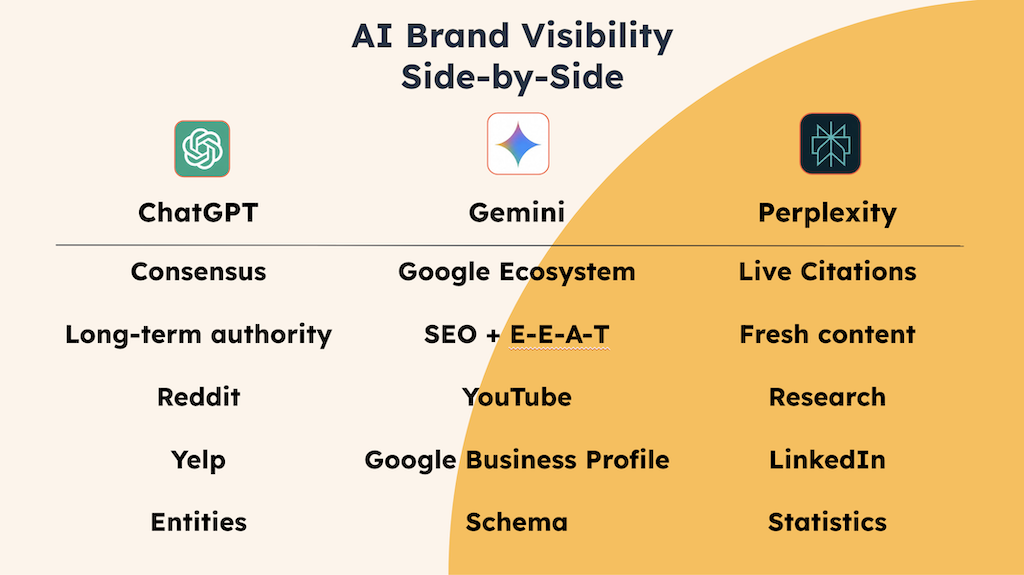
These are not isolated ecosystems. Strong entity work helps all three. Great videos can help all three. Reviews can reinforce trust everywhere. Research can influence multiple models.
The point is not to create a different company for every AI platform.
The point is to understand why your visibility may differ by platform and then strengthen the evidence each engine is missing.
The Goal Is Not Three AEO Strategies. It Is AI Consensus.
This is the most important lesson from the entire experiment.
If you leave this article thinking you need a ChatGPT strategy, Gemini strategy, Perplexity strategy, Claude strategy, Copilot strategy, and a new strategy every time another AI engine launches or there’s a LLM model update, we failed.
The real goal is AI consensus.
AI engines work differently, but they all look for credible and consistent signals. Human expertise, helpful answers, fresh content, real customer stories, strong entities, and consistent messaging strengthen that consensus. Generic AI content, duplicate pages, anonymous content, conflicting information, and AI-generated fluff weaken it.
Think about how you decide whether to trust somebody.
If I tell you I am an expert, that is a claim.
If you find a webinar where I teach the topic, an article explaining the methodology, a case study showing the results, a YouTube video demonstrating the process, customer feedback, LinkedIn conversations, and other people independently discussing the work, now you have evidence.
You are no longer trusting one webpage. You are trusting the consensus. AI is doing the same thing at a much larger scale.
The goal of AEO is to give every AI enough consistent evidence to reach the same conclusion about your brand.
That is the strategy.
Not All AI Brand Visibility Is Equal
AEO reporting becomes much more useful when you stop treating every appearance as a win.
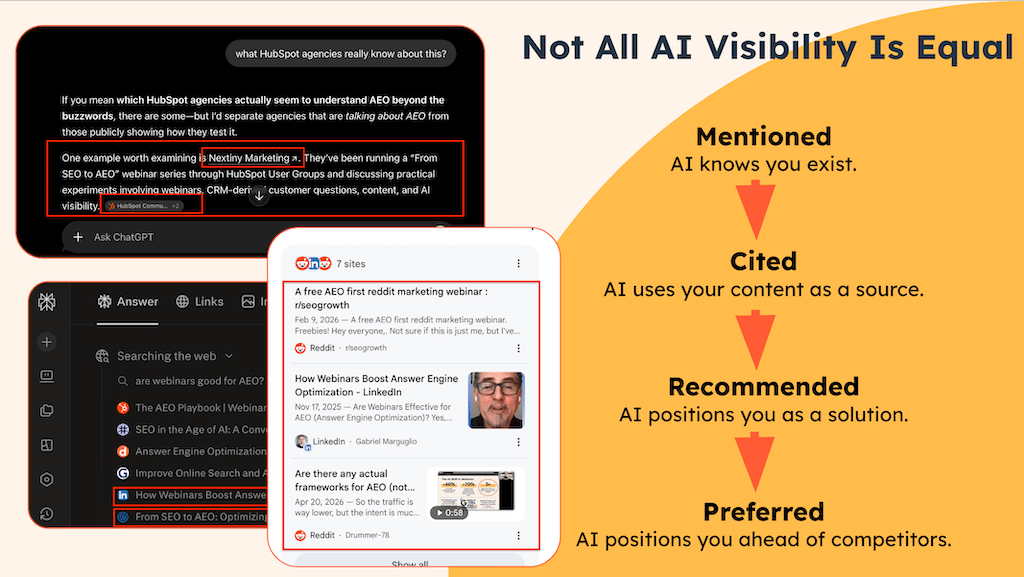
There are at least four levels of AI visibility:
- Mentioned: AI knows your brand exists.
- Cited: AI uses your content as a source.
- Recommended: AI positions your company as a credible solution.
- Preferred: AI positions your company ahead of competitors.
This is why sentiment matters just as much as visibility.
Your company could appear in every prompt while AI consistently describes a competitor as the better option.
That is not success.
The question is not: “Does ChatGPT mention us?”
It is: “When ChatGPT, Gemini, or Perplexity talks about us, what does it say, what evidence is it using, and does that help someone choose us?”
Don't Fall Into the AI Content Trap
Once marketers realize AI needs more evidence, the obvious temptation is to manufacture evidence at scale.
- Take 200 old articles.
- Run them through AI.
- Publish 500 new pages.
- Automate everything.
Please don't.
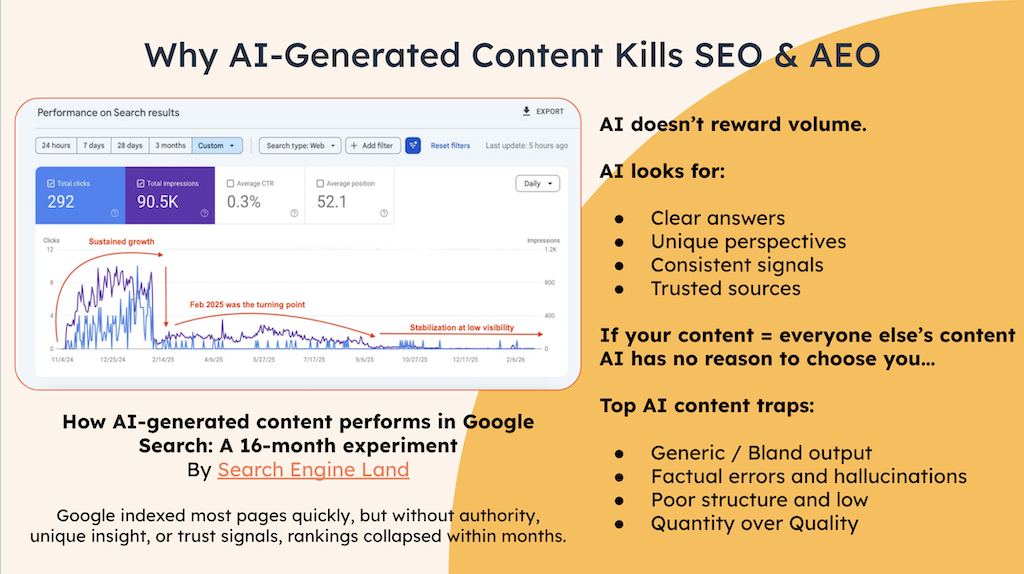
If ChatGPT can create your article itself, why would ChatGPT need your article as a trusted source?
AI needs something it does not already have.
- Your customer conversations.
- Your experience.
- Your data.
- Your opinions.
- Your experiments.
- Your case studies.
- Your mistakes.
- Your expertise.
That does not mean AI cannot help you write. AI helps us create almost everything we publish at Nextiny.
The important distinction is where the source material comes from.
A webinar transcript contains human expertise. A sales call contains real objections. A customer conversation contains actual buyer questions. A project review contains lessons learned in the real world.
AI can take that source material and help turn it into an article.
That is very different from asking AI to invent expertise from scratch.
Related Article: The AI Content Trap: Why Most AI Content Fails (And How to Win in SEO + AEO)
The Human-to-Answer™ Framework Creates AI Consensus
This is exactly why we created the Human-to-Answer™ Framework.
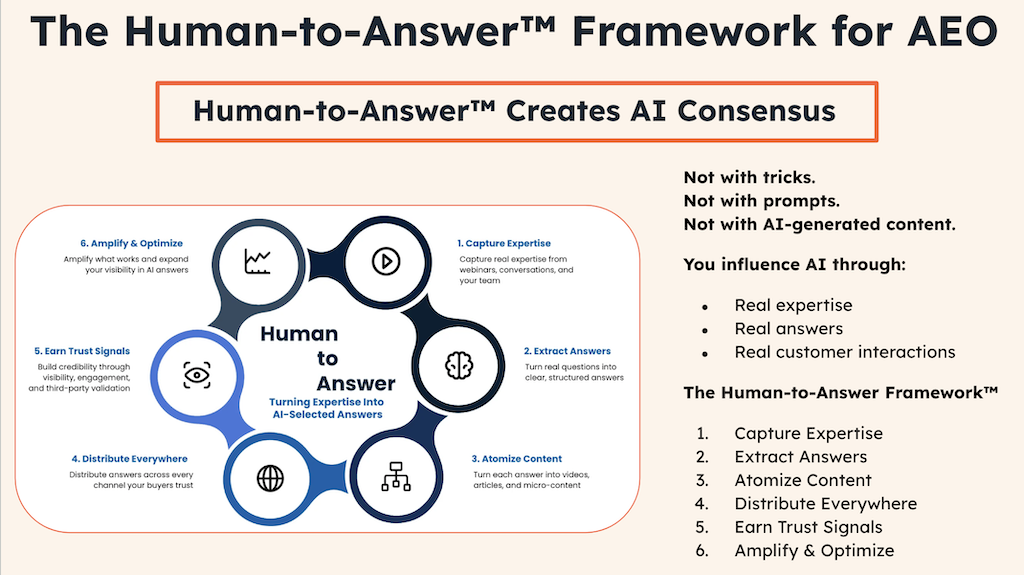
The framework is not designed to help businesses create more content for the sake of volume. It is designed to turn expertise your company already has into the evidence AI needs to understand and trust you.
The six steps are:
- Capture Expertise from webinars, conversations, meetings, customer questions, training, and real experiences.
- Extract Answers from the questions your buyers actually ask.
- Atomize Content into articles, videos, FAQs, social posts, comparisons, and other useful formats.
- Distribute Everywhere across your website, YouTube, LinkedIn, email, communities, and other relevant channels.
- Earn Trust Signals through citations, reviews, mentions, discussions, and external validation.
- Amplify & Optimize by measuring what AI is learning and improving the loop.
Our webinar summarized it simply: AI consensus does not come from tricks, prompts, or generic AI-generated content. It comes from real expertise, real answers, and real customer interactions.
Your best AEO content is probably already sitting somewhere inside your company.
The question is whether AI can find it.
Related Article: The Human to Answer Framework: How to Build an AEO Content Engine in HubSpot
How to Improve AI Visibility Across ChatGPT, Gemini, and Perplexity
If I were starting today, I would not begin by creating another 20 blog articles. I would start by understanding what AI already believes.
Test the questions your buyers actually ask. Test branded prompts. Compare yourself with competitors. Look at citations. Identify outdated information. Find the sources AI trusts. Determine where the story is inconsistent or weak.
Then strengthen the fundamentals: technical SEO, schema, entities, About pages, author pages, Google Business Profile where relevant, and content that clearly explains who you are, what you do, and who you help.
- Then create real content.
- Turn sales questions into articles.
- Turn webinars into videos and blogs.
- Publish customer stories.
- Share original research.
- Answer objections.
- Create comparisons.
- Distribute those answers beyond your website.
- Then measure what changes.
Our AEO checklist includes fixing the SEO foundation, implementing schema, structuring content around questions and answers, defining entities, creating real content, distributing it across channels, building citations, testing prompts, identifying gaps, using HubSpot AEO recommendations, repurposing content, tracking changes, keeping content fresh, aligning with sales, and turning the entire system into a loop rather than a one-time campaign.
That is how you improve HubSpot AEO for ChatGPT.Gemini and, Perplexity. And more importantly, that is how you build something that can survive whatever AI platform comes next.
Related Article: How to Run an AEO Audit: See How AI Understands Your Company
Frequently Asked Questions About HubSpot AEO
Can HubSpot AEO track ChatGPT brand visibility?
Yes. HubSpot AEO can measure whether your brand appears across relevant prompts evaluated on platforms including ChatGPT and lets you examine prompt-level visibility, competitor performance, citations, and changes over time.
Can HubSpot AEO track Gemini brand visibility?
Yes. HubSpot AEO can be used to monitor your visibility across Gemini-related prompts and compare how that visibility differs from other AI engines. For Gemini specifically, our testing suggests marketers should pay particular attention to Google's understanding of entities, technical SEO, schema, YouTube, Google Reviews, and Google Business Profile.
Can HubSpot AEO track Perplexity brand visibility?
Yes. HubSpot AEO can help track your brand's appearance across Perplexity prompts and identify sources contributing to AI answers. For Perplexity, fresh content, credible citations, research, statistics, and strong source material appear especially important in our observations.
Is AEO different for ChatGPT, Gemini, and Perplexity?
Yes. Based on our testing, ChatGPT tends to emphasize broad consensus and history, Gemini aligns closely with Google's ecosystem and entity understanding, and Perplexity places more emphasis on current, well-cited evidence. However, all three reward credible, consistent signals across the web.
Which AI platform is easiest to influence with AEO?
There is no universal answer because visibility varies by company, topic, and prompt. In our testing, different engines can respond at different speeds, which is why the best strategy is not to optimize for one platform exclusively. Build enough credible evidence that every engine has a reason to trust your brand.
How do you improve brand visibility across multiple AI platforms?
Focus on AI consensus: clear entities, strong technical foundations, real human expertise, useful answers, videos, reviews, citations, fresh content, external mentions, and consistent messaging across multiple channels. Then use HubSpot AEO to track where the models disagree and prioritize the gaps.
The Future of AEO Is Not About Hacking AI
ChatGPT, Gemini, and Perplexity are different.
- ChatGPT appears to ask: What does the internet generally believe about this company?
- Gemini appears to ask: How does Google understand this company?
- Perplexity appears to ask: What evidence supports this answer right now?
But underneath those differences, they are all trying to solve the same problem:
What can I trust enough to tell a human?
That is why the future of AEO belongs to companies that build real expertise, answer real questions, create useful content, make their entities clear, publish across multiple channels, earn reviews and mentions, and continually measure how AI interprets those signals.
Humans helping humans.
That is still the strategy. AI has simply become another human's way of finding the answer.
And if ChatGPT, Gemini, Perplexity, Google, your customers, and your industry repeatedly reach the same conclusion about who you are and why you are valuable, you do not need to hack an algorithm.
You have built something much harder to copy.
You have built consensus.