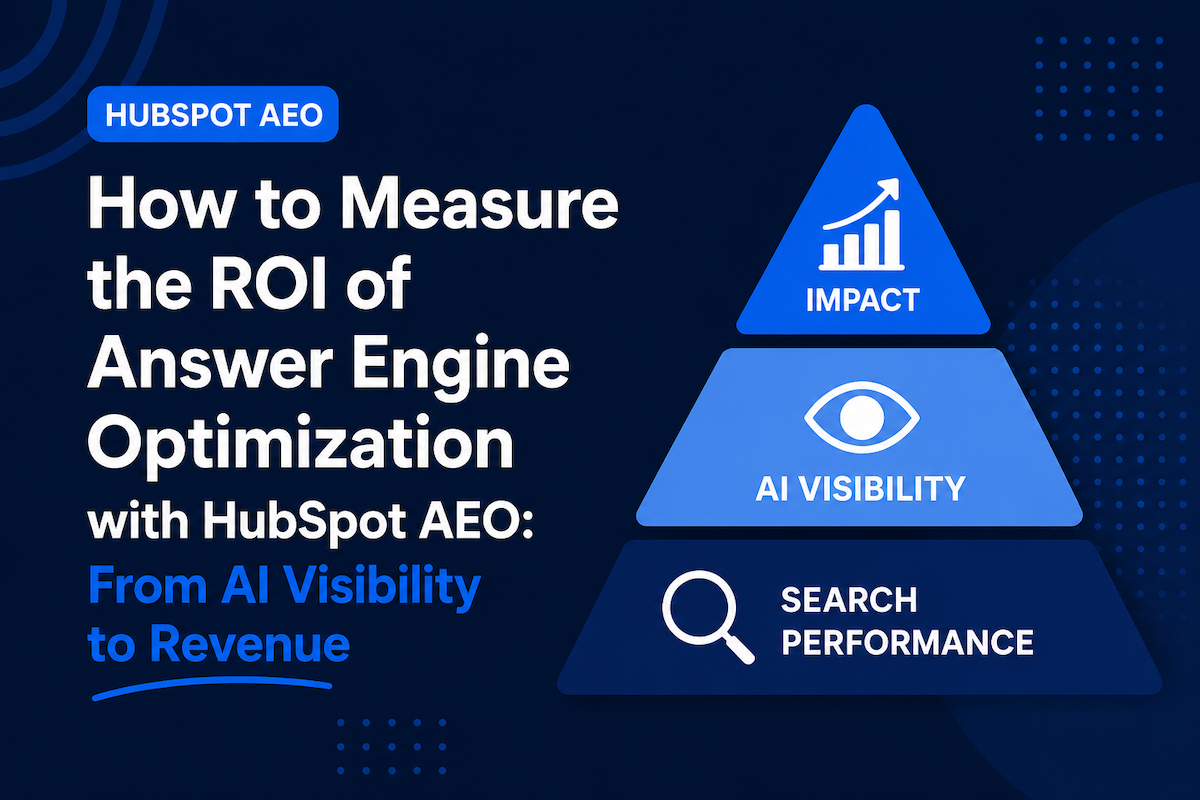
AI search is changing how buyers discover, compare, validate, and choose companies. But most marketing teams are still trying to measure that new buyer journey with the same metrics they have used for traditional SEO: rankings, traffic, clicks, and form submissions.
Those metrics still matter. They just don’t tell the whole story anymore. A buyer can discover your company in Google AI Overviews, ask ChatGPT to compare you with three competitors, use Perplexity to validate your expertise, and then call your sales team directly. They may never click the link or visit the page that originally influenced their decision.
That doesn’t mean marketing stopped working. It means the old measurement model can no longer capture the entire buyer journey. So the question is no longer simply, “How much traffic did this content generate?” The better question is: “How much visibility, influence, pipeline, and revenue did this content help create?”
That is the measurement problem we explored in our recent HubSpot User Group webinar, How to Measure AEO Success: From AI Visibility to Leads and Revenue
And the framework is simpler than it might sound.
To measure Answer Engine Optimization (AEO) effectively, marketers need to connect three layers:
- Search performance
- AI visibility
- Business impact
Search tells you whether you can be found. AI visibility tells you whether you are part of the answer. Business impact tells you whether any of it is actually helping grow the company.
That is the foundation for measuring AEO success, and for turning HubSpot AEO from another marketing dashboard into a tool for understanding and improving how AI influences your pipeline.
Why Traditional Marketing Metrics Aren’t Enough for AEO
Traditional SEO and marketing metrics measure clicks and conversions well, but they struggle to measure the influence AI has before a buyer ever reaches your website. That creates a major blind spot as more discovery, research, comparison, and validation happens inside AI platforms.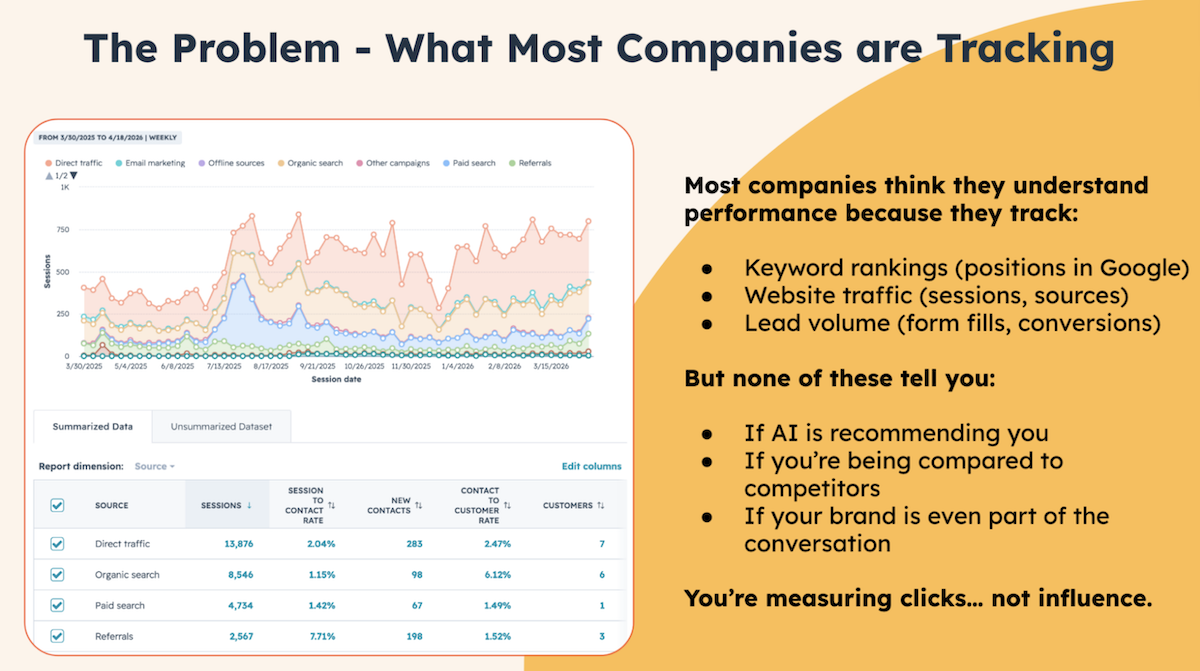
Most companies already track keyword rankings, organic traffic, website sessions, traffic sources, lead volume, form submissions, conversion rates, pipeline, and revenue. Keep tracking all of them.
The problem is that none of those metrics alone tells you whether ChatGPT is recommending you, whether Gemini understands what your company actually does, whether Perplexity is citing your content, or whether AI is consistently positioning a competitor ahead of you.
In other words, you may be measuring clicks while missing influence entirely.
AI Now Influences More Than Discovery
Think about how someone actually buys today. A buyer might ask AI to understand a problem before they even know your category exists. Then they can ask about possible solutions, compare vendors, evaluate trade-offs, resolve objections, and eventually make a decision.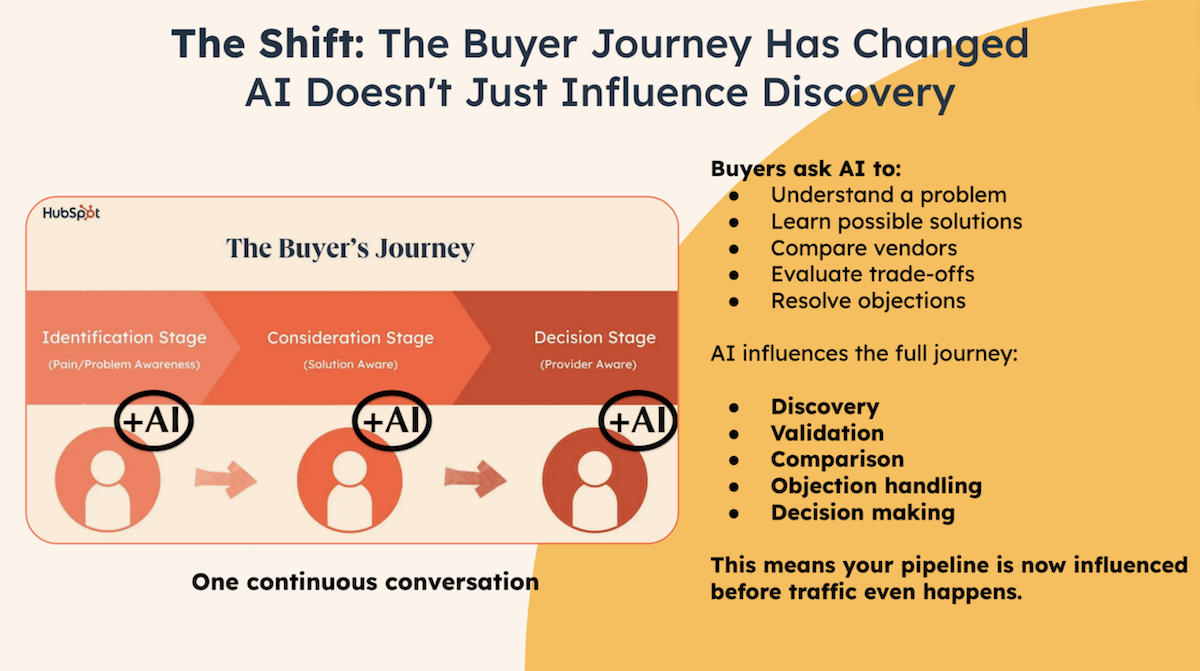
AI can now influence the buyer across: Discovery → Validation → Comparison → Objection Handling → Decision
That means your pipeline can be influenced before a website session ever occurs.
If ChatGPT recommends your company and the buyer later Googles your brand name, Google may get credit for the visit. If someone sees your company cited in an AI Overview and calls the phone number on your Google Business Profile, there may be no AI referral at all.
And if a prospect already talking to sales asks Gemini to compare you with a competitor and then replies to the salesperson’s email, AI may have materially influenced the deal without appearing anywhere in traditional attribution
This is why AI visibility is not just another traffic source. It is a layer of influence across the buyer journey.
The AEO Measurement Framework: Search Performance + AI Visibility + Business Impact
The simplest way to measure AEO success is to use a three-layer framework: search performance at the foundation, AI visibility in the middle, and business impact at the top. Looking at all three together prevents marketers from drawing the wrong conclusion from any single metric.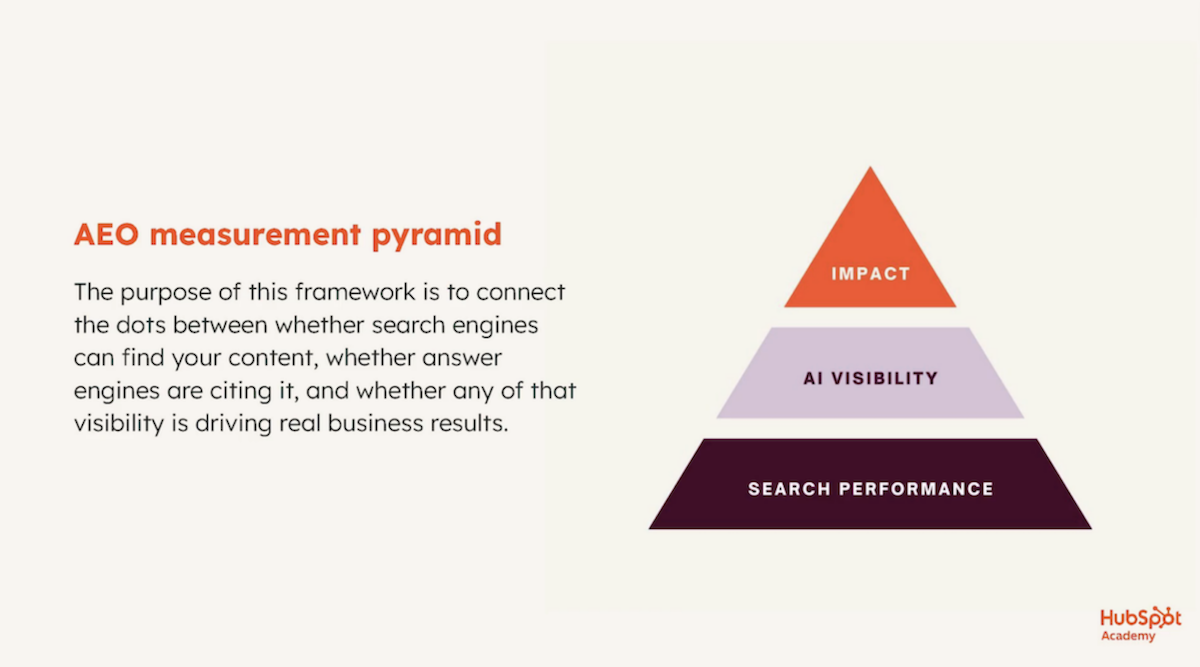
HubSpot Academy created an AEO measurement pyramid to solve for this. Its purpose is to determine whether search engines can find your content, whether answer engines are citing it, and whether that visibility is producing real business results.
At the foundation, Search Performance asks whether search engines can find and understand your content. The second layer, AI Visibility, asks whether answer engines are finding, mentioning, citing, and accurately describing your brand.
Finally, Business Impact asks whether your search and AI visibility are translating into leads, opportunities, pipeline, customers, and revenue.
This matters because each layer can move independently. You could lose organic traffic while increasing AI visibility and revenue. You could gain hundreds of AI mentions without generating a qualified lead.
You could rank extremely well in Google while ChatGPT consistently recommends competitors. Or you could receive very little AI referral traffic while AI is quietly influencing branded search and direct conversions.
No single metric can tell you whether your AEO strategy is working. You need the full pyramid.
1. Measure Search Performance: SEO Is Still the Foundation of AEO
AEO does not replace SEO. Strong search performance remains the foundation because AI systems need to discover, crawl, understand, and trust the information surrounding your brand.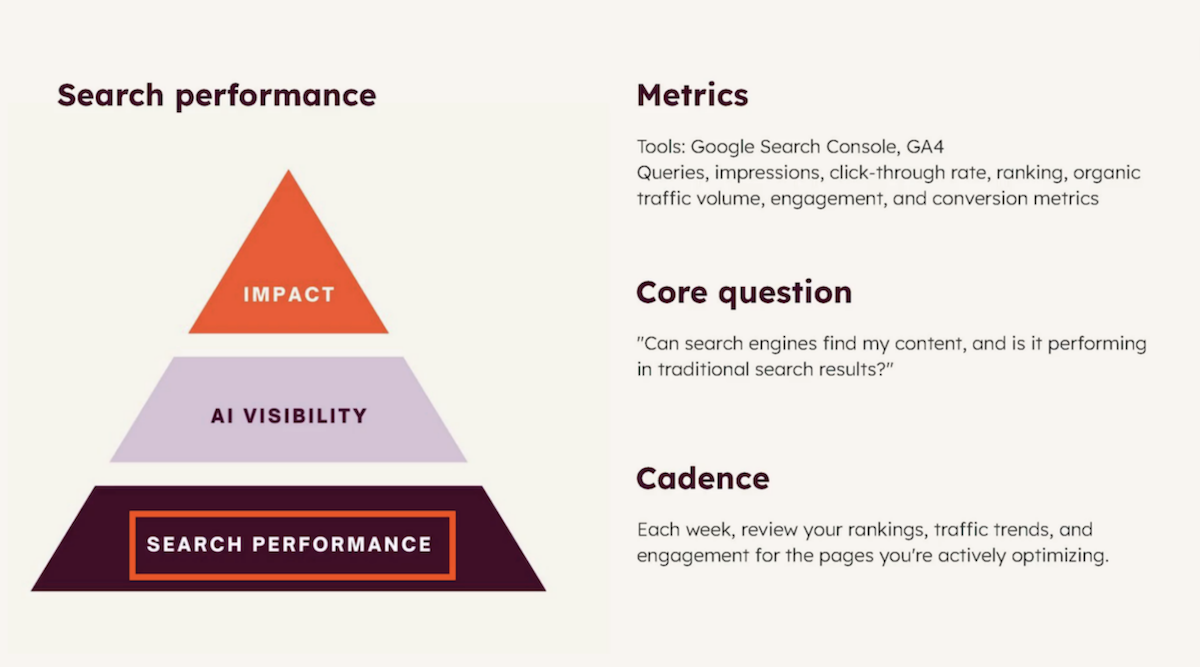
This is one of the biggest misconceptions I see around AEO. People hear “AI search” and assume traditional SEO suddenly doesn’t matter.
It does.
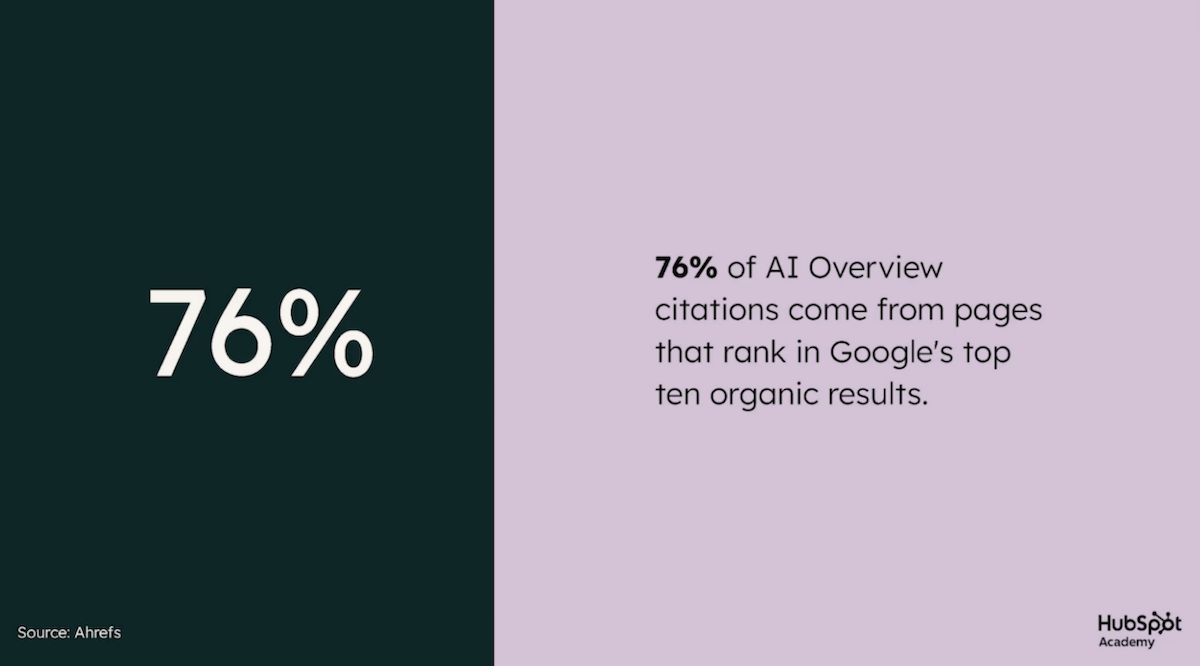
HubSpot Academy shared in their AEO Certification that 76% of AI Overview citations come from pages ranking in Google’s top ten organic results.
Source Article: 76% of AI Overview Citations Pull From the Top 10
That doesn’t mean “rank first and AI will cite you.” AEO is much more complicated than that. But throwing away twenty years of SEO best practices because ChatGPT exists would be a mistake.
If your website is technically broken, your pages are slow, your content is thin, your internal linking is poor, and Google struggles to understand your company, you are starting your AEO strategy at a disadvantage.
Continue measuring rankings, impressions, click-through rates, organic traffic, search queries, branded search, website performance, technical SEO, internal linking, backlinks, citations, engagement, and conversion metrics. Google Search Console, Google Analytics, and HubSpot remain important parts of the measurement stack.
The difference is that we no longer stop there. Before you can understand whether AI visibility is changing your outcomes, you need a clear picture of your baseline search performance.
2. Measure AI Brand Visibility: Are You Actually Part of the Answer?
AI brand visibility measures whether your company appears when buyers ask relevant questions in AI platforms—and how those systems describe, cite, compare, and recommend you.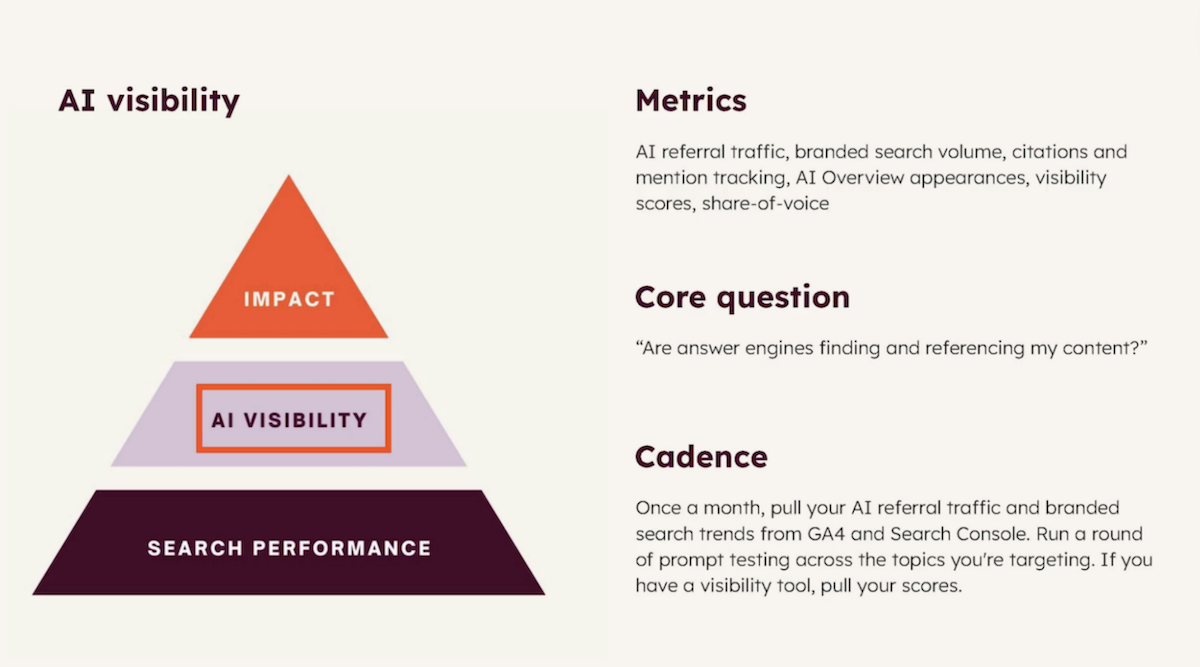
This is where AEO measurement becomes very different from SEO. In SEO, we have historically asked, “Where do we rank for this keyword?” In AEO, the more interesting question is:
“When our ideal buyer asks this question, does AI understand and recommend us?”
That requires looking beyond rankings. We have identified metrics such as AI referral traffic, branded search volume, citation and mention tracking, AI Overview appearances, visibility scores, and share of voice as important indicators of AI visibility.
But before you automate that measurement, I recommend understanding the problem manually.
How to Test Your AI Visibility Manually
A manual AEO audit involves asking real buyer questions across multiple AI models and recording how your brand appears, how it is described, which competitors appear with it, and which sources influence the answer.
This is one of the most useful exercises you can do before getting lost in dashboards. Don’t just ask ChatGPT, “What do you know about my company?” Test questions that resemble actual buying behavior:
- “Best [your category] companies”
- “Top providers for [specific problem]”
- “Compare [your company] vs. [competitor]”
- “What do you know about [your company]?”
- “What does [your company] do?”
Then run similar prompts across multiple platforms, including ChatGPT, Gemini, Perplexity, Claude, Copilot, and Grok. We recommend testing across models rather than assuming one engine represents the entire AI ecosystem.
For every prompt, record whether your brand appears, how prominently it appears, which competitors show up alongside you, how your brand is described, and which sources are referenced. That becomes your AI visibility map.
But presence alone isn’t enough.
When we manually test Nextiny Marketing and the entities associated with our company, we aren’t simply checking whether the name “Nextiny” appears. We’re evaluating accuracy—is AI describing us correctly?
Clarity—does AI understand our value? Differentiation—does the answer explain what makes us different? And completeness—are important services, expertise, or capabilities missing?
That is closer to measuring market perception than measuring rankings. AI doesn’t simply rank ten blue links; it synthesizes answers from patterns across multiple sources.
And sometimes those sources can surprise you.
Old Content Can Still Shape What AI Says About Your Brand
AI systems can use outdated blogs, old YouTube videos, Reddit discussions, LinkedIn posts, directories, reviews, and third-party websites to form an understanding of your company.
This is one of the more uncomfortable things we find during AEO audits. Companies assume their newest website messaging represents their brand online. AI may disagree.
In one of the examples from our webinar, we found multiple AI models drawing from old content, including outdated blogs, older YouTube videos, Reddit discussions, and LinkedIn posts.
That creates a real business risk. If AI doesn’t mention your company, describes it generically or incorrectly, or consistently positions competitors as stronger options, your pipeline can be influenced before your sales or marketing teams ever get an opportunity to correct the narrative.
And AI doesn’t rely on one source. Your website matters, but so do your blog, videos, social channels, reviews, communities, directories, and third-party mentions.
This is why AEO is fundamentally a multi-channel strategy. AI builds answers from signals across the internet, and your job is to create enough accurate, credible, consistent evidence that those systems can understand what you actually want to be known for.
3. Use HubSpot AEO to Measure AI Brand Visibility at Scale
HubSpot AEO helps marketers move from occasional manual testing to systematic measurement of brand visibility, sentiment, prompts, competitors, citations, and optimization opportunities across AI search.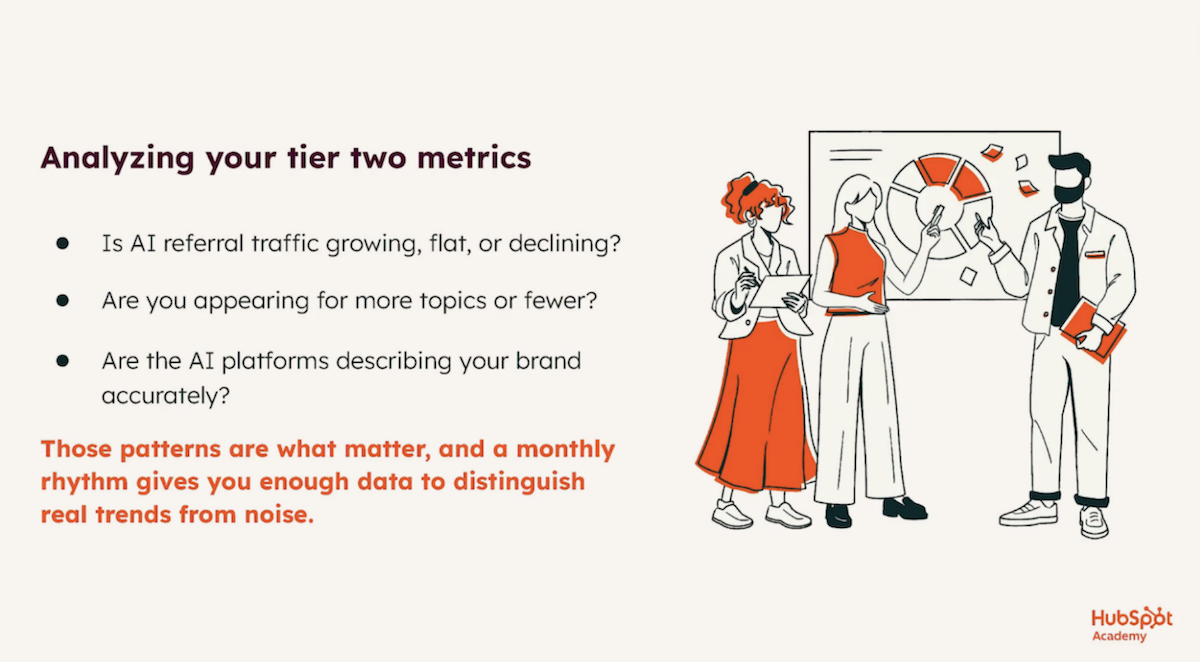
Manual testing is essential because it helps you understand what you’re actually measuring, but it doesn’t scale. You don’t want your AEO reporting process to consist of someone opening ChatGPT once a month, running five prompts, taking screenshots, and declaring victory.
AI answers are probabilistic. The same prompt can produce different responses at different times, and different AI models can understand the same company differently. HubSpot AEO gives marketers a way to move from individual observations to patterns.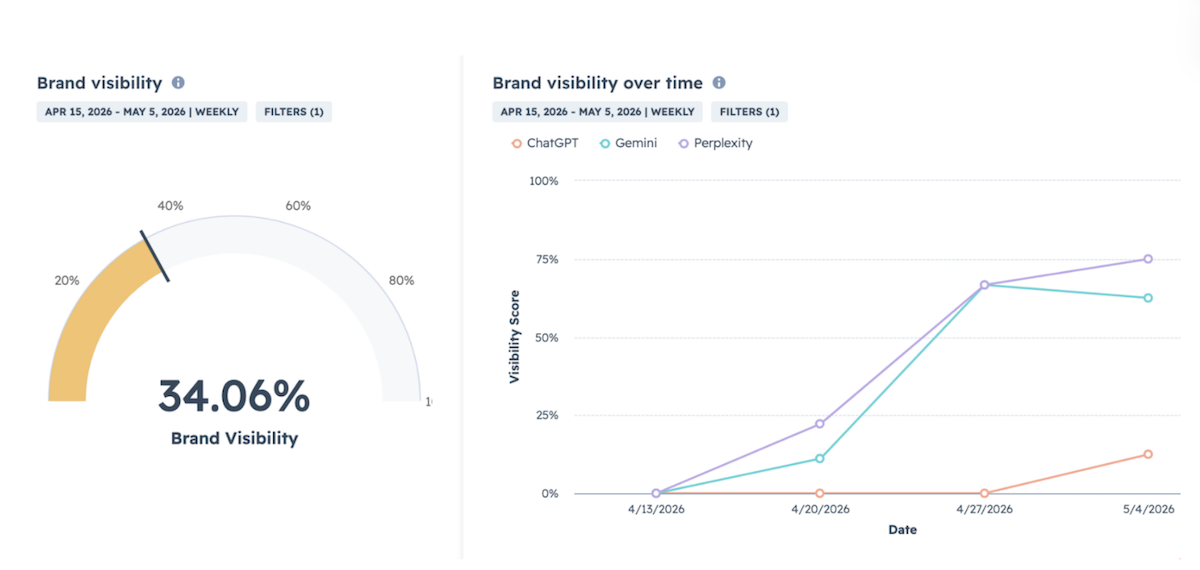
What Is HubSpot’s AI Brand Visibility Score?
HubSpot’s Brand Visibility Score measures the percentage of relevant prompts in which your brand appears across AI platforms such as ChatGPT, Gemini, and Perplexity.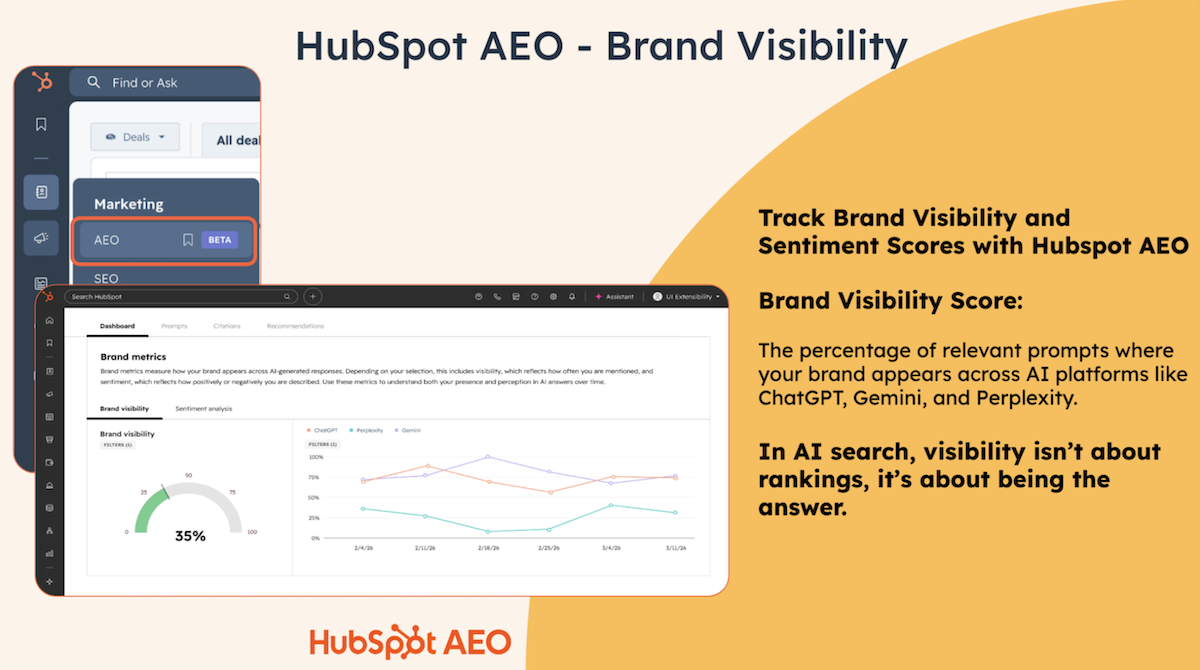
The key word is prompts. AI search isn’t really about tracking another list of keywords; it’s about tracking the questions your customers are asking.
HubSpot AEO can show visibility at the individual prompt level, allowing you to see whether your company appears for specific buyer questions rather than relying only on an aggregate score.
That makes the measurement much more useful because a visibility score can tell you whether something changed. A prompt can tell you where and why it matters.
HubSpot AEO Prompts Connect Visibility to Buyer Intent
HubSpot AEO prompts represent questions buyers may ask AI systems, allowing marketers to measure visibility around actual intent rather than treating AEO as traditional keyword tracking.
Prompts can be suggested from your CRM data, helping them reflect questions relevant to your actual buyers.
When you click into an individual prompt, you can compare your visibility with competitors, monitor how positioning changes over time, identify which channels are producing citations, find weaknesses in your visibility, and get recommended actions for improvement.
This is one of the biggest conceptual shifts from SEO measurement. A keyword tells you where a page ranks. A buyer prompt tells you whether AI considers your company part of the solution.
Mentions, Citations, and Sentiment Are Not the Same Thing
Not all AI visibility is valuable. A mention tells you that AI knows your company exists, a citation shows that AI is using a source as evidence, and sentiment tells you how positively or negatively your brand is being represented.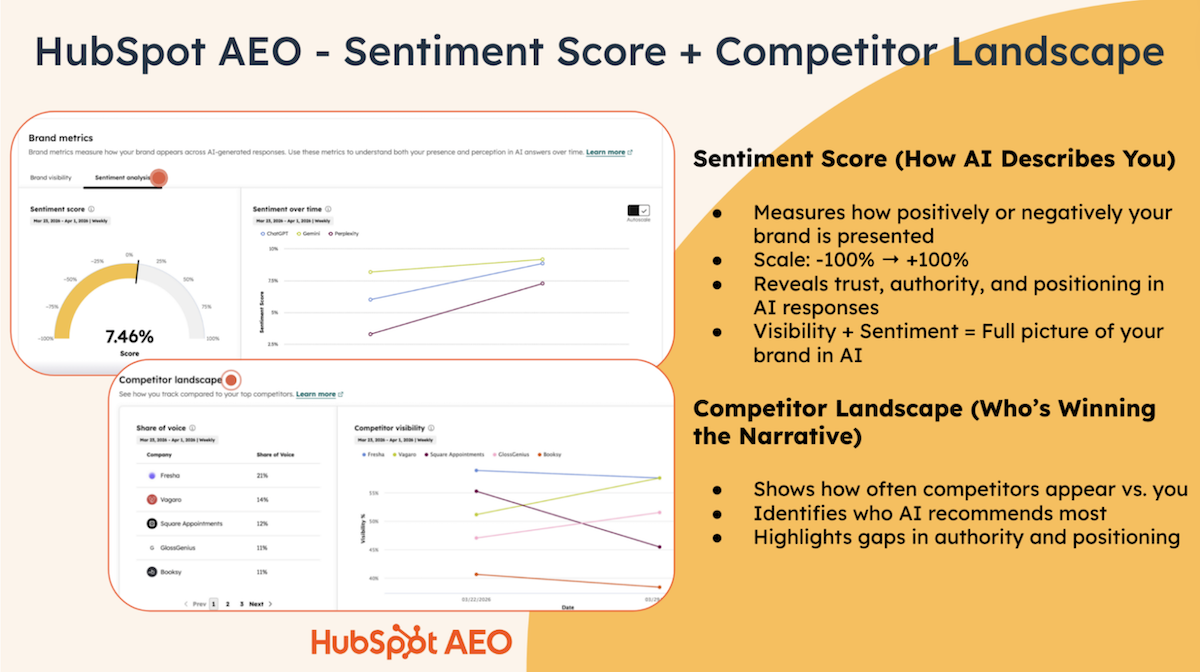
Imagine ChatGPT includes your company in an answer about the best providers in your category. Great. But then imagine the answer describes you as expensive, outdated, or appropriate only for small companies while presenting your competitor as the better choice for the buyer asking the question.
You got the mention, but commercially, you lost.
That is why HubSpot AEO’s sentiment measurement is important. Sentiment Score is a way of measuring how positively or negatively AI presents the brand, using a scale from -100% to +100%. Combined with visibility, it gives marketers a more complete picture of their AI positioning.
HubSpot’s competitor landscape adds another dimension by showing how often competitors appear relative to you, who AI recommends, and where you may have authority or positioning gaps.
So don’t just ask, “Are we visible?”
Ask, “What does AI believe about us when we are visible?”
Citations Show You What AI Actually Trusts
AI citations reveal the specific sources answer engines are using to support their responses, giving marketers clues about which content, channels, and third-party sources are influencing brand visibility.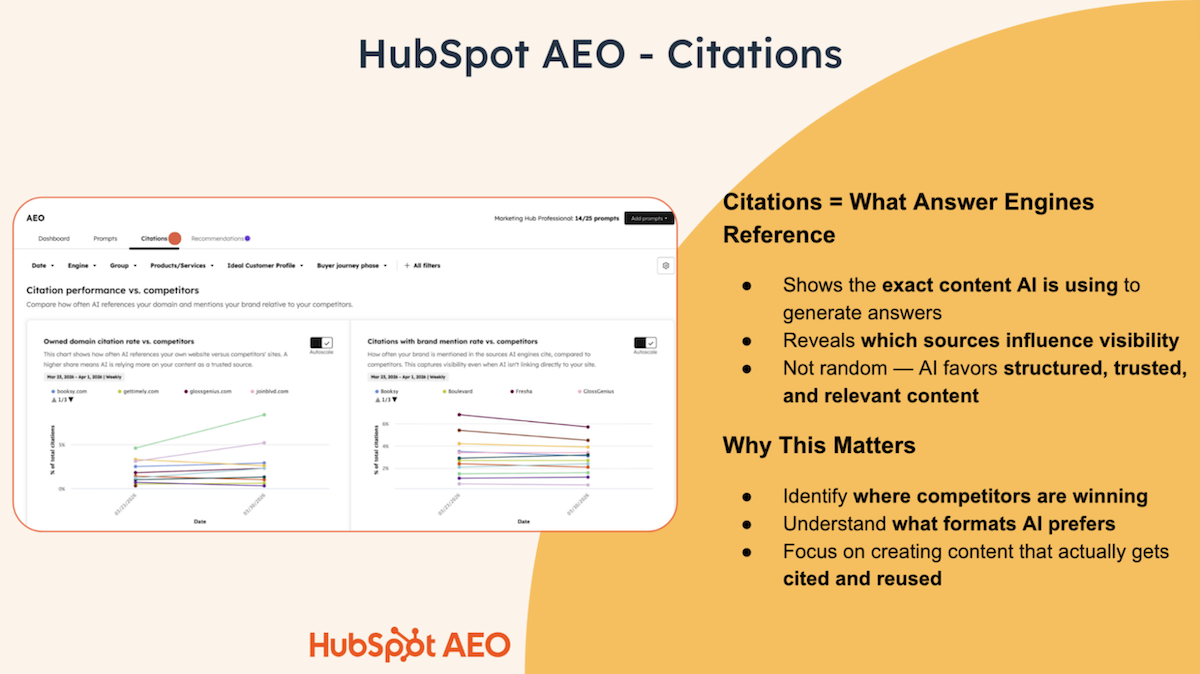
This is where AEO gets really interesting. When you inspect citations, you’re not just measuring an outcome; you’re getting clues about why the outcome exists.
HubSpot AEO can help identify the content being referenced in AI answers and reveal which sources are influencing visibility. That can help you understand where competitors are winning, which formats are being surfaced, and what kinds of content you should strengthen or create.
If a competitor is consistently winning a prompt, inspect the evidence supporting that recommendation. Is AI citing their website, research, comparison pages, videos, reviews, Reddit discussions, directories, industry publications, or LinkedIn content? Then compare that evidence with your own.
That’s much more actionable than staring at a visibility score.
Use HubSpot AEO Recommendations to Turn Gaps Into Content
HubSpot AEO can turn visibility gaps into content recommendations, giving marketers specific opportunities to create or improve content and then measure whether those changes affect AI citations and visibility.
This is where the tool starts becoming more than a reporting dashboard. The workflow is straightforward:
Find a gap → Create or improve content → Publish → Add the URL into AEO → Measure citations and visibility → Learn → Improve again
HubSpot’s recommendations can identify missing content and suggest topics to create, including a proposed title, summary, and explanation of why the content opportunity exists. After publishing, you can add the URL back into the AEO workflow and monitor whether it begins earning citations and improving visibility.
That’s the loop marketers should be trying to create. AEO measurement shouldn’t end with a monthly report. Measurement should tell you what to do next.
Related Case Study: HubSpot AEO Case Study: How We Increased AI Brand Visibility in Weeks using the Human-to-Answer™ Framework
4. Measure Business Impact: How Do You Measure AEO ROI?
To measure AEO ROI, connect changes in AI visibility with referral traffic, branded search, conversions, leads, opportunities, pipeline, customers, and revenue—while accepting that AI influence will not always produce a directly attributable click.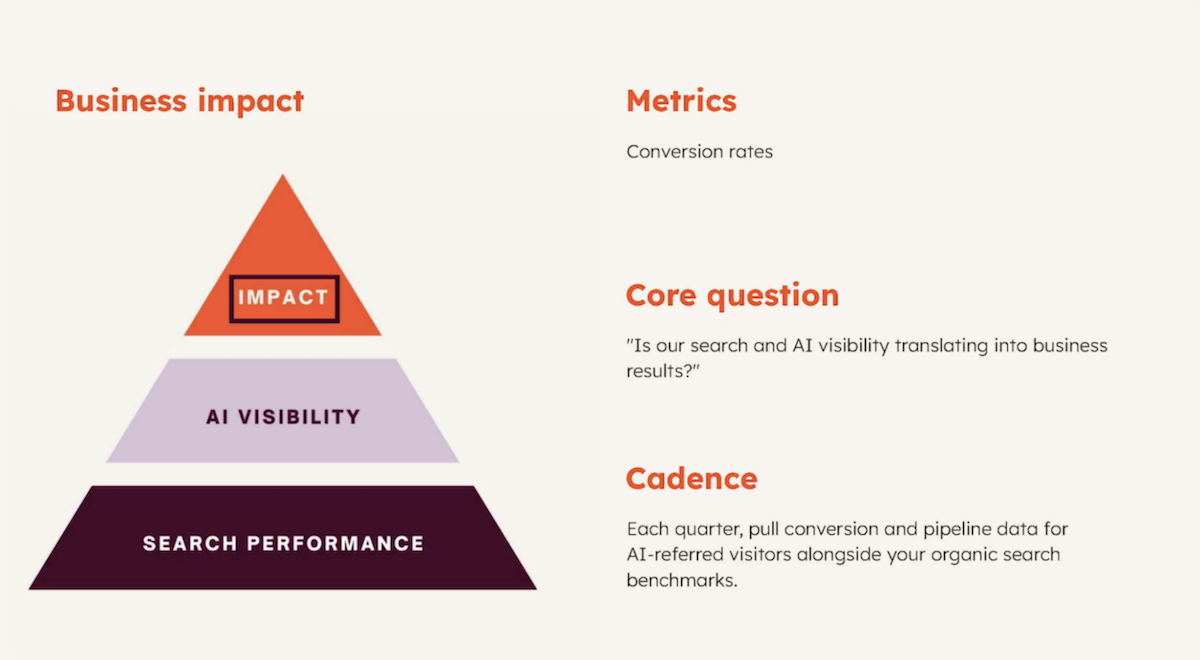
Eventually, somebody in the company is going to ask the question that matters most: Did this generate business?
Visibility, citations, and sentiment are all useful signals, but none of them pays the bills by itself. The top of the AEO measurement pyramid is business impact, which means connecting AI visibility with the CRM metrics you already care about: AI referral traffic, lead generation, conversion rates, opportunity creation, pipeline, close rates, customers, and revenue.
There is an important caveat, though: you will never perfectly attribute every AI-influenced sale. That isn’t really a HubSpot problem. It’s a buyer journey problem.
AI Influence Will Not Always Show Up as AI Referral Traffic
AI referral traffic captures only the buyers who actually click from an AI platform to your website; it cannot capture every buyer who was influenced by AI and converted through another channel.
Suppose someone discovers Nextiny through ChatGPT but, instead of clicking a citation, Googles our name the next day and visits the site through branded organic search. Google will probably get the attribution. Or perhaps they use Perplexity to compare agencies and then navigate directly to our website, giving direct traffic the credit.
The attribution becomes even harder when sales is already involved. A prospect might ask Gemini, “Compare Nextiny with [competitor] for a HubSpot implementation,” then return to the salesperson’s email and schedule the next meeting. There may be no trackable AI website session at all, even though AI influenced the deal.
Modern AEO measurement therefore needs to combine attribution with influence. Look at AI referral traffic, branded search growth, direct traffic, sales feedback, self-reported attribution, closed-deal interviews, and CRM source data. And start asking customers directly: “Did you use ChatGPT, Gemini, Perplexity, Google AI, or another AI tool while researching us?”
Digital marketing spent years convincing us that if we couldn’t attribute something to a click, it didn’t happen. AI is exposing how incomplete that assumption always was.
AI Referral Traffic May Be Small, but Look at the Conversion Quality
AI referral traffic can be dramatically smaller than organic search traffic while still producing meaningful business results because some AI visitors arrive later in the research and evaluation process.
One of the most interesting examples we have seen in HubSpot portals shows how Organic search generated 4000 visits, 42 leads and 1 client, while in the same period AI referral sources generated 90 visits, 2 leads and also 1 client.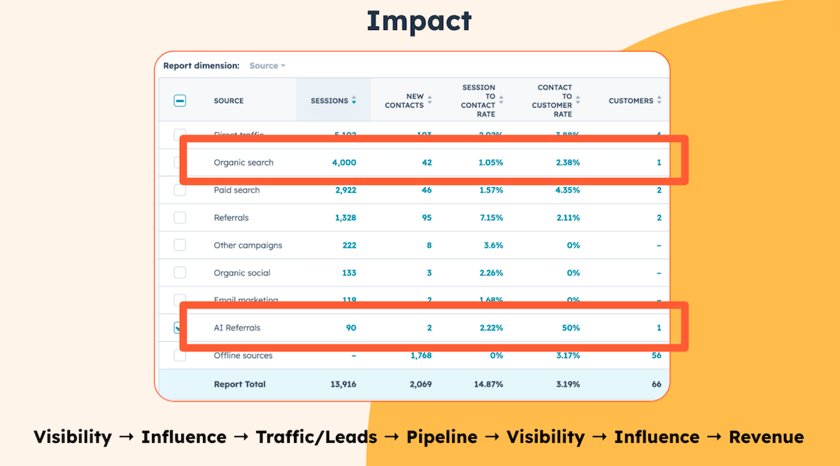
The organic channel generated thousands more visits, yet both produced one customer in the example.
That doesn’t mean every business should expect AI traffic to convert like this, and it certainly doesn’t mean organic search suddenly doesn’t matter. It illustrates something more important: judge AI traffic by quality, not just volume.
Someone arriving through an AI referral may already have spent ten minutes asking questions, comparing providers, understanding trade-offs, reading summaries, and validating their decision. AI can effectively do some of the education that previously happened after a visitor landed on your website, which means that visitor may arrive more informed and further down the funnel.
So instead of only asking, “How much AI traffic did we get?” ask a more useful question: “What did those visitors do after they arrived?”
A Drop in Organic Traffic Does Not Automatically Mean Marketing Is Failing
Traffic can decline while overall search and AEO performance improves, which is why marketers need to evaluate visibility, branded demand, conversion quality, and revenue together.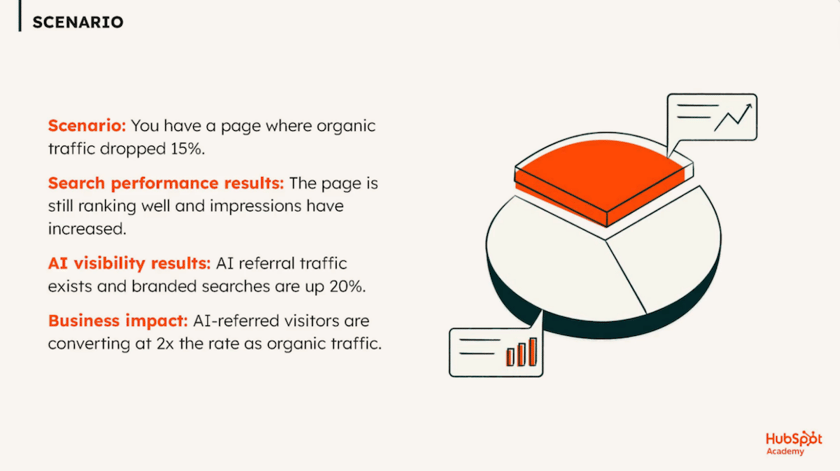
Imagine one of your pages loses 15% of its organic traffic. At first, everyone panics. Then you look deeper and realize the page is still ranking well, impressions have increased, AI referral traffic exists, branded searches are up 20%, and AI-referred visitors are converting at 2x the rate of organic traffic.
Is the 15% traffic decline a marketing failure? Probably not.
This is the danger of measuring AEO with SEO metrics alone. Traffic is not the business outcome. The path is increasingly something like:
Search Visibility → AI Visibility → Influence → Traffic/Leads → Pipeline → Revenue
AI can also re-enter that journey multiple times during research, comparison, objection handling, and validation. This is why in the webinar we frame the journey around visibility → influence → traffic/leads → pipeline → influence → revenue rather than a simple click-to-conversion funnel.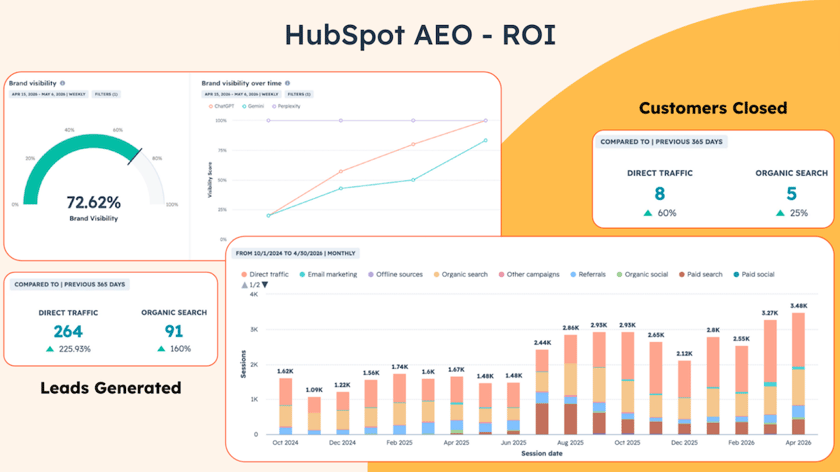
Related Case Study: How Nextiny Increased AI Visibility, Organic Traffic, Leads, and Revenue by Turning Real Human Conversations Into a HubSpot AEO Engine
5. Track Trends, Not Individual AI Answers
AI visibility is probabilistic and noisier than traditional search performance, so marketers should measure patterns over time rather than overreacting to individual prompts or daily fluctuations.
Google rankings move, but marketers have decades of experience measuring them. AI answers are inherently more variable, and running the same prompt several times can produce slightly different responses even when nothing obvious has changed. Models change, sources change, new content appears, and different engines update at different speeds.
Checking AI visibility too frequently can make normal variation look like meaningful change.
That’s why cadence matters. Search performance and actively optimized pages can be monitored weekly, while AI referral traffic and important analytics signals can be watched on an ongoing basis.
AI visibility, prompts, citations, sentiment, branded search, and share of voice are more useful as monthly trends, while conversion quality, pipeline, customers, revenue, and broader business impact deserve a longer quarterly view.
For AI visibility specifically, look for patterns. Is referral traffic growing, flat, or declining? Are you appearing across more relevant topics? Are AI systems describing the brand more accurately? Are citations improving? Are important competitors gaining or losing ground?
A monthly rhythm can help distinguish genuine trends from noise.
6. ChatGPT, Gemini, and Perplexity May Understand Your Brand Differently
Different AI engines can understand and surface brands differently, so AEO measurement should compare performance across models rather than assuming visibility in one platform means visibility everywhere.
We covered this extensively in another webinar, so I won’t turn this article into another full breakdown. But it matters to measurement.
Related Article: HubSpot AEO for ChatGPT, Gemini, and Perplexity: How to Improve AI Brand Visibility for Different LLM
Based on our AEO audits, hundreds of prompt tests, official documentation, client testing, and recurring patterns we’ve observed, we currently think about the three major engines like this:
|
AI Engine |
Pattern We’ve Observed |
Simplified Question |
|
ChatGPT |
Consensus and historical reputation |
“What does the internet generally believe?” |
|
Gemini |
Google ecosystem and entity understanding |
“What does Google understand about this entity?” |
|
Perplexity |
Live web research and citations |
“What evidence supports this answer?” |
These are observed patterns, not hard algorithmic rules. Nobody outside the AI companies knows the complete algorithms, and these systems continue to change.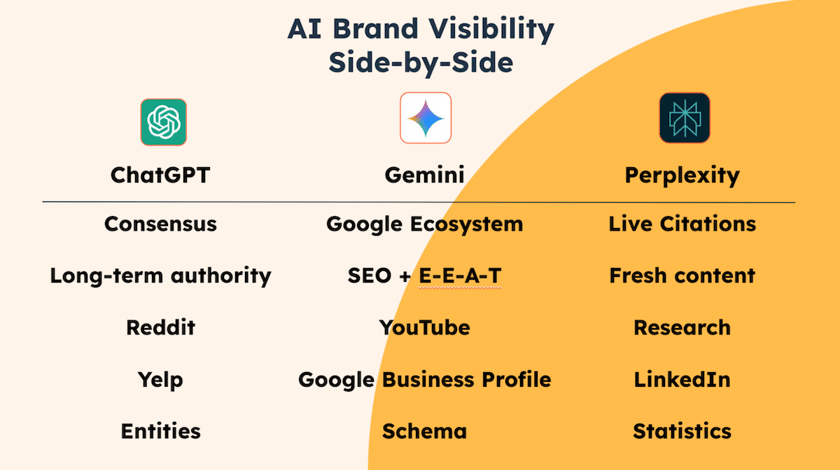
For example, we’ve observed ChatGPT surfacing community conversations, review sites, directories, Yelp, and even relatively obscure sources such as Chamber of Commerce pages when establishing broader consensus about a company.
Perplexity, meanwhile, has behaved more like a research and citation engine in our testing, frequently surfacing blogs, LinkedIn, Reddit, research, and statistics.
This is exactly why you shouldn’t judge your entire AEO program by one ChatGPT prompt. Measure across models, then look for AI consensus. Can multiple systems independently understand who you are, what you do, why you’re credible, and where you’re a strong fit?
That’s a much more resilient goal than chasing one algorithm.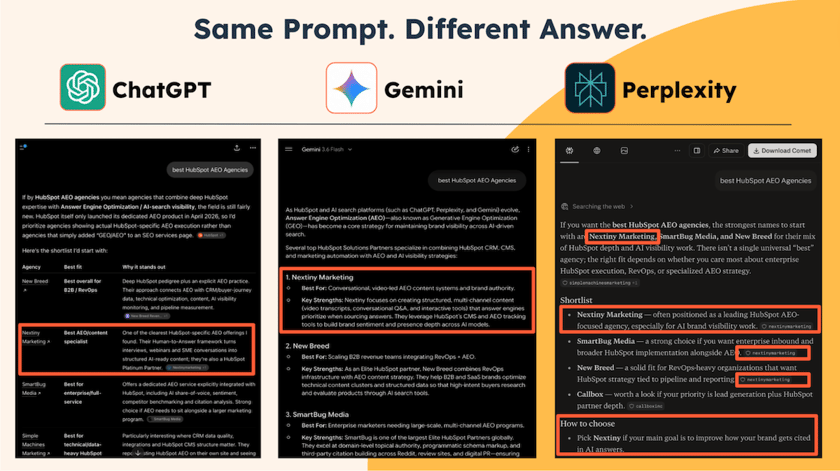
7. Not All AI Visibility Is Equal: Mentioned → Cited → Recommended → Preferred
The value of AI visibility increases as a brand moves from simply being mentioned to being used as a source, recommended as a solution, and ultimately preferred for the buyer’s specific needs.
This is one of the most important distinctions I want marketing teams to understand. A visibility score is useful, but visibility is only the starting point.
I think about AI visibility in four levels:
1. Mentioned: AI knows your company exists and includes you in the conversation.
2. Cited: AI considers your content or another source about you useful enough to reference as evidence.
3. Recommended: AI actively positions your company as a possible solution to the buyer’s problem.
4. Preferred: AI has enough evidence and context to position you as the strongest choice for a particular situation.
Mentioned → Cited → Recommended → Preferred.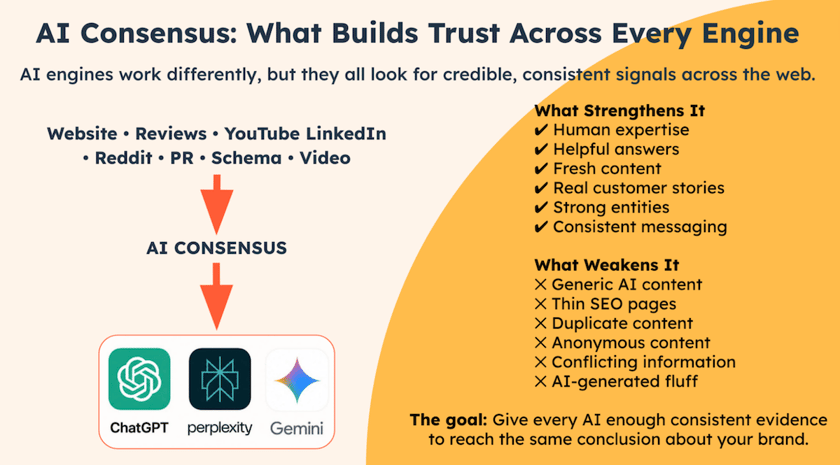
This is why I wouldn’t walk into an executive meeting and simply say, “Our AI visibility score increased 12%.”
That’s interesting, but what happened to citations? Did sentiment improve? Are we appearing for commercially important prompts? Are we being recommended more often? Is branded demand increasing? Are AI referrals converting? Is sales hearing AI come up in conversations? Did pipeline move?
The goal isn’t visibility for visibility’s sake. The goal is business impact.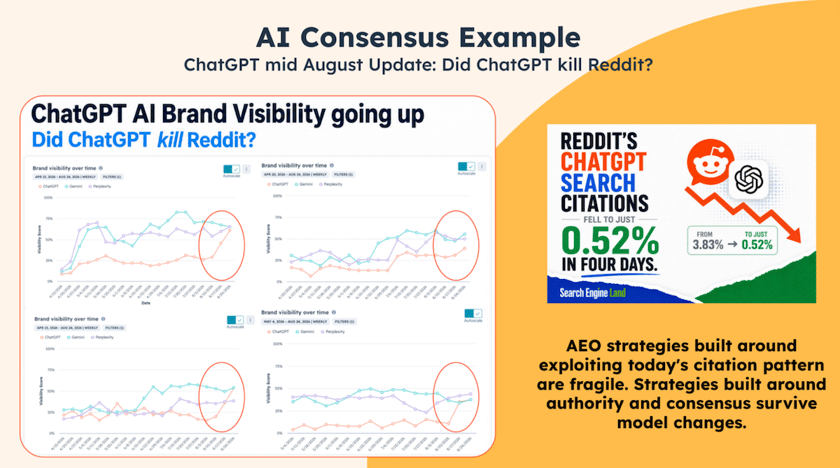
8. Turn AEO Measurement Into a Continuous Optimization Loop
AEO measurement works best as a continuous feedback loop in which marketers establish a baseline, identify visibility and citation gaps, improve content and entities, distribute the evidence, measure the results, and repeat.
This is where everything comes together. Don’t build an AEO dashboard that everyone looks at once a quarter and then forgets. Use the data to decide what to do next.
Our AEO checklist provides a practical roadmap:
1. Fix the SEO foundation. Address technical issues, speed, crawlability, and overall website health.
2. Implement schema. Strengthen Organization, Local, FAQ, Video, and other relevant structured data.
3. Structure content for answers. Use question-oriented headings, direct answers, supporting explanations, and useful FAQs.
4. Define and connect entities. Clarify relationships between your brand, people, services, industries, locations, and expertise.
6. Distribute across channels. Reinforce the same expertise through LinkedIn, YouTube, your blog, email, and other relevant platforms.
7. Build citations. Strengthen reviews, forums, directories, and external mentions.
8. Test buyer prompts. Compare how your company and competitors appear across AI platforms.
9. Identify gaps. Find missing topics, weak positioning, incorrect information, and outdated content.
10. Use HubSpot AEO recommendations. Prioritize opportunities based on what the data is showing.
11. Repurpose strategically. Turn expertise into FAQs, comparisons, “Top X” content, video, social content, and other useful formats.
12. Track changes carefully. When possible, change one variable at a time and monitor visibility and sentiment.
13. Keep content fresh. Update, expand, and reinforce authority instead of assuming published content is finished.
14. Align AEO with sales. Use the content in sales conversations, webinars, follow-ups, and objection handling.
15. Make it a loop. AEO isn’t a one-time project.
That final point matters most: Measure → Learn → Improve → Distribute → Measure Again
Over time, HubSpot AEO can become more than a visibility dashboard. It becomes part of your AEO content and optimization engine.
Related Article: How to Run an AEO Audit: See How AI Understands Your Company
How Fast Can AEO Improvements Show Up?
Some AEO improvements can become visible within days or weeks, but speed varies by platform and should not be confused with guaranteed or permanent results.
This is one of the things marketers naturally want to know: how long does this take?
We have seen surprisingly fast movement. One example in our webinar showed a single blog update executed through HubSpot beginning to appear in AI answers within days. The presentation also notes that ChatGPT can take longer and recommends using Google AI Overviews as one way to test changes more quickly.
The larger HubSpot AEO examples in the presentation also show content updates and new content making an impact over a period of weeks.
That means AEO doesn’t necessarily require waiting six months before learning anything. Update a page, improve the entities, answer the question more clearly, add appropriate schema, publish supporting video, distribute it, and build corroborating evidence. Then measure again to see whether those changes improved visibility, citations, or sentiment.
Just remember: AI is probabilistic. You’re not flipping a ranking switch. You’re increasing the amount and quality of evidence AI systems can use to understand, cite, and recommend your brand.
Related Article: The Human-to-Answer™ Framework: How to Build an AEO Content Engine in HubSpot
The AEO Dashboard I Would Build in HubSpot Today
A useful AEO dashboard should combine search performance, AI visibility, and business impact instead of trying to summarize success with one visibility score.
If I were building an executive AEO dashboard today, I would organize it around the same three layers:
|
Measurement Layer |
What to Track |
Main Question |
|
Search Performance |
Rankings, impressions, clicks, branded search, organic traffic, technical health, conversions |
Can search engines find and understand us? |
|
AI Visibility |
Brand Visibility Score, prompts, mentions, citations, sentiment, competitor visibility, AI referrals, AI Overview appearances |
Are answer engines finding, understanding, citing, and recommending us? |
|
Business Impact |
Lead conversion, opportunities, pipeline, customers, revenue, self-reported AI influence |
Is our visibility contributing to business results? |
Then use different reporting cadences. Search data can be monitored frequently, while AI visibility should usually be evaluated as a trend rather than a daily score. Business impact deserves a longer window because leads, pipeline, and revenue take time to develop.
This creates a much better executive conversation than simply saying, “Our traffic was down 8% this month.”
Maybe that’s bad. Maybe it isn’t. Show me the rest of the pyramid.
The Future of Marketing Measurement Is Influence, Not Just Attribution
AI is making marketing attribution less linear, so the future of measurement requires marketers to evaluate influence alongside clicks, traffic, and directly attributable conversions.
For years, digital marketing trained us to believe that every interaction should be trackable through UTM parameters, cookies, sessions, source attribution, multi-touch models, and CRM campaigns. Those tools remain valuable, but the buyer journey was never as clean as our dashboards made it look. Now it’s even less linear.
People discover you in one place, research you somewhere else, ask AI to compare you with competitors, watch a video, read reviews, return to AI with objections, search your brand, and eventually talk to sales. Some of those interactions will be measurable. Others won’t.
The answer isn’t to abandon attribution. It’s to stop pretending attribution tells the entire story.
Measure search performance, AI visibility, citations, sentiment, AI referral traffic, branded demand, conversions, pipeline, and revenue. Ask customers how AI influenced their research. Then connect the dots.
The brands that win in AI search will be the brands that are visible, trusted, consistently understood, repeatedly cited, and increasingly recommended
Ultimately, the most important AEO metric isn’t whether ChatGPT mentioned you. It’s whether all that visibility and influence helped someone trust you enough to become a customer.
Frequently Asked Questions About Measuring AEO Success
How Do You Measure AEO Success?
Measure AEO across three connected layers: search performance, AI visibility, and business impact. Search performance tells you whether your content can be discovered, AI visibility shows whether answer engines understand, mention, and cite your brand, and business metrics show whether that influence contributes to leads, pipeline, customers, and revenue.
What Is AI Brand Visibility Score in HubSpot AEO?
HubSpot AEO’s Brand Visibility Score measures the percentage of relevant prompts in which your brand appears across AI platforms such as ChatGPT, Gemini, and Perplexity. It gives marketers a directional measure of how consistently their brand is appearing in AI-generated answers.
What Should I Track in HubSpot AEO?
Track Brand Visibility Score, prompt-level visibility, mentions, citations, sentiment, competitor visibility, changes over time, and optimization opportunities. Then connect those metrics with AI referral traffic, branded search, conversions, CRM data, pipeline, and revenue.
What Is the Difference Between an AI Mention and an AI Citation?
An AI mention occurs when an answer engine includes your company or brand in its response. An AI citation occurs when the engine references a specific source as evidence for its answer. Citations are particularly useful because they help reveal what content and sources are influencing AI’s understanding and link to your website.
Why Does Sentiment Matter in AEO?
Sentiment helps you understand how AI describes your brand, not simply whether your brand appears. A company can have strong visibility while still being positioned negatively, inaccurately, generically, or as inferior to competitors. Visibility and sentiment together provide a more complete picture of AI brand perception.
Can HubSpot Track AI Referral Traffic?
HubSpot can be used to separate and analyze AI referral traffic so marketers can evaluate visits and downstream conversions from AI sources. However, AI referrals represent only part of AI’s influence because buyers may research a company in AI and later convert through branded search, direct traffic, sales, or another channel.
Can You Measure AEO ROI?
Yes, but not with perfect attribution. Measure AI referrals, conversion rates, leads, opportunities, pipeline, customers, and revenue while also monitoring branded demand and collecting qualitative or self-reported data about whether buyers used AI during research. The goal is to combine attribution with influence.
How Often Should You Measure AI Brand Visibility?
AI results are probabilistic and can fluctuate, so focus on trends rather than individual answers. We recommend a monthly rhythm for identifying meaningful AI visibility patterns, while search performance can be reviewed more frequently and business impact can be evaluated quarterly.
How Quickly Can AEO Results Improve?
Some changes can appear within days or weeks, although results vary by platform. In one of our examples, a HubSpot blog update began appearing in AI answers within days, while ChatGPT was noted as typically taking longer. Fast feedback should be treated as a signal to continue testing, not a guarantee of permanent visibility.
Does Visibility in ChatGPT Mean I Will Also Be Visible in Gemini and Perplexity?
No. Different AI platforms can rely on different signals and sources. Based on the patterns we’ve observed, ChatGPT often behaves more like a consensus model, Gemini is strongly connected to Google’s ecosystem and entity understanding, and Perplexity behaves more like a live citation and research engine. These are observations rather than fixed algorithmic rules.
Final Takeaway: Measure AEO From Visibility to Revenue
The biggest mistake marketers can make with AEO is either ignoring measurement completely or trying to force AI search into the old SEO reporting model.
SEO still matters. Traffic, rankings, and leads still matter too. But the buyer journey has changed, and our measurement needs to evolve with it.
Start with the SEO foundation, then measure whether AI understands your brand. Track the buyer prompts that actually matter and inspect mentions, citations, sentiment, and competitors. Look at the sources shaping AI answers and use HubSpot AEO to identify gaps and prioritize what to improve.
Measure AI referral traffic, but don’t assume it captures all AI influence. Watch branded search, direct traffic, conversion quality, pipeline, and self-reported attribution, and connect everything back to business outcomes.
Most importantly, don’t measure any of these signals in isolation.
The framework is: Search Performance → AI Visibility → Business Impact
And the progression we’re ultimately trying to create is:
Mentioned → Cited → Recommended → Preferred
AI visibility is only the starting point. The goal is to turn that visibility into trust, preference, pipeline, and revenue.